



Antique Trench Watches
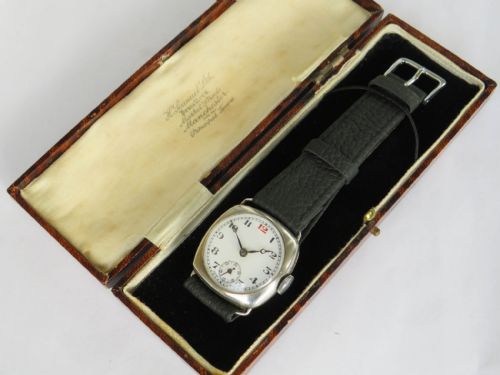
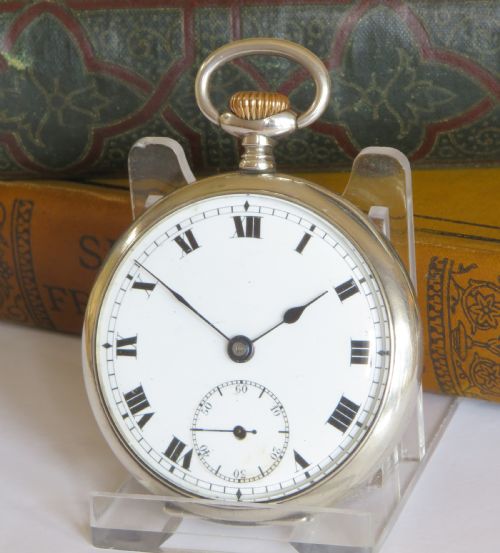
A trench watch is a small wristwatch of the First World War era, a pocket-watch movement fitted into a lugged case and worn on a strap so the time could be read without freeing a hand.
Antique Trench Watches
Wristwatches of this type came in early in the twentieth century, and the pattern was fixed by the First World War: a small pocket-watch-style movement in a case with wire lugs, worn on a leather strap. Protective grilles, hinged covers and screw-down cases followed from wear in the field.
Silver is close to definitional. Of eighty listings on Sellingantiques, 59 titles say silver and 43 say gents, and the plain open-dial silver watch with a hallmark year in the title is what you meet first. Six titles specify 9ct gold, with single examples in gun metal and steel.
The dating is decade-shaped. The dealers' own field runs 1900 to 1930, and 66 of the 80 listings fall in the 1910s. Titles are often more precise than the field, giving exact years such as 1911, 1915, 1917 or 1924, so the title year is the better guide. Some carry only "c1910s" or "WW1 era".
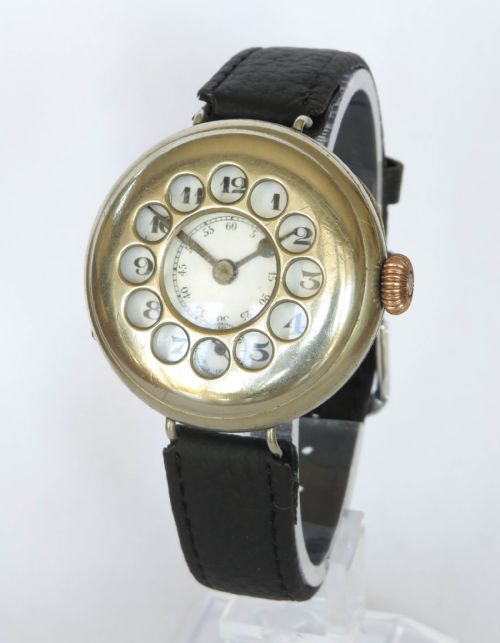
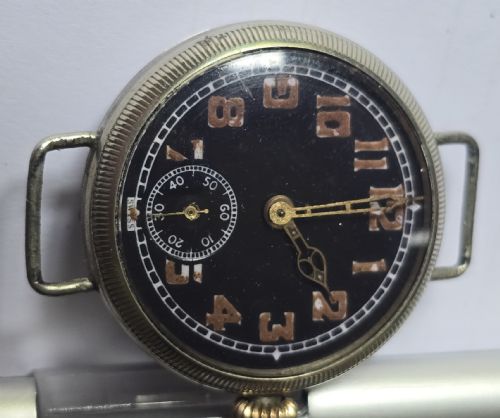
Around a quarter of titles flag WW1. Beyond that sit smaller groups: four half hunters with a hinged cover over the dial, four Borgel screw-together cases plus a couple more described as waterproof or screw front and back, and two watches described as military issued with black dials. A few sit well after the war they are named for, including a 1933 and a 1934 in steel.
Where The Range Widens
A named movement maker does most of the work. Longines, Omega, Zenith, Movado, Waltham, Marvin, Electa, Buren and Vertex all appear in titles, and they cluster in the upper half of the range. Unattributed silver watches fill the lower half. No single maker turns up often enough to be called typical of the category.
Case construction is the other lever. Borgel cases, waterproof-design cases, screw front-and-back and hermetic construction are named only above the middle of the range, and sealed cases are the recurring technical talking point across the archive. Gold and steel cases sit above the plain silver majority; gun metal appears once, mid-range.
Anything documented or unusual pulls upward. The two military-issued black-dial watches sit near the top, one recording a broad arrow and serial. Half hunter covers and the single shrapnel-guard example price above the plain open dial, and "large" in five titles trends up while the one mid-size example sits lower.
Antique Trench Watches Retail Price Guide 2026
Typical UK retail prices for trench watches, calculated from the Sellingantiques database of over a million retail prices indexed since 2003. This retail price guide relies exclusively on Sellingantiques data; no external sources or auction records are used, so the figures do not describe the wider market.
A shrapnel guard - the pierced metal grille fitted over the glass - has turned up exactly once in the whole archive. So has a hermetic case.
The Antique Trench Watches Glossary
- Trench watch
- Small wristwatch of the WW1 era, essentially a pocket watch movement in a lugged case worn on a strap.
- Gents
- Dealer shorthand for a man's size watch. It appears in 43 of the 80 titles, against a single mid-size example and five described as large.
- Half hunter
- Hinged metal cover over the dial with a glazed aperture, so the time reads without opening it. Four titles.
- Borgel case
- A screw-together case type named in four titles and associated with better water resistance. Hermetic, used once, means the same sealed idea.
- Shrapnel guard
- Pierced metal grille fitted over the crystal to protect the glass. It turns up exactly once in the whole archive.
- Broad arrow
- Government issue mark. One title records the arrow mark alongside the serial 25105R and a black dial.
Antique Trench Watches: Frequently Asked Questions
Why are so many trench watches silver?
Silver dominates the category. Of eighty listings, 59 titles say silver, which is why hallmark years turn up so often in the titles themselves.
The alternatives are thin on the ground: six titles specify 9ct gold, and gun metal and steel each appear once.
What date range do these cover?
The dealers' dating field runs 1900 to 1930, and 66 of the 80 listings fall in the 1910s. The category is effectively one decade wide.
The earliest title year in the samples is 1905. The latest is a 1934 Longines in steel, with a 1933 close behind, so a handful post-date the war they are named for.
Where the title year and the decade bucket disagree, the title year is the more exact of the two.
Are military-marked examples common?
No. Only two of the eighty are described as military issued at all, both with black dials, and one records original military markings including a broad arrow and a serial.
About a quarter of titles flag WW1 in some form, but that is a period reference rather than a record of issue.
How many come up for sale?
Around eight a year come to market on Sellingantiques, listed by six dealers in all. A steady trickle rather than a flood.
The plain gents' silver watch dated to the 1910s makes up the bulk of what appears.
What is a Borgel case?
A screw-together case type, named in four titles and associated with better water resistance than the standard snap-back arrangement.
Two more titles describe waterproof design or screw front and back construction, and one 1930 watch is called hermetic. Sealed cases are the recurring technical point in this category.
The highest-priced piece in the archive is a silver Longines in a Borgel case dated around 1915.
Do retailer or jeweller names appear?
Only in passing. A Harrods-supplied half hunter, a large watch marked for Lawrence & Mayo of London, and two London-hallmarked examples.
Retailer-marked pieces are the exception. Where a name is given at all, it is more often the Swiss or American movement maker.