

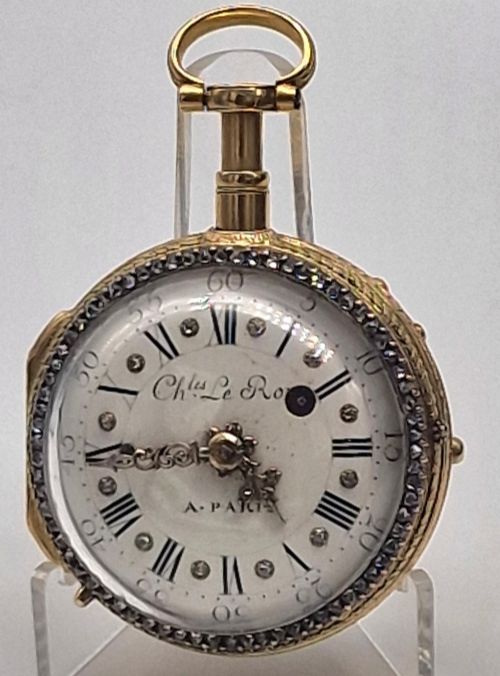


Antique Repeater Watches
A pocket watch with a striking complication: operate the slide or push-piece and it sounds the time on a gong or bell, so the hour could be heard rather than read.
Antique Repeater Watches
Repeating watches were developed in the late seventeenth century, when hearing the time mattered because seeing it at night was awkward. Through the eighteenth and nineteenth centuries the complication was refined, moving from striking the quarters toward striking the exact minute.
Every repeater listed on Sellingantiques has been a pocket watch. No wristwatch repeater has appeared. Each is described by the interval it strikes, and three intervals turn up across the archive: quarter, five-minute and minute. Quarter repeaters are the ones you'll meet most, written in titles as both "quarter repeater" and "1/4 Repeater".
Cases run from gold plated to 14k and 18k gold, with a case metal stated in four of the five listings. Full hunter is the only case style named, and it appears on two of them: a hinged metal cover over the dial that opens to read the time.
Dating is thin. Two listings carry a clean year, 1920 and 1930. Two more are labelled only "19th Century", which is a century wide rather than a date, and one carries no date at all. Roughly one repeater is listed a year, and four different dealers have handled one.
Where The Range Sits
The striking interval does most of the work. Quarter repeaters sit at the bottom of the range, while the five-minute repeater and the minute repeater sit at the upper end. Finer intervals mean more mechanism, and the archive prices them that way.
Case metal follows the same line. "Gold Plated" appears near the bottom; 14k and 18k gold sit toward the top. Stated stones push upward too, with "Gold & Jewels" and "Diamond Crown" both appearing only in the upper half.
A second complication lifts a watch further: the one title pairing a minute repeater with a chronograph is among the highest in the archive. A named watchmaking centre on the dial or case does the same, Geneve and Paris appearing on the two highest-priced titles while the cheaper ones name no centre. Rangoon turns up as a retail origin on another, a far-flung spread for so few pieces.
Antique Repeater Watches Retail Price Guide 2026
Typical UK retail prices for repeater watches, calculated from the Sellingantiques database of over a million retail prices indexed since 2003. This retail price guide relies exclusively on Sellingantiques data; no external sources or auction records are used, so the figures do not describe the wider market.
About one repeater watch is listed on Sellingantiques each year, and four different dealers have handled one.
The Antique Repeater Watches Glossary
- Repeater
- A watch that strikes the time on demand when a slide or push-piece is operated. "Repeating" is used interchangeably with it in dealer titles.
- Quarter repeater
- Strikes the hours and the quarter-hours. The commonest form in this archive, and the interval that sits lowest in the range.
- Five-minute repeater
- Strikes the hours, then the number of completed five-minute intervals since the hour. It has appeared once.
- Minute repeater
- Strikes hours, quarters and then the individual minutes, the finest of the three intervals seen.
- Full hunter
- A case with a hinged metal cover over the dial, which must be opened to read the time.
- Complicated
- Dealer shorthand for a watch carrying more than plain timekeeping, such as a chronograph alongside the striking work.
Antique Repeater Watches: Frequently Asked Questions
What does a repeater watch actually do?
It sounds the time on a gong or bell when a slide or push-piece is operated. The idea came from the late seventeenth century, when hearing the hour was easier than seeing it after dark.
How precisely it sounds the time depends on the interval it was built to strike.
Which striking interval is most common?
The quarters. Three of the five listings on Sellingantiques name a quarter repeater, written variously as "quarter repeater", "1/4 Repeater" and "Quarter Repeating".
The finer intervals have each appeared once: one five-minute repeater and one minute repeater.
Are there wristwatch repeaters in this category?
Not in this archive. Every repeater listed has been a pocket watch.
Two of the five are full hunters, with a hinged cover over the dial. That is the only case style named in any of the titles.
How are the cases described?
Case metal is stated in four of the five titles. It runs from gold plated at one end to 14k and 18k gold at the other.
One title reads "Gold & Jewels", another names a diamond crown. Both of those sit in the upper half of the range.
Can these watches be dated closely?
Rarely. Only two listings carry a clean year, 1920 and 1930, and both sit at the lower end of the range.
Two more are dated "19th Century" by the dealer, a century-wide label rather than a date, and those two sit well above the dated pair. One has no date at all.
Does a chronograph turn up with the striking work?
Once. A minute repeater combined with a chronograph has appeared in this category and nowhere else in it.
It is one of the highest-priced pieces in the archive, which is what a second complication tends to do.