


A 2026 Guide by Sellingantiques
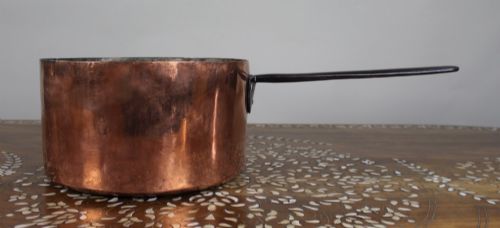
Copper variants dominated grand kitchens for centuries. Heat distribution made them a chef's primary choice long before gas dials arrived.
Cast iron became the standard for rural hearths. Thick sides retained heat well during long, slow cooking over hot coals.
Changing hearth designs shaped these antique pans. Flat bottoms replaced rounded ones as enclosed ranges took over from open fires.
Look for regional differences in the handle shapes. French kitchens favoured a steep angle, while British examples often sit flatter.
Leon Jaeggi & Sons supplied the London catering trade during the late nineteenth century. Their stamped antique pans often turn up in commercial kitchen clearances.
Benham & Froud operated in London during the Victorian period. They marked their copper wares with an orb and cross stamp.
E. Dehillerin started outfitting Parisian chefs in eighteen twenty. Heavy saucepans bearing their early maker's mark remain common finds across Europe.
The 2026 retail price guide for Antique Pans is drawn from a proprietary archive of over 1.1 million retail prices indexed by Sellingantiques since 2003. This guide relies exclusively on their own internal data; no external sources or auction records are used.
Analysing nearly 25 years of UK antique market history alongside current retail values, the data indicates that typical UK retail prices for Antique Pans range between £200 and £1,200. Entry-level prices generally fall under £200 and premium examples upwards of £1,200.
Examine the rivet heads where the handle meets the rim. Hand-hammered fixings show irregular facets rather than smooth, uniform domes.
Rolled rims add structural rigidity to copper walls. A thick wire sits hidden inside the folded metal edge to stop distortion.
Hanging loops sit at the end of most handles. Some are simple pierced holes, while others are forged into teardrop shapes.
Early copper vessels feature a castellated seam joining the sides to the base. Coppersmiths cut teeth into both edges before brazing them tight.
Spinning lathes eventually replaced the hammer and anvil. This process pushed flat discs of metal over wooden chucks to form seamless bodies.
Cast iron production improved as foundries refined their sand moulds. Later nineteenth-century examples show thinner walls and much smoother external finishes.
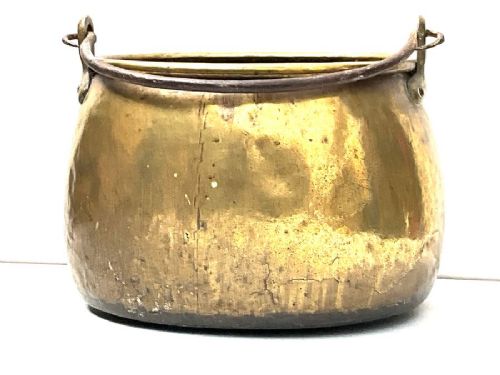
"Solid brass jam pans were considered essential for summer fruit harvests. The metal reacts well with sugar to help pectin set properly."
"Many large country houses marked their battery with specific room or shelf numbers. These tiny stamped digits helped keep vast kitchens organised."
"Thick copper can last for centuries with basic maintenance. You just have to get the inside wiped with fresh tin when it wears thin."
Based on almost 25 years of Sellingantiques UK antique market data, Antique Pans appeared 1000 times (out of 1,100,000 antiques) which gives it a rarity score of 82/100.
This score measures scarcity within the Sellingantiques archive only and is not a survey of the entire antiques market, so these statistics may not be indicative of the general availability of Antique Pans elsewhere.
Warm water and mild soap handle daily cleaning. Avoid abrasive scouring pads, as they will scratch through a tin lining quickly.
If the copper exterior turns dark, a simple paste of lemon juice and salt brings the shine back. Wash the paste off and dry the metal quickly to prevent water marks.
The easiest method is stripping it back to bare iron using a lye bath or commercial oven cleaner. Put the piece in a bin bag and spray it generously. Leave it outside for a few days to soften the old grease.
Wash away the loose grime with wire wool and cold water. Dry it over a low heat and rub a thin layer of oil over the surface to build a new seasoning.
Yes. Cast iron works on almost any heat source including modern induction hobs.
Copper requires a solid tin lining before cooking acidic food. Take an antique piece to a specialist for retinning if bare copper shows through.
Loose handles are a common issue with large antique pans. Copper expands and contracts with heat, which slowly loosens the iron rivets over several decades of daily use.
Any competent metalworker or coppersmith can tighten them again. They support the rivet head on an anvil and strike the inside end with a hammer to compress the metal tight.
Please note: This Antique Pans guide and its associated pricing data are provided for general informational purposes only. It does not constitute formal financial, investment, or appraisal advice and should not be relied upon as the sole basis for any commercial activity, purchasing, or sales decisions. Sellingantiques.co.uk accepts no liability for any actions taken in reliance on this information. Always consult with a qualified professional or independent appraiser.
