

Farnham Antique Carpets has dated this piece to the 1880s.
Combined with the soft yellow main border, featuring the S design, often used as a reference to the Sun in tribal weavings, coming from the Caucasus and the Kurdish weavers of the North-West of Persia.
Woven in a loom in the ground, these were often taken up when the Kurd weavers would move onto pastures new. So they were rarely completely straight, this runner is close to it, with minimal twist to the weave. Adds a great deal to these collectable and beautiful runners in our opinion, and when laid flat on the floor with our underlay it would look superb, bringing colour and charm to a space.
Visit our barn showroom in Crondall, Surrey, we are open Monday to Saturday by appointment. Or allow us to visit you with this antique runner so you can trial it at home.
Kurdish rug weavers were mainly woman who adapted and experimented with neighbouring weaving designs and used them in their own carpets. Nomadic rugs of the Kurds of Azerbaijan and the Caucasus used often primitive designs, whereas the the Kurdish Northwest Persia weavers used Caucasian designs of Kazak and Karabagh such as the diagonally striped field or bold geometric motifs.
Kurdish carpets are on the whole are coarse in comparison to the sophisticated rugs of Senneh, the capital of Kurdistan. The designs can be similar to that of Senneh, more often open in pattern and will use the 'Boteh' motifs or stylised flowers, 'S' Sun motifs or striped patterns such as on this runner.
Farnham Antique Carpets has dated this piece to the 1880s.
Specialists in antique decorative carpets, rugs and runners.
You can view the stock and full dealer information on the Farnham Antique Carpets Profile Page
Farnham Antique Carpets is a registered member of LAPADA BADA
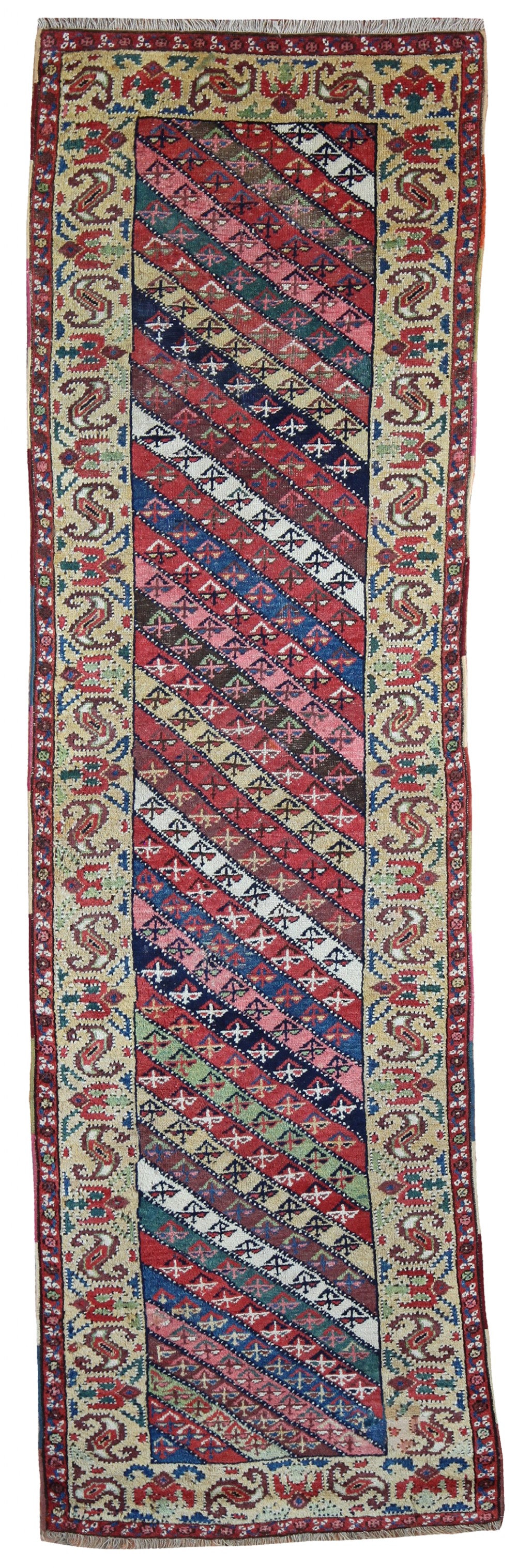
Antique Kurdish Runner