23,618  PAGES BROWSED TODAY PAGES TODAY 106 ANTIQUES UPLOADED TODAYNEW ARRIVALS
106 ITEMS ADDED TODAY
Sort Order
Items Per Page
Browse Categories
Sort order
Relevant Links
Items per page
ID #SA1235605
FOR SALE
£4,750
Email Phone
Save
Edward Charles Williams & William Shayer, the Country Inn - Antique Oil Painting
For sale by Brave Fine Art
for sale €5,558     $6,033
£4,750
Brave Fine Art

Brave Fine Art

Sellingantiques Verified Since Nov 2018
Browse dealers 75 items
  • About Us
    Exquisite antique paintings that capture the imagination.
Id #SA1235605
PDF SHARE
SAVE

Edward Charles Williams & William Shayer, the Country Inn - Antique Oil Painting

19th century
For Sale by Brave Fine Art
Description

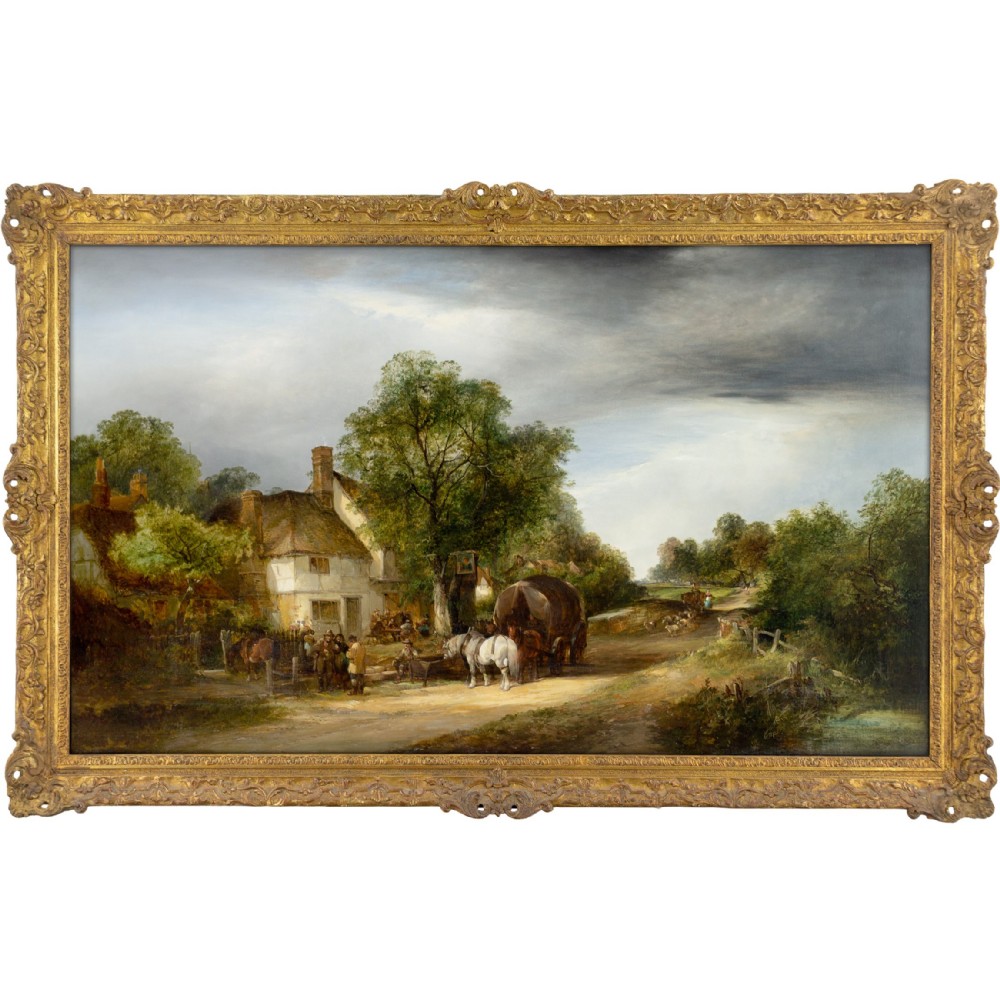
This splendid mid-19th-century oil painting is a collaborative work by English artists, Edward Charles Williams (1807-1881) and William Shayer (1787-1879). It depicts a busy country inn on a bright summer's day in 1850. Travellers have stopped with their horses and wagon, villagers gather outside the building, and a shepherd drives his flock along the winding road beyond.

Williams and Shayer were particularly well suited as collaborators. Williams provided the landscape, architecture and atmosphere, while Shayer specialised in the people and animals that brought such places to life. Shayer's characters seem to belong naturally within Williams's landscape. Everyone has arrived for a reason.

At the centre, two sturdy horses remain harnessed to a covered wagon, which has pulled up beneath the trees beside the inn. Another horse buries its head into well-earned fodder. Around them unfolds a wonderful collection of minor encounters. Several men have gathered in conversation outside the inn. Others sit at tables beneath the trees. Farther along the road, a shepherd accompanies a flock of sheep while travellers approach from the opposite direction. Each group occupies its own little world, yet together they create the impression of a place temporarily brought alive by people passing through.

And then there is the solitary man sitting beside the road. Can you spot him there alongside the trough? Shayer has given him remarkably little to do. Hat pulled low, one leg comfortably extended, he sits quietly while the enormous wagon and its horses wait immediately beside him. Perhaps he's a traveller taking the weight from his feet, perhaps connected with the wagon, or simply a local watching the traffic come and go.

Shayer understood these characters particularly well. Born the son of a Southampton publican, he had grown up in the Horse and Jockey inn and spent much of his career painting the working communities of Hampshire and the New Forest. Inns, wagoners, labourers, horses and rural travellers belonged to a social world with which he had been familiar since childhood.

His figures possess an appealing solidity. The horses have weight, the men lean and slouch rather than pose, and conversations seem already underway before we notice them. His interest was less in individual identity than in the gestures and relationships through which a community becomes believable.

Williams provides an expansive stage for these encounters. An old rendered and timbered inn nestles beneath enormous trees, its patched walls and irregular roofline suggesting a building that has developed gradually over generations. Beyond it, the road rises gently through open countryside before disappearing among the trees.

Following conservation, the atmosphere is particularly impressive. What previously appeared to be a rather sombre landscape has emerged as a luminous daytime scene. Sunlight breaks through the shifting clouds and catches the road, white horses, inn walls and distant fields, while cooler passages of blue and grey sweep across the enormous sky.

A painting you'll return to time and time again.

Monogrammed by both artists in the lower right, dated, and held in a fine later gilt frame.

Learn more about Edward Charles Williams and William Shayer in our directory.

Medium: Oil on canvas

Overall size: 55” x 35” / 140cm x 89cm

Year of creation: 1850

Provenance: Private collection, UK.

Condition: Cleaned. Revarnished. Canvas relined. Fine craquelure throughout. The paint layer is stable. Frame in good condition with minor age-related wear.

Artist’s auction maximum: William Shayer: £57,700 achieved in 1996 for ‘Isle of Wight with Figures and Horses (1854)’, Edward Charles Williams: £25,000 achieved in 2006 for ‘Punch and Judy/The Itinerant Musician’.

Our reference: BRV2339

Physical Dimensions
Height
89cm (35.04")
Width
140cm (55.12")
Depth
7cm (2.76")
Declaration

Brave Fine Art has dated this Victorian Landscape Oil Painting to the 1850s.

Reference Numbers
Sellingantiques Reference
SA1235605
Dealers Internal Reference
BRV2339
Description
This splendid mid-19th-century oil painting is a collaborative work by English artists, Edward Charles Williams (1807-1881) and William Shayer (1787-1879). It depicts a busy country inn on a bright summer's day in 1850.
Travellers have stopped with their horses and wagon, villagers gather outside the building, and a shepherd drives his flock along the winding road beyond.
Brave Fine Art

Williams and Shayer were particularly well suited as collaborators. Williams provided the landscape, architecture and atmosphere, while Shayer specialised in the people and animals that brought such places to life. Shayer's characters seem to belong naturally within Williams's landscape. Everyone has arrived for a reason.

At the centre, two sturdy horses remain harnessed to a covered wagon, which has pulled up beneath the trees beside the inn. Another horse buries its head into well-earned fodder. Around them unfolds a wonderful collection of minor encounters. Several men have gathered in conversation outside the inn. Others sit at tables beneath the trees. Farther along the road, a shepherd accompanies a flock of sheep while travellers approach from the opposite direction. Each group occupies its own little world, yet together they create the impression of a place temporarily brought alive by people passing through.

And then there is the solitary man sitting beside the road. Can you spot him there alongside the trough? Shayer has given him remarkably little to do. Hat pulled low, one leg comfortably extended, he sits quietly while the enormous wagon and its horses wait immediately beside him. Perhaps he's a traveller taking the weight from his feet, perhaps connected with the wagon, or simply a local watching the traffic come and go.

Shayer understood these characters particularly well. Born the son of a Southampton publican, he had grown up in the Horse and Jockey inn and spent much of his career painting the working communities of Hampshire and the New Forest. Inns, wagoners, labourers, horses and rural travellers belonged to a social world with which he had been familiar since childhood.

His figures possess an appealing solidity. The horses have weight, the men lean and slouch rather than pose, and conversations seem already underway before we notice them. His interest was less in individual identity than in the gestures and relationships through which a community becomes believable.

Williams provides an expansive stage for these encounters. An old rendered and timbered inn nestles beneath enormous trees, its patched walls and irregular roofline suggesting a building that has developed gradually over generations. Beyond it, the road rises gently through open countryside before disappearing among the trees.

Following conservation, the atmosphere is particularly impressive. What previously appeared to be a rather sombre landscape has emerged as a luminous daytime scene. Sunlight breaks through the shifting clouds and catches the road, white horses, inn walls and distant fields, while cooler passages of blue and grey sweep across the enormous sky.

A painting you'll return to time and time again.

Monogrammed by both artists in the lower right, dated, and held in a fine later gilt frame.

Learn more about Edward Charles Williams and William Shayer in our directory.

Medium: Oil on canvas

Overall size: 55” x 35” / 140cm x 89cm

Year of creation: 1850

Provenance: Private collection, UK.

Condition: Cleaned. Revarnished. Canvas relined. Fine craquelure throughout. The paint layer is stable. Frame in good condition with minor age-related wear.

Artist’s auction maximum: William Shayer: £57,700 achieved in 1996 for ‘Isle of Wight with Figures and Horses (1854)’, Edward Charles Williams: £25,000 achieved in 2006 for ‘Punch and Judy/The Itinerant Musician’.

Our reference: BRV2339

Height
89cm (35.04")
Width
140cm (55.12")
Depth
7cm (2.76")
Date of Manufacture

Brave Fine Art has dated this Victorian Landscape Oil Painting to the 1850s.

Reference Numbers
Sellingantiques Ref
SA1235605
Dealers Internal Ref
BRV2339
Brave Fine Art
Brave Fine Art
Sellingantiques verified Since Nov 2018

Exquisite antique paintings that capture the imagination.

Dealer Profile

You can view the stock and full dealer information on the Brave Fine Art Profile Page
PDF SHARE
SAVE
A 19th-century oil painting depicting a rural tavern scene with horses, figures, and a covered wagon, encased in a heavily carved gilt frame.
1 / 1
Archive I A 19th-century oil painting depicting a rural tavern scene with horses, figures, and a covered wagon, encased in a heavily carved gilt frame.

Edward Charles Williams & William Shayer, the Country Inn - Antique Oil Painting

Enlarged Archival View
Telephone 01684 215986
Location
21 Enterprise Way
Arle Road
Cheltenham
Cotswolds
GL51 8LZ
United Kingdom

Under appointment only.
Verified Since Nov 2018
Items For Sale 75
Items Sold 1,843
Brave Fine Art
Brave Fine Art
Verified Since Nov 2018
View Dealer Info
Location: 21 Enterprise Way, Arle Road, Cheltenham, Cotswolds, GL51 8LZ, United Kingdom, , Under appointment only.
Verified
Nov 2018
For Sale
75
Sold
1,843
A 19th-century oil painting depicting a rural tavern scene with horses, figures, and a covered wagon, encased in a heavily carved gilt frame.
Edward Charles Williams & William Shayer, The Country Inn - Antique Oil Painting
Ref: SA1235605
A 19th-century oil painting depicting a rural tavern scene with horses, figures, and a covered wagon, encased in a heavily carved gilt frame.
Archival Detail
Every single antique dealer on our platform is individually approved by our internal team. We verify their professional trade history, ethical standards, and photographic quality to ensure a secure, high-standard buying environment. Upon joining, every dealer agrees to a strict 9-point code of conduct. While issues can occasionally arise, our dealers typically resolve them swiftly and directly with the buyer. In fact, since our founding in 2002, Sellingantiques has only had to step in to help resolve an issue on roughly five occasions—a true testament to the quality of our dealers and their dedication to your happiness.
Our dealers are highly experienced in packing and shipping fragile, high-value antiques. Because you are in direct contact with the dealer, you will be able to easily go through all available shipping and insurance options together to ensure your item arrives safely.
Antiques are the ultimate green purchase. By choosing historical pieces over newly manufactured goods, you completely eliminate the carbon footprint of modern mass production while preserving exceptional, timeless craftsmanship.
Written by Sellingantiques from the dealer’s photographs and listing
  • ObjectWall Art
  • Period19th century
  • StyleVictorian
  • MaterialOil on Canvas, Gilt Wood
  • ColourWarm Brown
  • MotifsGilt frame, landscape scene, rustic architecture, equestrian figures
  • SizeH 89 cm (35 in) x W 140 cm (55 in) x D 7 cm (3 in)

19th-century British landscape art focused on rural realism and romanticised rustic life, capturing natural light, pastoral activities, traditional architecture, and detailed foliage.

These works typically consist of oil-based pigments applied to stretched linen or cotton canvas, mounted on a wooden frame and enclosed in a carved timber frame with gilded gesso detail.

Authentic pieces display natural age craquelure across the paint layer, genuine patina or oxidation on the gilt frame, period-appropriate timber stretchers, and artist signatures or gallery labels on the canvas or reverse.

Position the framed canvas as a focal point above a fireplace or sideboard, pairing its rich tones with clean-lined contemporary furniture or classic wood joinery to create visual contrast.

Keep the artwork away from direct sunlight, extreme humidity, and direct heat sources. Dust the frame gently with a soft dry brush and consult a professional conservator for surface cleaning or varnish restoration.
items
Add keywords to the filter
Price
£100
£250000
Era
Movements
Material
Origin
Stock Location
Freshness
Online Payments
Categories