28,372  PAGES BROWSED TODAY PAGES TODAY 227 ANTIQUES UPLOADED TODAYNEW ARRIVALS
227 ITEMS ADDED TODAY
Sort Order
Items Per Page
Browse Categories
Sort order
Relevant Links
Items per page
ID #SA1233507
FOR SALE
£9,250
Email
Save
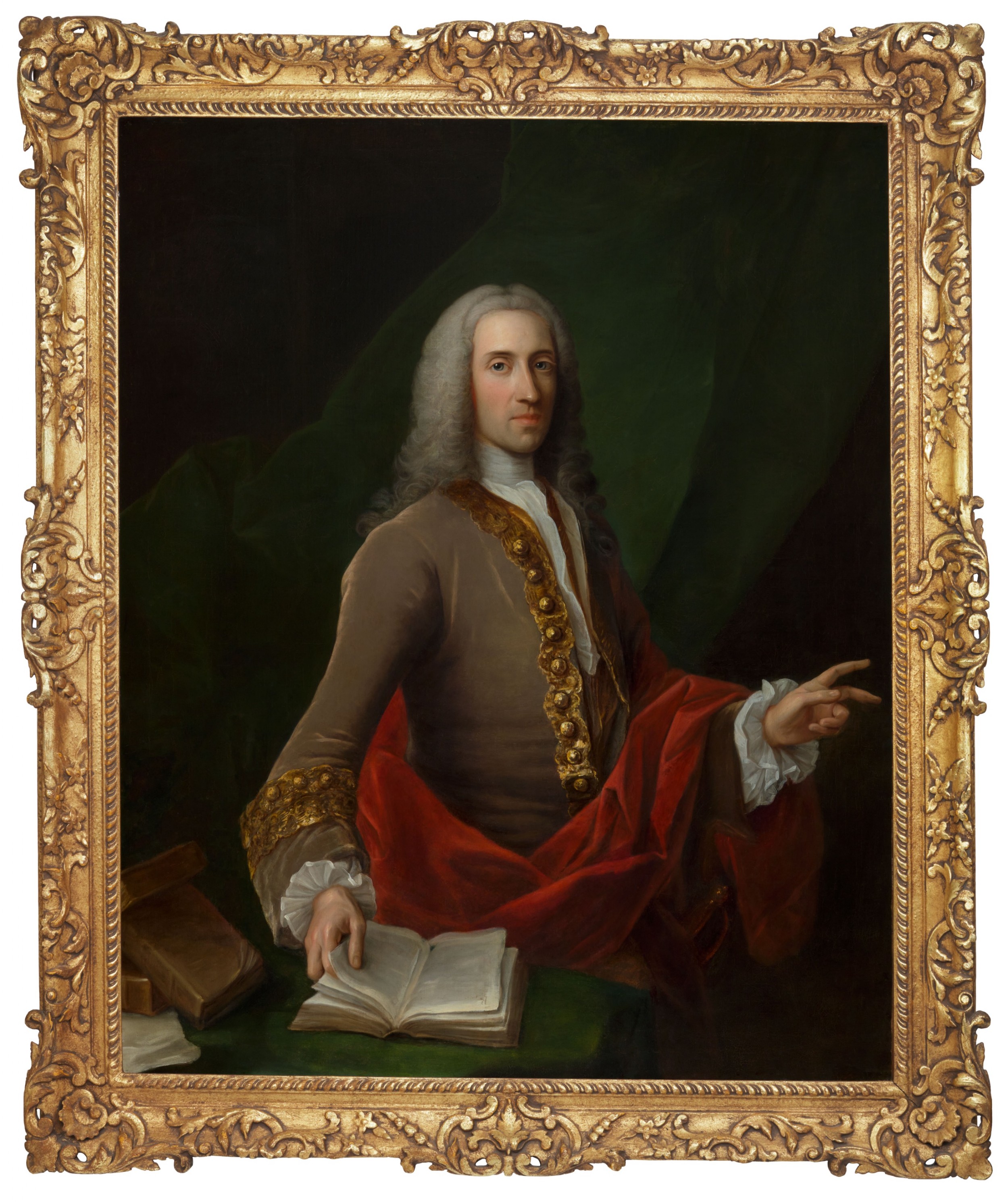
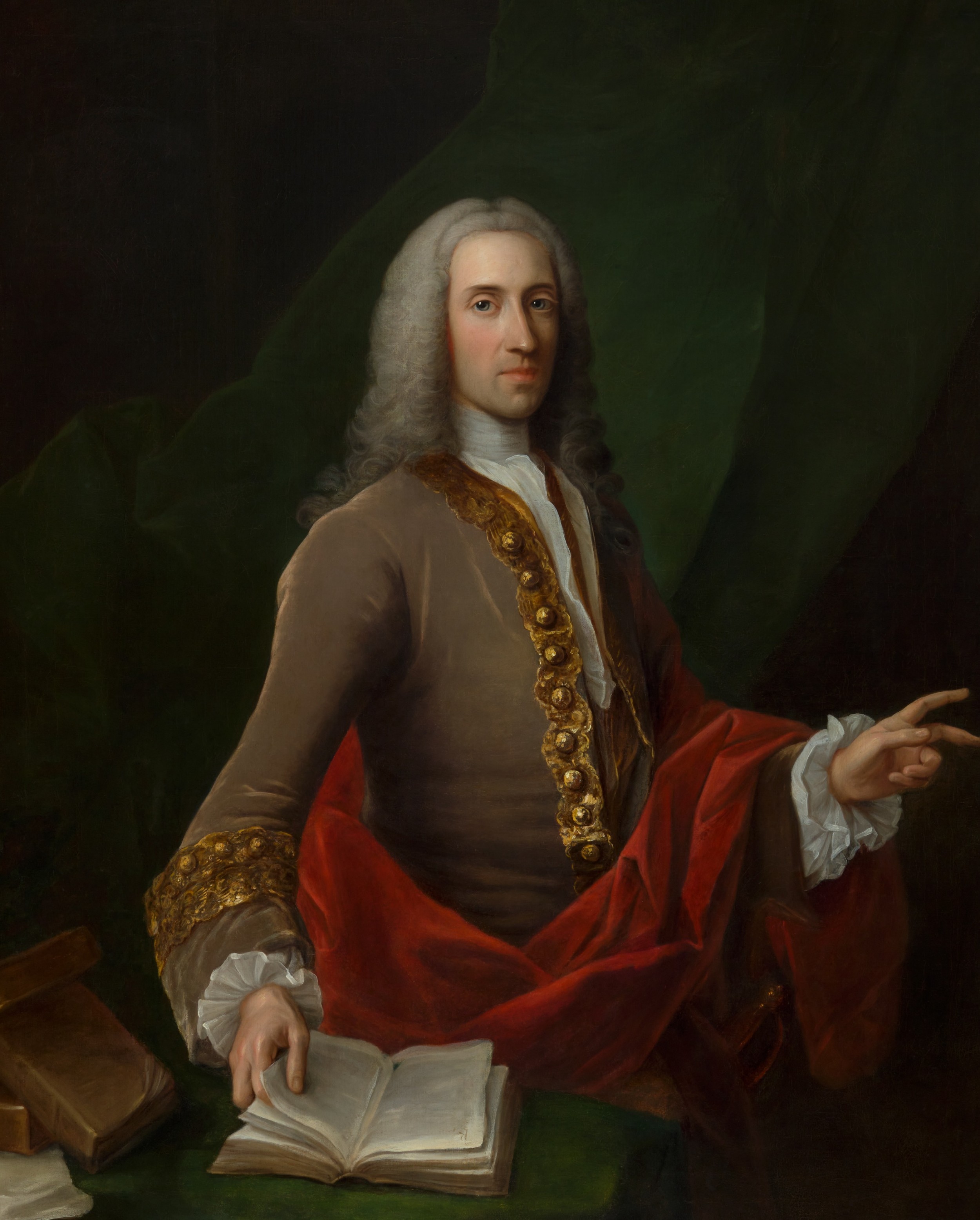
Portrait of a Gentleman, James Douglas, Lord Aberdour, Later 14th Earl of Morton (1702–1768), with Books; Attributed to Jeremiah Davison (C.1695–1745)
Titan Fine Art
for sale €10,823     $11,748
£9,250
Titan Fine Art

Titan Fine Art

Sellingantiques Verified Since Jul 2016
View Dealers Stock Page
  • About Us
    Specialist in 17th & 18thc portraits. Highly curated selection, museum-level research & pro conservation. Exceptional art, expertly vetted.
Relevant Links
Id #SA1233507
PDF SHARE
SAVE

Portrait of a Gentleman, James Douglas, Lord Aberdour, Later 14th Earl of Morton (1702–1768), with Books; Attributed to Jeremiah Davison (C.1695–1745)

18th century
For Sale by Titan Fine Art
Description

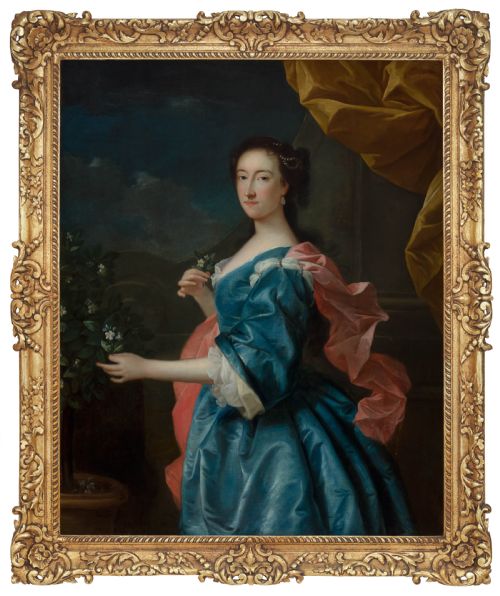
This exceptionally handsome and imposing portrait is a particularly accomplished example of British grand-manner portraiture of the early Georgian period. Preserved in excellent overall condition and retaining a remarkable degree of visual richness, the painting combines a penetratingly characterised likeness with sumptuous costume, dramatic colour and an unusually eloquent intellectual setting. At more than four feet high before framing, its scale is immediately impressive: the sitter occupies the composition with the assurance expected of a man of elevated position, yet the inclusion of books and his animated pointing gesture distinguishes the portrait from the more formulaic aristocratic likenesses of the period. The picture was almost certainly conceived as the male half of a pendant pair with the closely corresponding portrait of a young woman beside an orange tree, and the two works share the same dimensions, pictorial ambition and early history.

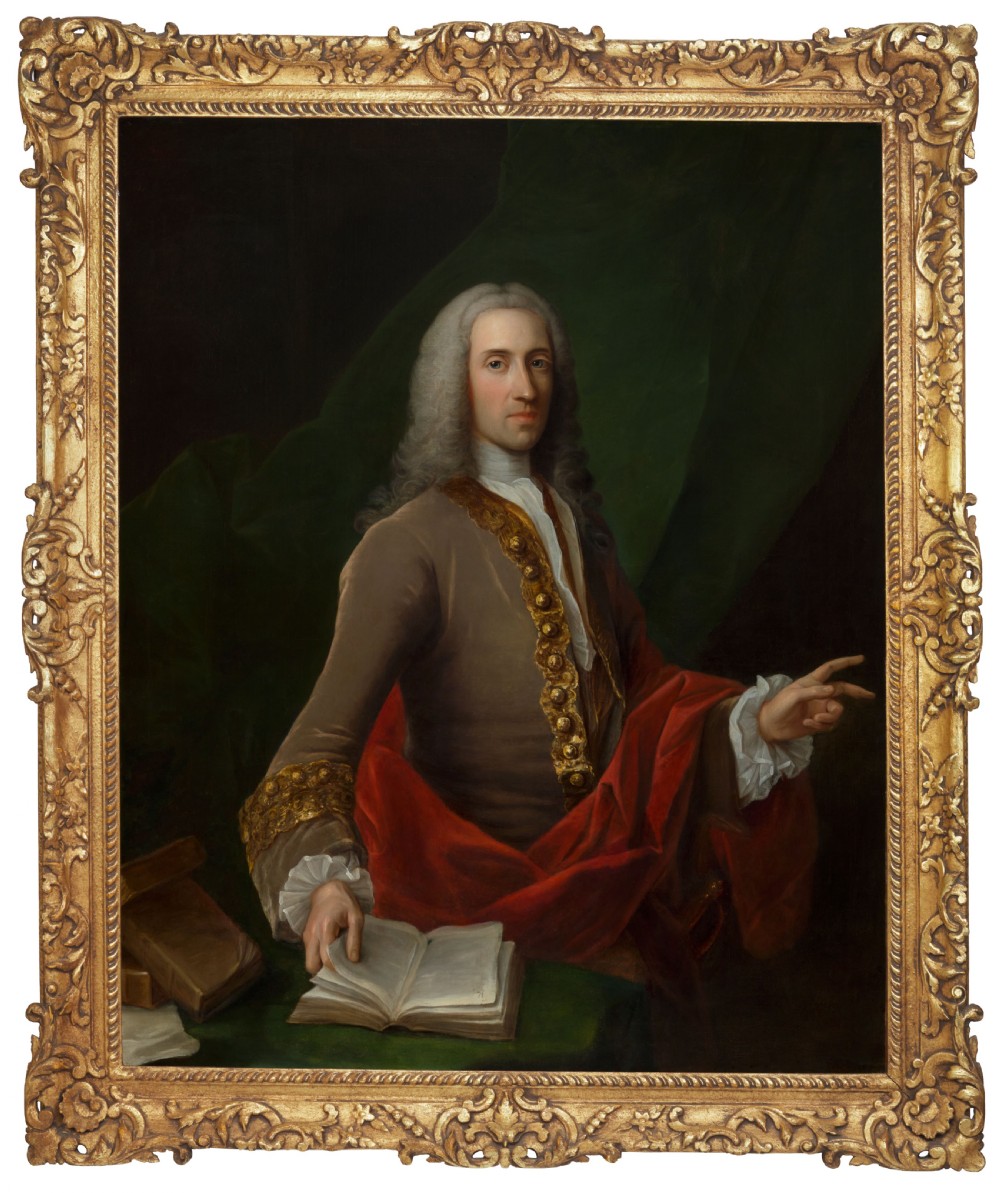
The picture is in excellent overall condition, its principal passages remaining notably legible and visually effective. It is presented in a substantial carved and gilded frame of George II/Rococo character, richly ornamented with pierced scrolling acanthus, flowerheads and bold foliate corner and centre motifs around a gadrooned inner edge. The frame gives the portrait an architectural presence appropriate to its scale without overwhelming the sitter.
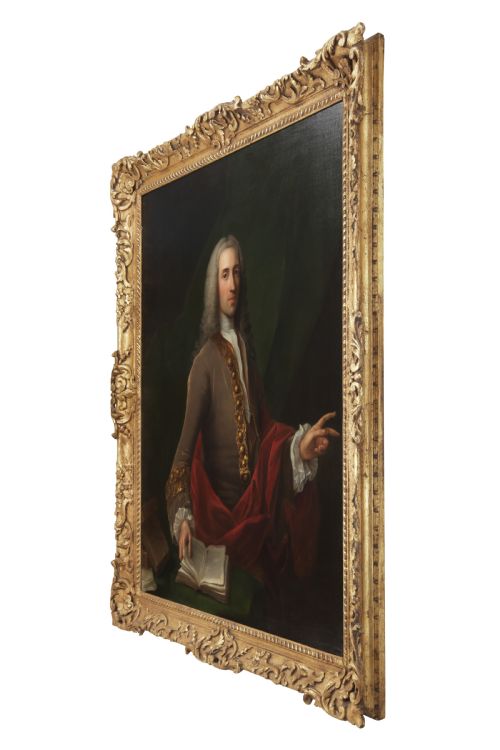
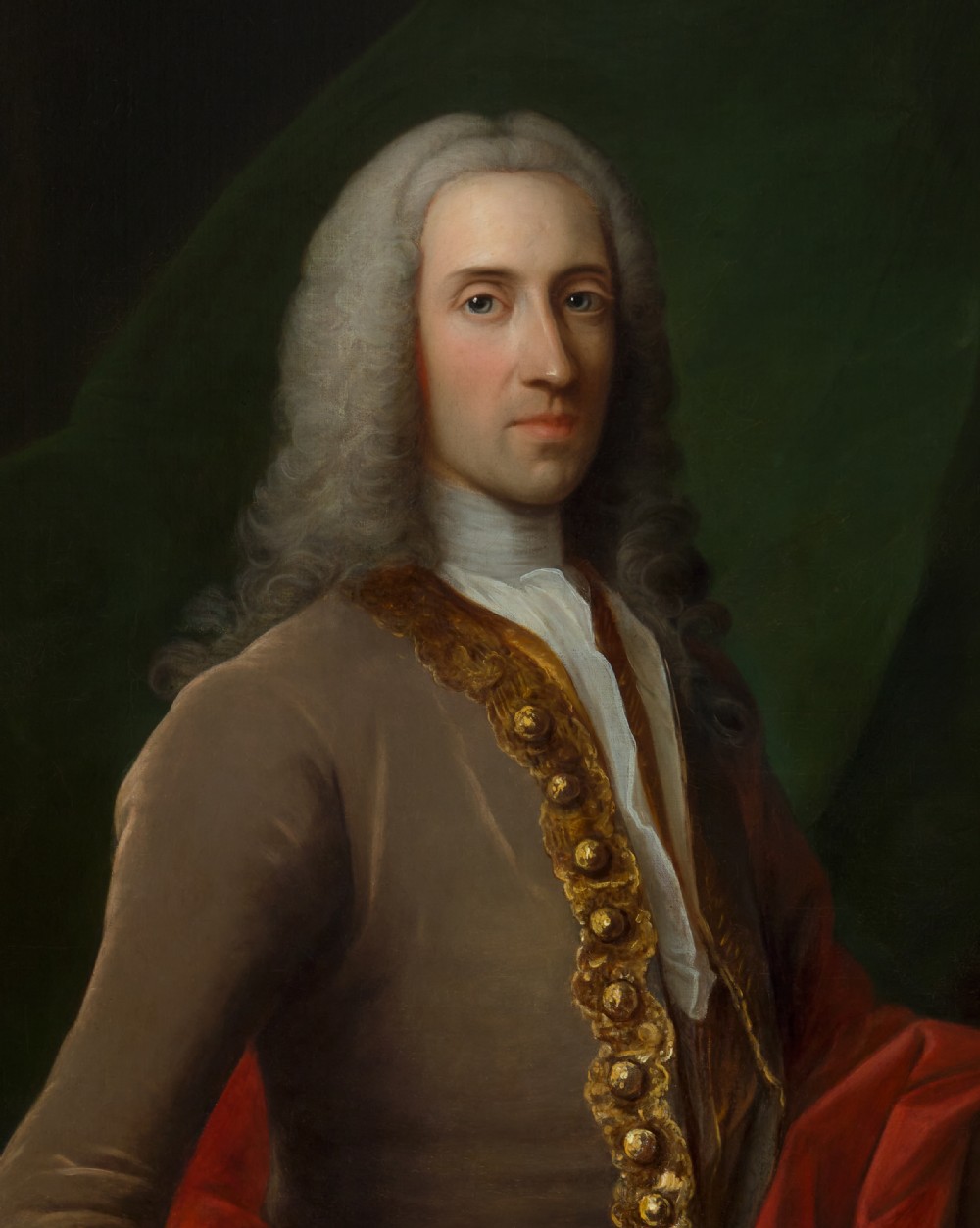
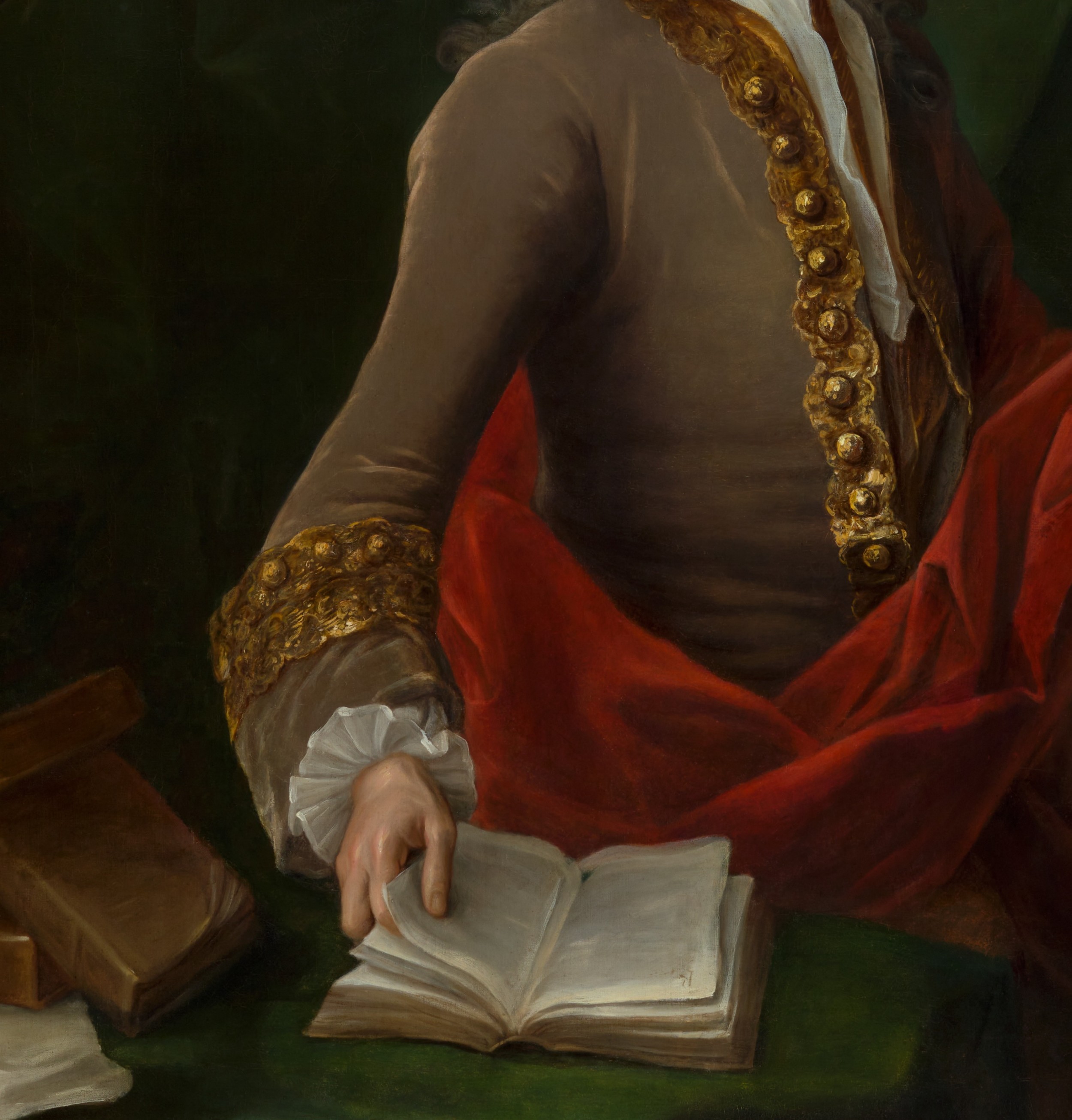
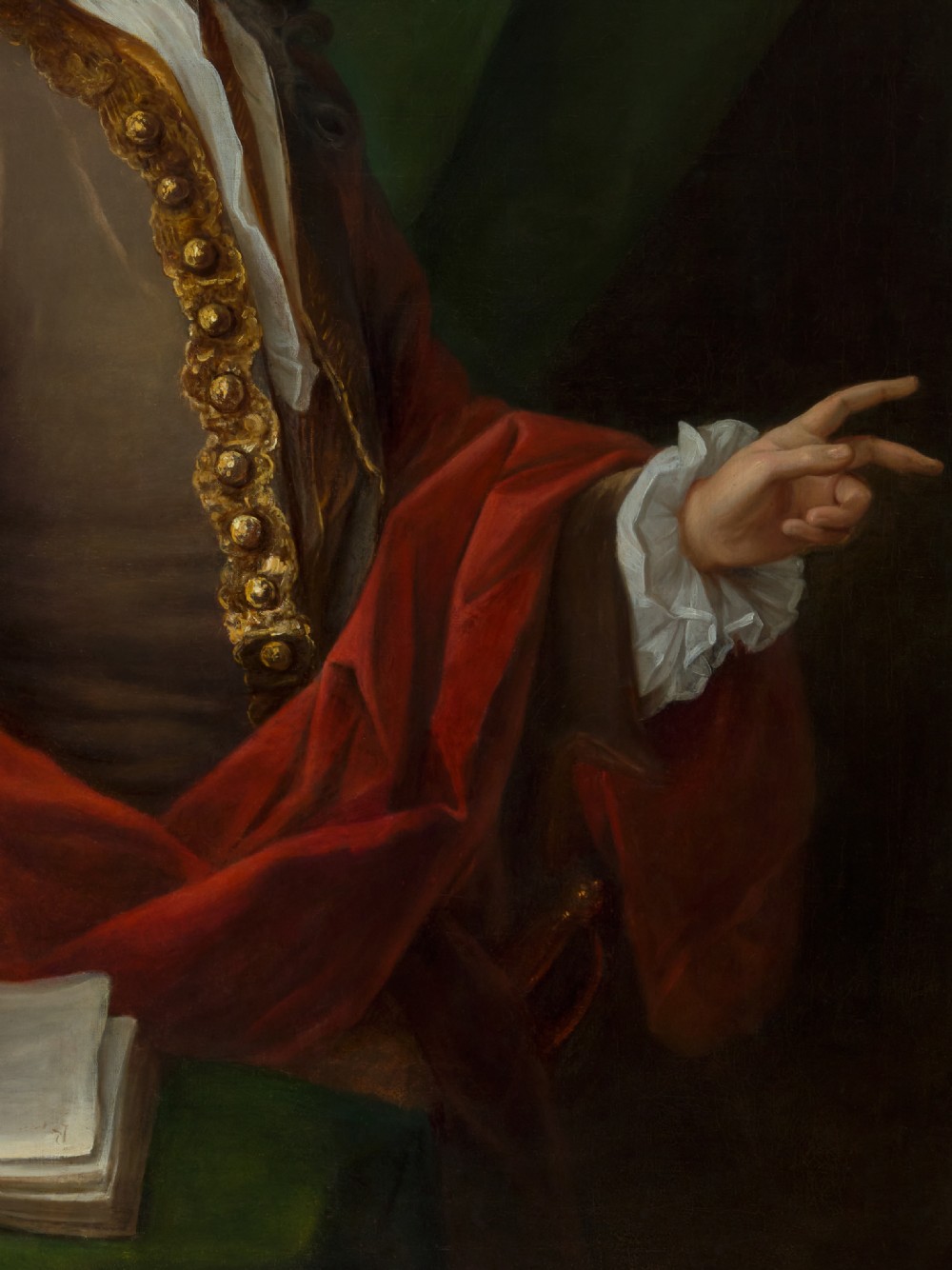
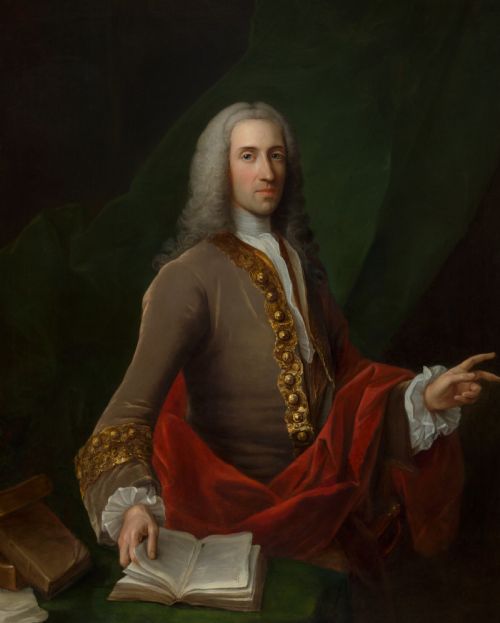
The gentleman is shown three-quarter-length before a monumental sweep of deep green drapery. His body turns across the picture while his pale, carefully modelled face meets the viewer more directly. A long, narrow nose, level mouth and intelligent, slightly reserved expression give the head an individuality quite separate from the rhetoric of the pose. The books are conspicuous enough to be more than incidental studio furniture. They proclaim learning, cultivated thought and intellectual accomplishment, while the extended hand transforms the sitter from a passive object of scrutiny into an active participant in the scene. If the identification with James Douglas is correct, this aspect of the portrait acquires particular resonance.
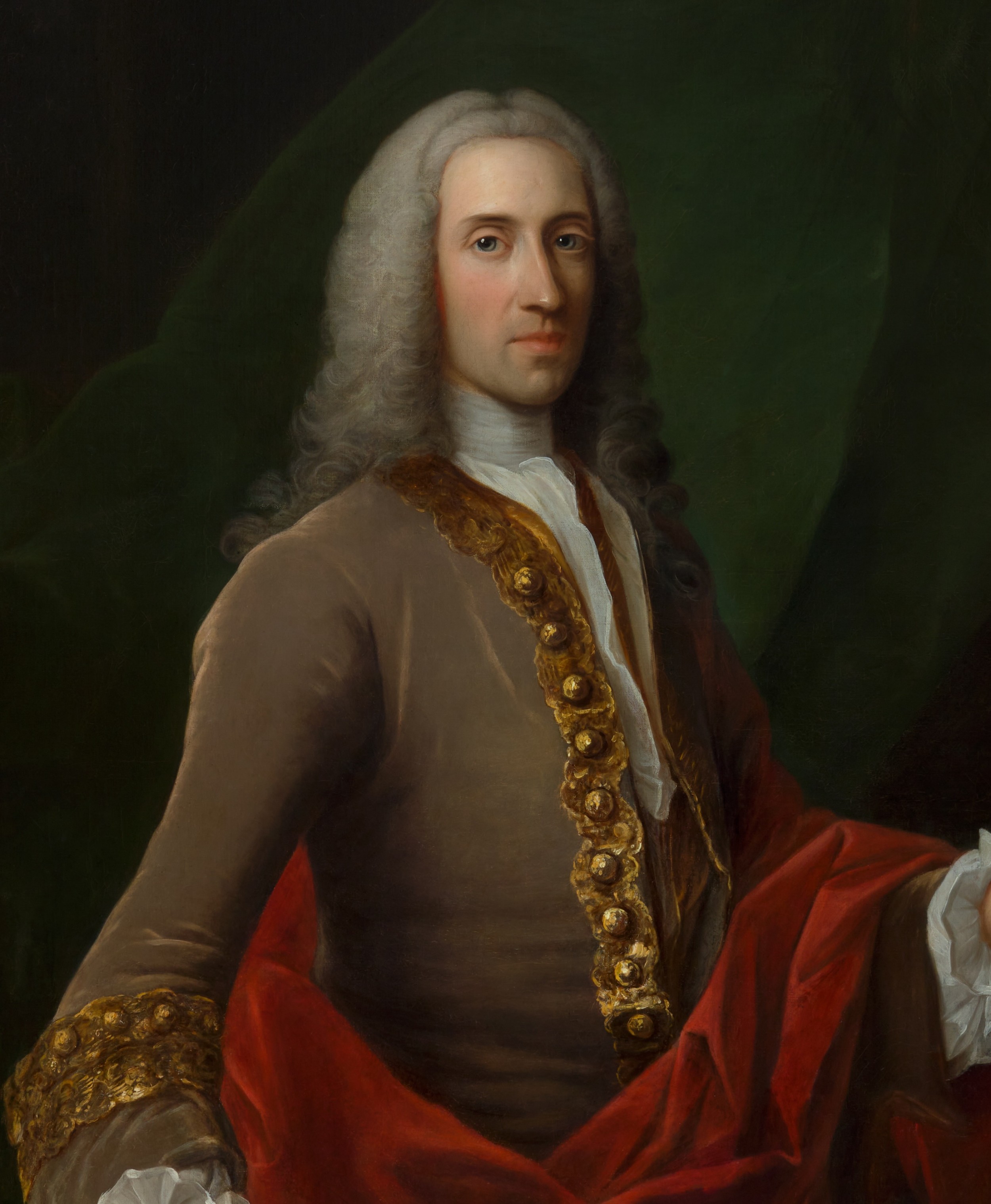
The portrait is said to represent James Douglas (1702–1768), then styled Lord Aberdour and later 14th Earl of Morton. Born in Edinburgh, Douglas was the eldest son of George Douglas, 13th Earl of Morton, and his second wife Frances, daughter of William Adderley of Kent. Douglas married Agatha Halyburton, daughter and heiress of James Halyburton of Pitcur in Angus, before 1731.
Jeremiah Davison occupies an interesting position in this generation of British portraitists. Born in London in about 1695 to Scottish parents, he worked in London until the mid-1730s before the Duke of Atholl encouraged him to establish himself in Edinburgh, where introductions through the Atholl family brought important commissions from the Scottish aristocracy.

Full description at: www.titanfineart.com

Physical Dimensions
Height
148cm (58.27")
Width
124cm (48.82")
Depth
9cm (3.54")
Declaration

Titan Fine Art has dated this 18th Century Oil Portrait to the 18th Century.

Reference Numbers
Sellingantiques Reference
SA1233507
Dealers Notes

Much more info about this item at: www.titanfineart.com

In a market saturated with available paintings, Titan Fine Art offers a distinct advantage: we sift through thousands of works to provide a specially curated selection. Each piece is meticulously chosen based on technical merit, provenance, and decorative appeal, ensuring our clients view only the finest examples of British and European art.

With over 20 years of expertise and 1,000+ works placed with collectors and institutions, we are one of the most prolific specialists in 17th and 18th-century portraiture. We combine a scholarly approach with museum-level rigor to replace the uncertainty of the open market with absolute confidence.

Why Buy From Titan Fine Art?

• Expertly Curated Selection

We act as your expert eye, selecting only high-quality works that offer genuine historical and artistic value.

• Museum-Level Research

Each portrait is supported by extensive academic research, often exceeding 40 hours, to establish attribution, sitter identity, and historical context.

• Professional Conservation

All paintings are carefully cleaned and stabilised by professional conservators, and are presented ready to hang.

• Transparent Pricing

No buyer’s premium or hidden fees—unlike auction houses, where additional costs can add 25–35%.

• Export Pricing Advantage

Reduced pricing is available for works exported outside the UK.

• Specialist Global Shipping

We manage the entire process, including custom crating, export documentation, and fully tracked delivery worldwide.

• Buy with Confidence

A 7-day return policy and the option to pay in GBP, USD, or EUR for convenience and transparency.

• Original Period Frames

Many works retain their original carved and gilded frames, which are works of art in their own right and enhance both historical authenticity and decorative impact.

• Personal Advisory Service

We work directly with collectors and interior designers, offering guidance on selection, scale, and placement—including bespoke room mock-ups on request.

Subscribe to our monthly 'new item alert' to be the first to hear about new works

Description
This exceptionally handsome and imposing portrait is a particularly accomplished example of British grand-manner portraiture of the early Georgian period. Preserved in excellent overall condition and retaining a remarkable degree of visual richness, the painting combines a penetratingly characterised likeness with sumptuous costume, dramatic colour and an unusually eloquent intellectual setting. At more than four feet high before framing, its scale is immediately impressive: the sitter occupies the composition with the assurance expected of a man of elevated position, yet the inclusion of books and his animated pointing gesture distinguishes the portrait from the more formulaic aristocratic likenesses of the period. The picture was almost certainly conceived as the male half of a pendant pair with the closely corresponding portrait of a young woman beside an orange tree, and the two works share the same dimensions, pictorial ambition and early history.
The picture is in excellent overall condition, its principal passages remaining notably legible and visually effective.
Titan Fine Art

It is presented in a substantial carved and gilded frame of George II/Rococo character, richly ornamented with pierced scrolling acanthus, flowerheads and bold foliate corner and centre motifs around a gadrooned inner edge. The frame gives the portrait an architectural presence appropriate to its scale without overwhelming the sitter.

fig 1. An 18th-century oil portrait depicting a wigged gentleman in a brown coat seated beside open books, enclosed in a carved giltwood frame.
fig 1. Portrait of a Gentleman, James Douglas, Lord Aberdour, Later 14th Earl of Morton (1702–1768), with Books; Attributed to Jeremiah Davison (C.1695–1745)

The gentleman is shown three-quarter-length before a monumental sweep of deep green drapery. His body turns across the picture while his pale, carefully modelled face meets the viewer more directly. A long, narrow nose, level mouth and intelligent, slightly reserved expression give the head an individuality quite separate from the rhetoric of the pose. The books are conspicuous enough to be more than incidental studio furniture. They proclaim learning, cultivated thought and intellectual accomplishment, while the extended hand transforms the sitter from a passive object of scrutiny into an active participant in the scene. If the identification with James Douglas is correct, this aspect of the portrait acquires particular resonance.

fig 2. An 18th-century oil portrait depicting a wigged gentleman in a brown coat seated beside open books, enclosed in a carved giltwood frame.
fig 2. Portrait of a Gentleman, James Douglas, Lord Aberdour, Later 14th Earl of Morton (1702–1768), with Books; Attributed to Jeremiah Davison (C.1695–1745)

The portrait is said to represent James Douglas (1702–1768), then styled Lord Aberdour and later 14th Earl of Morton. Born in Edinburgh, Douglas was the eldest son of George Douglas, 13th Earl of Morton, and his second wife Frances, daughter of William Adderley of Kent. Douglas married Agatha Halyburton, daughter and heiress of James Halyburton of Pitcur in Angus, before 1731.

fig 3. An 18th-century oil portrait depicting a wigged gentleman in a brown coat seated beside open books, enclosed in a carved giltwood frame.
fig 3. Portrait of a Gentleman, James Douglas, Lord Aberdour, Later 14th Earl of Morton (1702–1768), with Books; Attributed to Jeremiah Davison (C.1695–1745)

Jeremiah Davison occupies an interesting position in this generation of British portraitists. Born in London in about 1695 to Scottish parents, he worked in London until the mid-1730s before the Duke of Atholl encouraged him to establish himself in Edinburgh, where introductions through the Atholl family brought important commissions from the Scottish aristocracy.

Full description at: www.titanfineart.com

Height
148cm (58.27")
Width
124cm (48.82")
Depth
9cm (3.54")
Date of Manufacture

Titan Fine Art has dated this 18th Century Oil Portrait to the 18th Century.

Reference Numbers
Sellingantiques Ref
SA1233507
Titan Fine Art
Titan Fine Art
Sellingantiques verified Since Jul 2016

Specialist in 17th & 18thc portraits. Highly curated selection, museum-level research & pro conservation. Exceptional art, expertly vetted.

Dealer Profile

You can view the stock and full dealer information on the Titan Fine Art Profile Page
PDF SHARE
SAVE
An 18th-century oil portrait depicting a wigged gentleman in a brown coat seated beside open books, enclosed in a carved giltwood frame.
1 / 8
Archive I An 18th-century oil portrait depicting a wigged gentleman in a brown coat seated beside open books, enclosed in a carved giltwood frame.

Portrait of a Gentleman, James Douglas, Lord Aberdour, Later 14th Earl of Morton (1702–1768), with Books; Attributed to Jeremiah Davison (C.1695–1745)
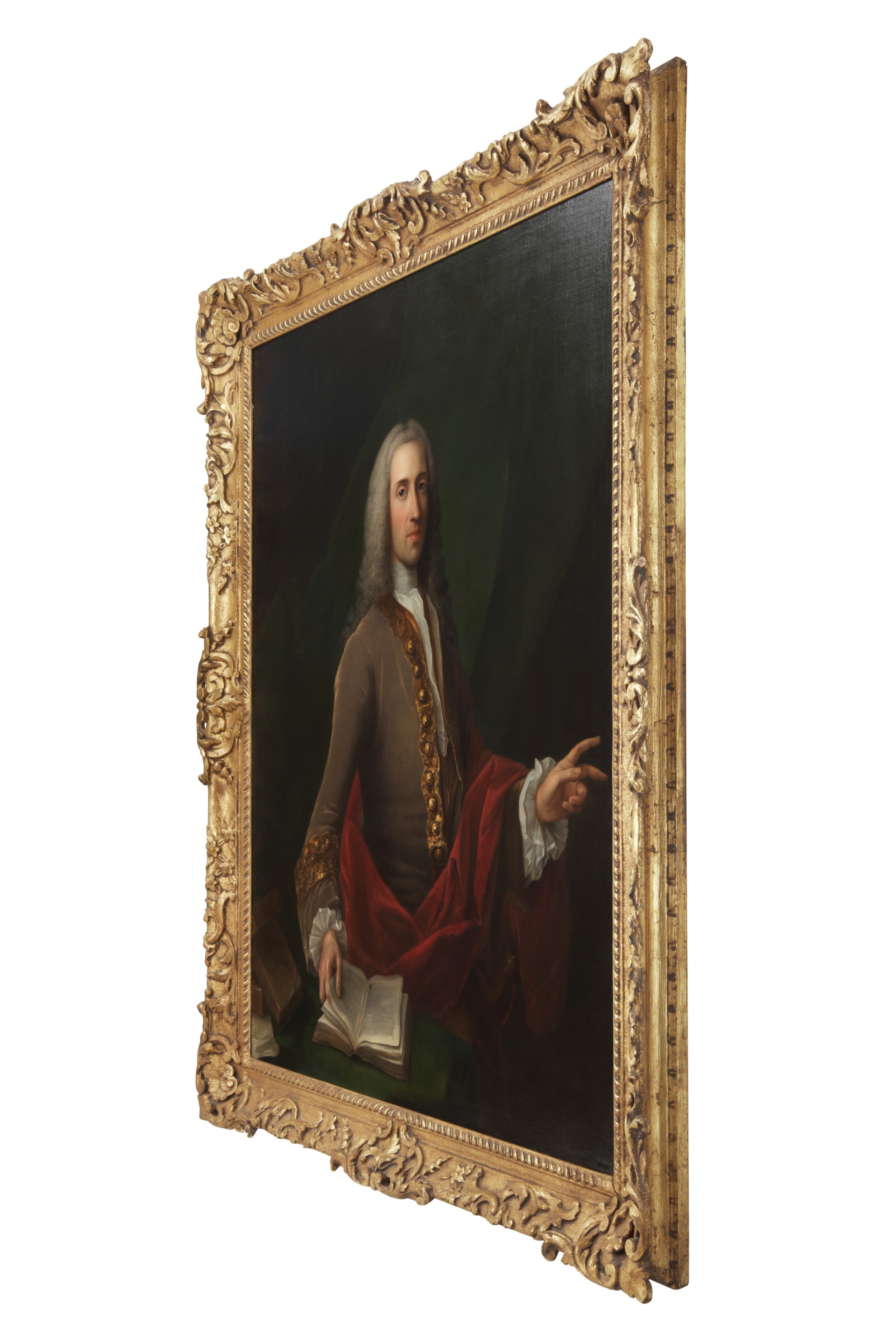
Archive II An 18th-century oil portrait depicting a wigged gentleman in a brown coat seated beside open books, enclosed in a carved giltwood frame. View II
Archive III An 18th-century oil portrait depicting a wigged gentleman in a brown coat seated beside open books, enclosed in a carved giltwood frame. View III
Archive IV An 18th-century oil portrait depicting a wigged gentleman in a brown coat seated beside open books, enclosed in a carved giltwood frame. View IV
Archive V An 18th-century oil portrait depicting a wigged gentleman in a brown coat seated beside open books, enclosed in a carved giltwood frame. View V
Archive VI An 18th-century oil portrait depicting a wigged gentleman in a brown coat seated beside open books, enclosed in a carved giltwood frame. View VI
Archive VII An 18th-century oil portrait depicting a wigged gentleman in a brown coat seated beside open books, enclosed in a carved giltwood frame. View VII
Archive VIII An 18th-century oil portrait depicting a wigged gentleman in a brown coat seated beside open books, enclosed in a carved giltwood frame. View VIII
FURTHER BROWSING

Visitors also looked at these ⇣

Enlarged Archival View
Telephone 07875 412 111
Location
London
United Kingdom
Dealer Profile Page sellingantiques.co.uk/titan
Verified Since Jul 2016
Items For Sale 18
Items Sold 401
Titan Fine Art
Titan Fine Art
Verified Since Jul 2016
View Dealer Info
Location: London, United Kingdom
Verified
Jul 2016
For Sale
18
Sold
401
An 18th-century oil portrait depicting a wigged gentleman in a brown coat seated beside open books, enclosed in a carved giltwood frame.
Portrait of a Gentleman, James Douglas, Lord Aberdour, later 14th Earl of Morton (1702–1768), with books; ATTRIBUTED TO JEREMIAH DAVISON (c.1695–1745)
Ref: SA1233507
An 18th-century oil portrait depicting a wigged gentleman in a brown coat seated beside open books, enclosed in a carved giltwood frame.
Detail View 1
Detail View 2
Detail View 3
Detail View 4
Detail View 5
Detail View 6
Detail View 7
Archival Detail
Every single antique dealer on our platform is individually approved by our internal team. We verify their professional trade history, ethical standards, and photographic quality to ensure a secure, high-standard buying environment. Upon joining, every dealer agrees to a strict 9-point code of conduct. While issues can occasionally arise, our dealers typically resolve them swiftly and directly with the buyer. In fact, since our founding in 2002, Sellingantiques has only had to step in to help resolve an issue on roughly five occasions—a true testament to the quality of our dealers and their dedication to your happiness.
Our dealers are highly experienced in packing and shipping fragile, high-value antiques. Because you are in direct contact with the dealer, you will be able to easily go through all available shipping and insurance options together to ensure your item arrives safely.
Antiques are the ultimate green purchase. By choosing historical pieces over newly manufactured goods, you completely eliminate the carbon footprint of modern mass production while preserving exceptional, timeless craftsmanship.

18th-century British portraiture is distinguished by formal compositions that emphasise the subjects social standing, intellect, and wealth. Sitters are frequently depicted with symbolic attributes such as manuscripts, books, or drapery, set against dark or classical backgrounds.

Paintings from this era were created using oil pigments on hand-stretched linen or cotton canvas. Frames were typically handcrafted from wood, carved with intricate foliate or shell motifs, and finished with water-gilded gold leaf.

Authentic Georgian paintings display natural craquelure across the paint layer, visible hand-woven canvas textures on the reverse, and historical stretcher construction. Frames usually show age-related wear to the gilding, including minor red bole exposure beneath the gold leaf.

A large framed historical portrait works well as a focal point above a fireplace mantel, sideboard, or within a gallery wall. Combining traditional artwork with clean, contemporary furniture creates a balanced, curated visual contrast.

Position the artwork away from direct sunlight, extreme humidity, and direct heat sources to prevent cracking or warping. Dust gently with a soft dry brush and consult a professional conservator for varnish cleaning or structural repairs.
items
Add keywords to the filter
Price
£100
£250000
Era
Movements
Material
Origin
Stock Location
Freshness
Online Payments
Categories