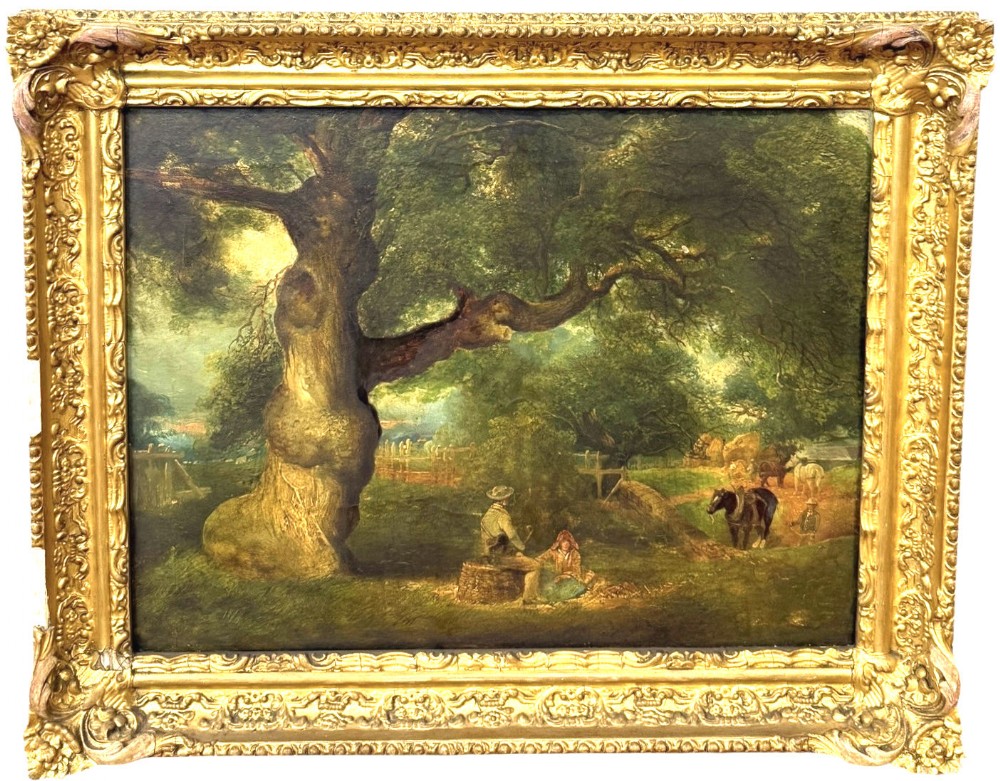
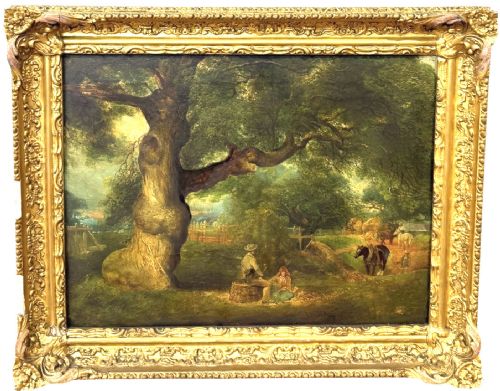
Artware Fineart has dated this Victorian Pastoral Landscape Painting to the 19th Century.
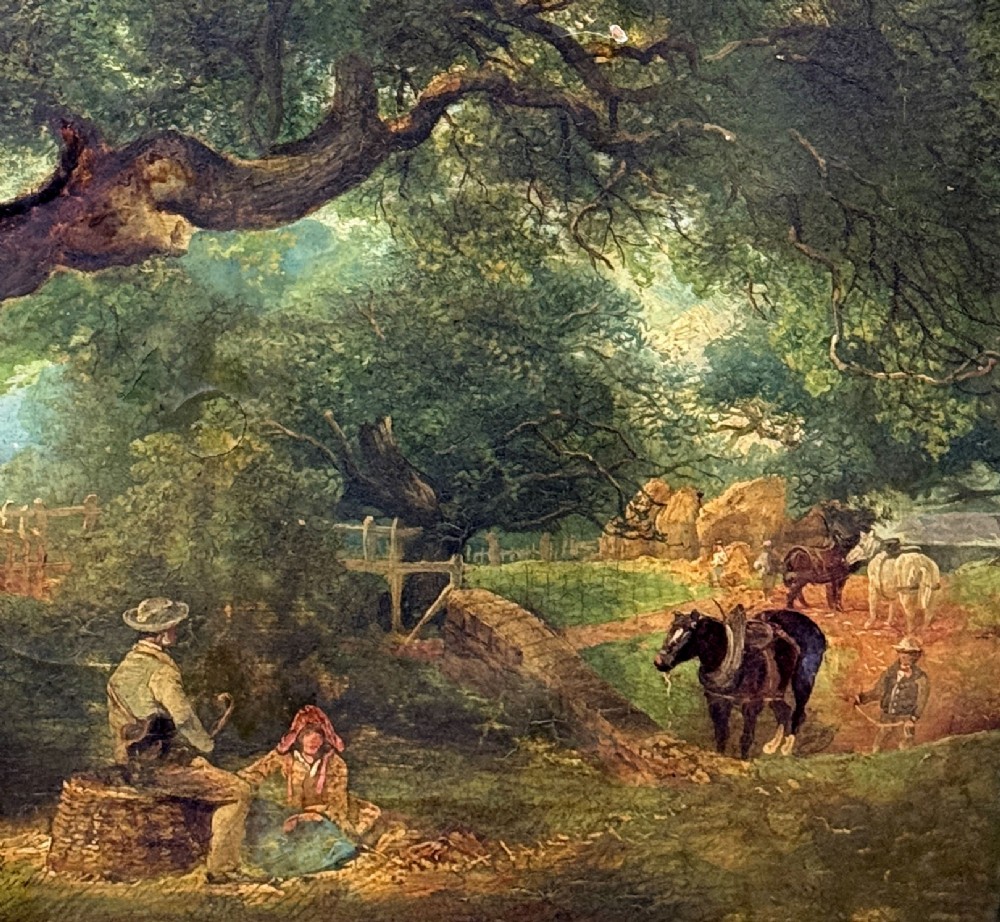
Labourers resting at Oak Tree with Shire & Carthorses working in the Farm Yard beyond
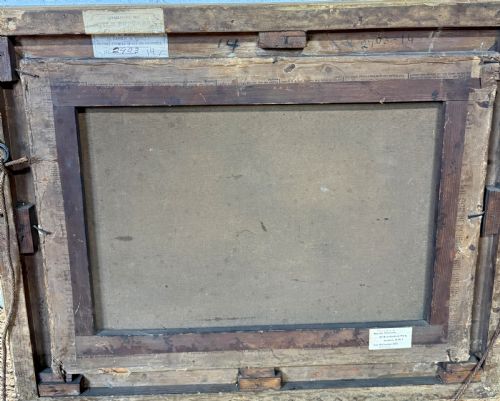
oil on canvas
34 x 45 cm.
Hay stacks are being built in the distance. The activity in the back ground looks like they were bringing in the hay harvest.Before the days of mechanical baler machines, hay was built into round stacks. A pole was sunk into the ground (a bit like a tall fence post) and the loose hay was packed tightly hand in a circle around the pole. The stacks were then thatched at the top to help keep the weather out. In the painting one stack is finished and another being made. The hay would have been used as winter feed for the cattle, sheep and horses on the farm. It is generally accepted that a third of the crops produced on farms, were used to feed the horses that the farms needed for doing the work. The colours of the horses in the picture suggest they are shires, or forerunners of what were eventually recognised as shires. Shires were not officially recognised as a breed until 1878 .
Notes
Carthorse, work horse or heavy horse, is a large horse bred to be a working animal hauling freight and doing heavy agricultural tasks such as plowing. There are a number of breeds, with varying characteristics, but all share common traits of strength, patience, and a docile temperament.
While indispensable to generations of pre-industrial farmers, draft horses are used today for a multitude of purposes, including farming, draft horse showing, logging, recreation, and other uses. Draft breeds have been crossbred with light riding breeds such as the Thoroughbred to create sport horses or warmbloods. While most draft horses are used for driving, they can be ridden and some of the lighter draft breeds are capable performers under saddle.
Draft horses are recognizable by their extremely muscular build. They tend to have broad, short backs with powerful hindquarters. In general, they are taller and tend to have heavier bone and a more upright shoulder than riding horses, producing conformation that is well suited for pulling. Many draft breeds have heavier hair, called feathering on their lower legs. Draft breeds range from approximately 163 to 193 cm (16 to 19 hands) high and from 640 to 910 kg (1,400 to 2,000 lb).
Background
Humans domesticated horses and used them to perform a variety of duties. One type of horse-powered work was the hauling of heavy loads, plowing fields, and other tasks that required pulling ability. A heavy, calm, patient, and well-muscled animal was desired for this work. Conversely, a light, more energetic horse was needed for riding and rapid transport. Thus, to the extent possible, a certain amount of selective breeding was used to develop different types of horse for different types of work.
It is a common misunderstanding that the Destrier that carried the armoured knight of the Middle Ages had the size and conformation of a modern draft horse, and some of these Medieval war horses may have provided some bloodlines for some of the modern draft breeds. The reality was that the high-spirited, quick-moving Destrier was closer to the size, build, and temperament of a modern Andalusian or Friesian. There also were horses of more phlegmatic temperaments used for pulling military wagons or performing ordinary farm work which provided bloodlines of the modern draft horse. Records indicate that even medieval drafts were not as large as those today. Of the modern draft breeds, the Percheron probably has the closest ties to the medieval war horse.
By the 19th century horses weighing more than 730 kilograms (1,600 lb) that also moved at a quick pace were in demand. Tall stature, muscular backs, and
Artware Fineart has dated this Victorian Pastoral Landscape Painting to the 19th Century.
You can view the stock and full dealer information on the Artware Fineart Profile Page
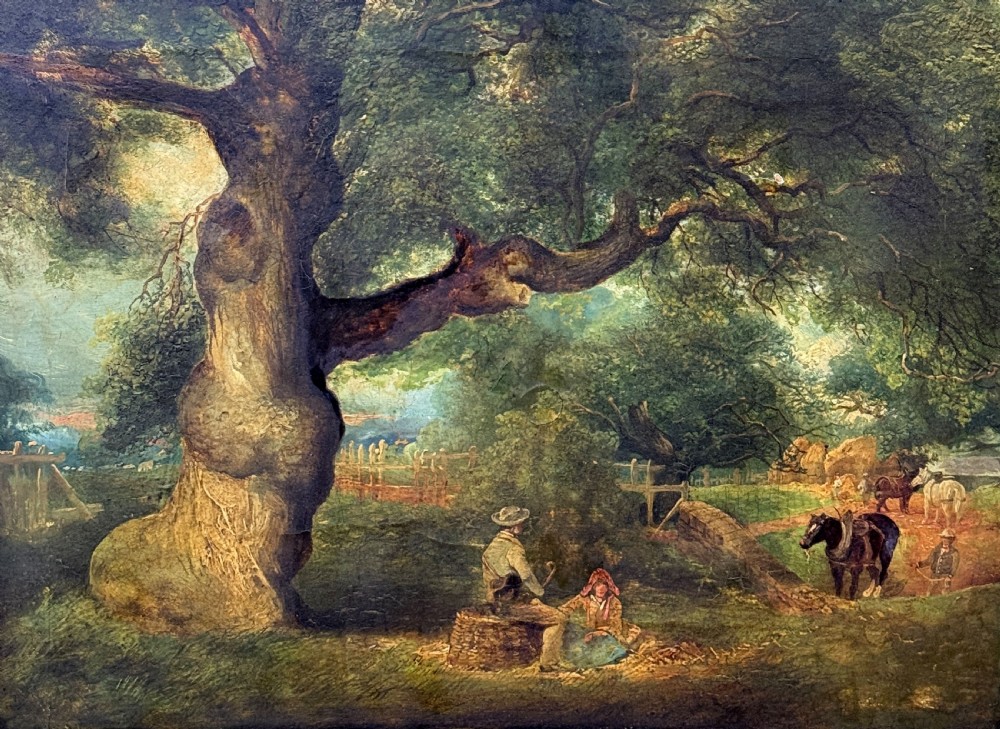
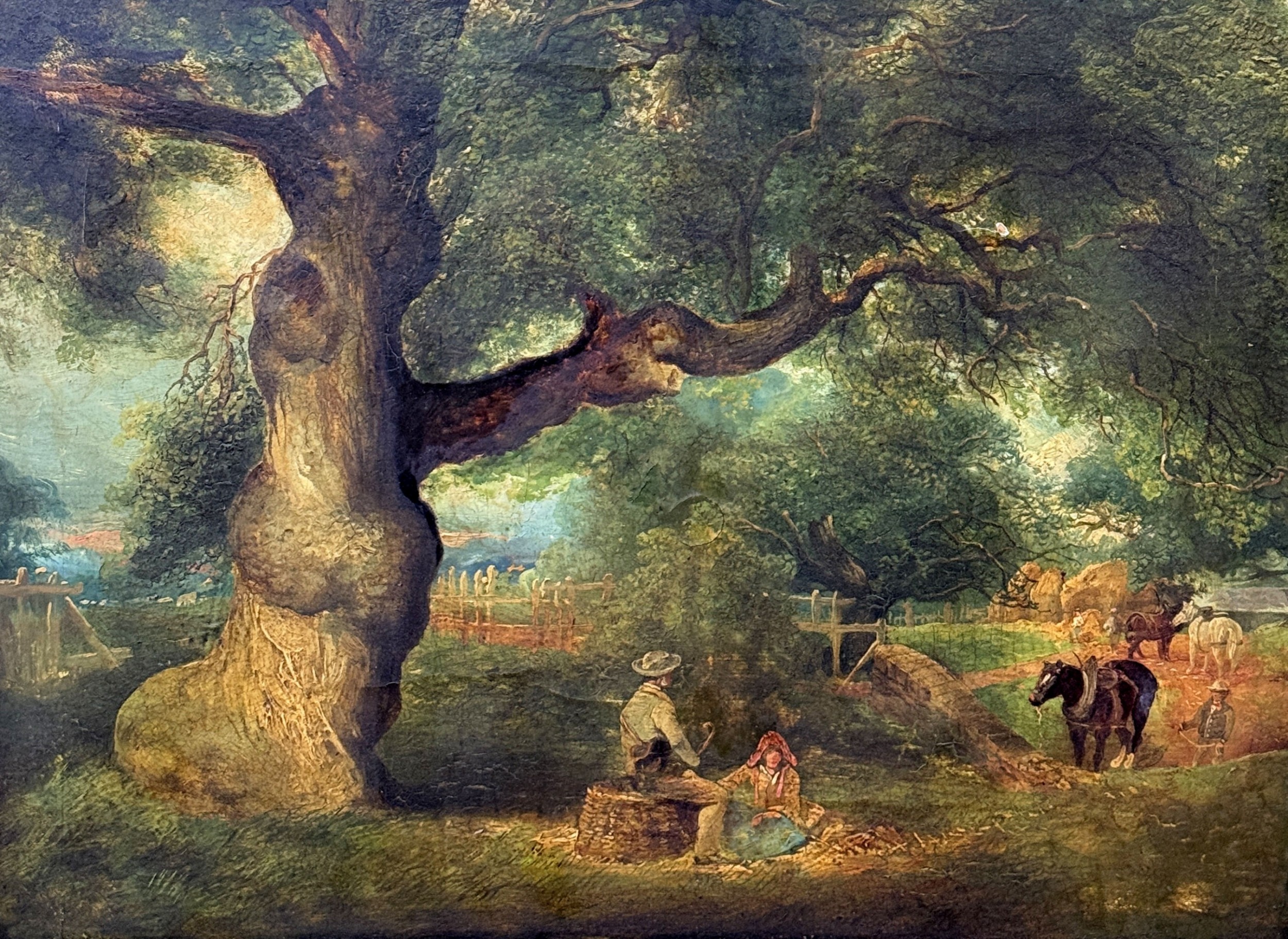
John Linnell 1792 -1882 Labourers Resting at Oak Tree with Shire & Carthorses Working in the Farm Yard Beyond oil on Canvas 34 X 45 Cm.