47,375  PAGES BROWSED TODAY PAGES TODAY 187  ANTIQUES UPLOADED TODAY NEW ARRIVALS
ID #SA1145254
FOR SALE
£1,600
Email
Save
Italia School Painting of the Madonna and Child with Two Angels, (Xvii-xviii) Follower of Orsola Maddalena Caccia
Westcoast Fine Art
for sale €1,872     $2,032
£1,600
Westcoast Fine Art

Westcoast Fine Art

Sellingantiques Verified Since May 2025
View Dealers Stock Page
  • About Us
    Westcoast fine art ltd is a UK based dealer in fine classical works of art.
Id #SA1145254
PDF SHARE
SAVE

Italia School Painting of the Madonna and Child with Two Angels, (Xvii-xviii) Follower of Orsola Maddalena Caccia

18th century
Description

Artist: (XVII-XVIII) Orsola Maddalena Caccia, Follower of

Title: Madonna and Child with Two Angels

Date: Circa late 17th, early 18th century

Measurements: Overall measurements are 126cm x 94cm x 4 and the painting measured at 110cm x 76cm
Provenance: From a private London collection

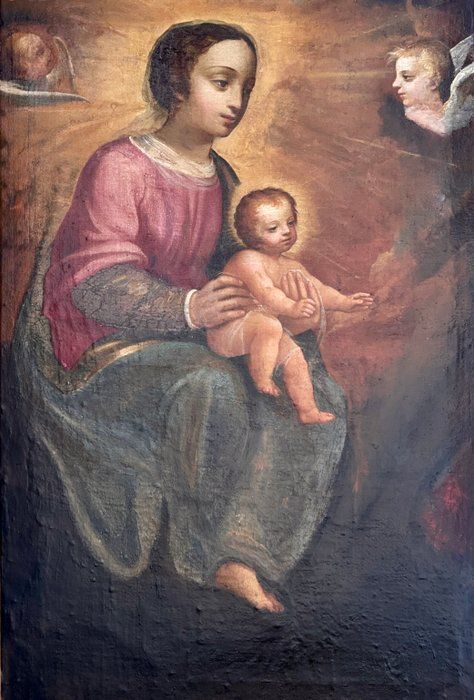
The present work depicts the Madonna holding the infant Jesus as two angels look on adoringly. The infant Jesus sits on the lap of the Madonna with arms outstretched. The attention to the role of light is evident, all played out in vivid contrasts, which gives prominence to the painting and creates vivid relationships, with a remarkable rendering of detail.

There is an elegant and refined character to this painting that suggests the painting of a female hand. The delicate features of the Madonna and Child are indicative of a feminine touch. Another artist whose work comes to mind in comparison with this work is Barbara Longhi (1552-1638), although this particular painting appears to be much closer to the work of Orsola Maddalena Caccia.

Orsola Maddalena Caccia, born Theodora Caccia (1596–1676) was an Italian mannerist painter and Catholic nun. She painted religious images, altarpieces, and still lifes Caccia spent the majority of her career running a successful studio in the Ursuline convent in Moncalvo, which was founded by her father in part to house his six daughters.

Orsola's father, painter Guglielmo Caccia, also known as Il Moncalvo, trained her and her sister, Francesca, in his studio.

In 1620, Orsola took her vows at the Convento delle Orsoline in Bianzè, Italy, in the northern region of Piedmont. At the time of her arrival, four of her sisters were already in residence. Bianzé was a fortified outpost between lands governed by the Gonzagas, the dukes of Mantua and Monferrato, and the Duchy of Savoy. Subsequently, its location was between these warring areas.

To find a safe place for his daughters, he sought permission from the Bishop of Casale Monferrato to establish the Ursuline convent at Moncalvo. For this project, he used his own resources—money and the houses he owned. In 1625, Orsola and her sisters transferred to the newly established convent.

A few months later, on April 15, 1625, Guglielmo died. He bequeathed his drawings, set squares, and tools to his daughters for their use at the convent. However, he stipulated that after all six of his daughters died, his belongings should be returned to his male heirs. He also stipulated in his will that Orsola complete an unfinished altarpiece for the Franciscan church of Montalvo. She did finish the work, in addition to taking commissions for other panel paintings for local churches.

Orsola took matters into her own hands when the convent experienced financial problems. She addressed the Duchess of Savoy, Madama Reale Christine of France, in two letters in 1643. Orsola requested an opportunity for paid work. Christine commissioned a Nativity and a Saint John the Baptist. Since commissions earned money for the convent, being able to paint well was a valuable skill. Painting was a vocation for the Ursulines of Moncalvo, and Orsola set up a painting studio within the convent, where she trained other nun artists.

Although influenced by her father’s technique, Orsola elaborated a personal style that is attentive to detail, as well as to developments in Lombard and Flemish painting. Despite executing numerous altarpieces, her fame especially rests in her small, refined cabinet paintings, and on her elegant female saints. Her patrons included both the courts of Savoy and the Gonzaga.

We think the pairing offered most likely to have been composed by a follower of the old master perhaps a student.

Physical Dimensions
Height
126cm (49.61")
Width
94cm (37.01")
Depth
4cm (1.57")
Declaration

Westcoast Fine Art has dated this Italian Baroque Oil Painting to the 18th Century.

Reference Numbers
Sellingantiques Reference
SA1145254
Dealers Notes

****Westcoast Fine Art is always willing to consider reasonable offers from prospective buyers. Please feel free to send us an inquiry regarding any proposal or offer; we will review and respond within 24 hours.

Please enquire about shipping before making a purchase.

Note:

The buyer is responsible for paying any import duties and associated taxes in the destination country. All works will be professionally packed and insured for shipment.

Shipping:

Please contact for exact shipping charges before purchasing

1) UK shipping please enquire

2) EU shipping please enquire

3) For other worldwide shipping, please contact us.

We offer a 14-day return period to the EU and UK, provided the painting is returned in the same condition as received, packaged to the same packaging standards and insured at the price paid to Westcoast Fine Art Ltd for the artwork.

**The buyer is responsible for paying any customs charges of the destination country. We always advise the buyer to check with their local customs authorities for customs tariffs.

The frame is a gift and is therefore being provided to you at no additional cost. Any damages to the frame during transit do not give the buyer a basis for a claim or validate a request for the cancellation of a sale.

Westcoast Fine Art is a trademark of Westcoast Fine Art Ltd. Registered in England and Wales No. 15030029.

Registered office: 71-75 Shelton Street, Covent Garden, London, United Kingdom, WC2H 9JQ

***Westcoast Fine Art is always willing to consider reasonable offers from prospective buyers. Please feel free to send us an inquiry regarding any proposal or offer; we will review and respond within 24 hours.

Note:

The buyer is responsible for paying any import duties and associated taxes in the destination country. All works will be professionally packed and insured for shipment.

Shipping:

Please contact for exact shipping charges before purchasing

1) UK shipping please request price

2) EU shipping please request price

3) For other worldwide shipping, please request price

We offer a 14-day return period to the EU and UK, provided the painting is returned in the same condition as received, packaged to the same packaging standards and insured at the price paid to Westcoast Fine Art Ltd for the artwork.

*The buyer is responsible for paying any customs charges of the destination country. We always advise the buyer to check with their local customs authorities for customs tariffs.

The frame is a gift and is therefore being provided to you at no additional cost. Any damages to the frame during transit do not give the buyer a basis for a claim or validate a request for the cancellation of a sale.

Westcoast Fine Art is a trademark of Westcoast Fine Art Ltd. Registered in England and Wales No. 15030029.

Registered office: 71-75 Shelton Street, Covent Garden, London, United Kingdom, WC2H 9JQ

Description
Artist: (XVII-XVIII) Orsola Maddalena Caccia, Follower of

Title: Madonna and Child with Two Angels

Date: Circa late 17th, early 18th century

Measurements: Overall measurements are 126cm x 94cm x 4 and the painting measured at 110cm x 76cm

fig 1. An XVII-XVIII century Italian School oil painting depicting the Madonna in a pink gown seated with the Christ child, flanked by two cherub angels in the upper corners.
fig 1. Italia School Painting of the Madonna and Child with Two Angels, (Xvii-xviii) Follower of Orsola Maddalena Caccia

Provenance: From a private London collection

The present work depicts the Madonna holding the infant Jesus as two angels look on adoringly. The infant Jesus sits on the lap of the Madonna with arms outstretched.
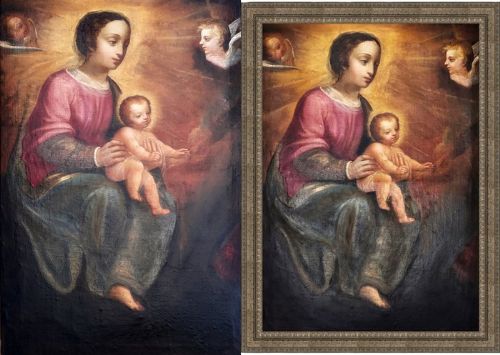
The attention to the role of light is evident, all played out in vivid contrasts, which gives prominence to the painting and creates vivid relationships, with a remarkable rendering of detail.
Westcoast Fine Art
fig 2. An XVII-XVIII century Italian School oil painting depicting the Madonna in a pink gown seated with the Christ child, flanked by two cherub angels in the upper corners.
fig 2. Italia School Painting of the Madonna and Child with Two Angels, (Xvii-xviii) Follower of Orsola Maddalena Caccia

There is an elegant and refined character to this painting that suggests the painting of a female hand. The delicate features of the Madonna and Child are indicative of a feminine touch. Another artist whose work comes to mind in comparison with this work is Barbara Longhi (1552-1638), although this particular painting appears to be much closer to the work of Orsola Maddalena Caccia.
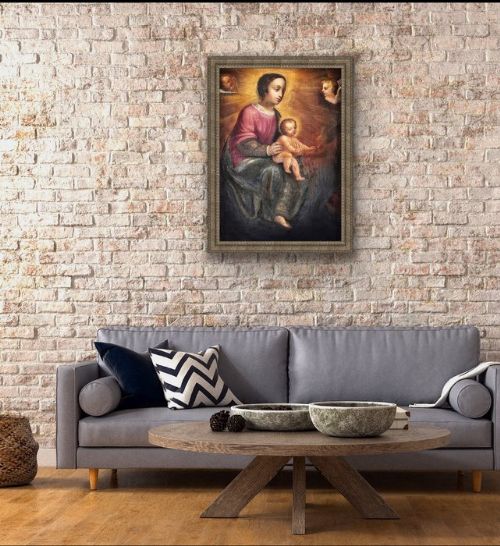
fig 3. An XVII-XVIII century Italian School oil painting depicting the Madonna in a pink gown seated with the Christ child, flanked by two cherub angels in the upper corners.
fig 3. Italia School Painting of the Madonna and Child with Two Angels, (Xvii-xviii) Follower of Orsola Maddalena Caccia

Orsola Maddalena Caccia, born Theodora Caccia (1596–1676) was an Italian mannerist painter and Catholic nun. She painted religious images, altarpieces, and still lifes Caccia spent the majority of her career running a successful studio in the Ursuline convent in Moncalvo, which was founded by her father in part to house his six daughters.

fig 4. An XVII-XVIII century Italian School oil painting depicting the Madonna in a pink gown seated with the Christ child, flanked by two cherub angels in the upper corners.
fig 4. Italia School Painting of the Madonna and Child with Two Angels, (Xvii-xviii) Follower of Orsola Maddalena Caccia

Orsola's father, painter Guglielmo Caccia, also known as Il Moncalvo, trained her and her sister, Francesca, in his studio.

In 1620, Orsola took her vows at the Convento delle Orsoline in Bianzè, Italy, in the northern region of Piedmont. At the time of her arrival, four of her sisters were already in residence. Bianzé was a fortified outpost between lands governed by the Gonzagas, the dukes of Mantua and Monferrato, and the Duchy of Savoy. Subsequently, its location was between these warring areas.

To find a safe place for his daughters, he sought permission from the Bishop of Casale Monferrato to establish the Ursuline convent at Moncalvo. For this project, he used his own resources—money and the houses he owned. In 1625, Orsola and her sisters transferred to the newly established convent.

A few months later, on April 15, 1625, Guglielmo died. He bequeathed his drawings, set squares, and tools to his daughters for their use at the convent. However, he stipulated that after all six of his daughters died, his belongings should be returned to his male heirs. He also stipulated in his will that Orsola complete an unfinished altarpiece for the Franciscan church of Montalvo. She did finish the work, in addition to taking commissions for other panel paintings for local churches.

Orsola took matters into her own hands when the convent experienced financial problems. She addressed the Duchess of Savoy, Madama Reale Christine of France, in two letters in 1643. Orsola requested an opportunity for paid work. Christine commissioned a Nativity and a Saint John the Baptist. Since commissions earned money for the convent, being able to paint well was a valuable skill. Painting was a vocation for the Ursulines of Moncalvo, and Orsola set up a painting studio within the convent, where she trained other nun artists.

Although influenced by her father’s technique, Orsola elaborated a personal style that is attentive to detail, as well as to developments in Lombard and Flemish painting. Despite executing numerous altarpieces, her fame especially rests in her small, refined cabinet paintings, and on her elegant female saints. Her patrons included both the courts of Savoy and the Gonzaga.

We think the pairing offered most likely to have been composed by a follower of the old master perhaps a student.

Height
126cm (49.61")
Width
94cm (37.01")
Depth
4cm (1.57")
Date of Manufacture

Westcoast Fine Art has dated this Italian Baroque Oil Painting to the 18th Century.

Reference Numbers
Sellingantiques Ref
SA1145254
Westcoast Fine Art
Westcoast Fine Art
Sellingantiques verified Since May 2025

Westcoast fine art ltd is a UK based dealer in fine classical works of art.

Dealer Profile

You can view the stock and full dealer information on the Westcoast Fine Art Profile Page

PDF SHARE
SAVE
An XVII-XVIII century Italian School oil painting depicting the Madonna in a pink gown seated with the Christ child, flanked by two cherub angels in the upper corners.
1 / 5
Archive I An XVII-XVIII century Italian School oil painting depicting the Madonna in a pink gown seated with the Christ child, flanked by two cherub angels in the upper corners.

Italia School Painting of the Madonna and Child with Two Angels, (Xvii-xviii) Follower of Orsola Maddalena Caccia
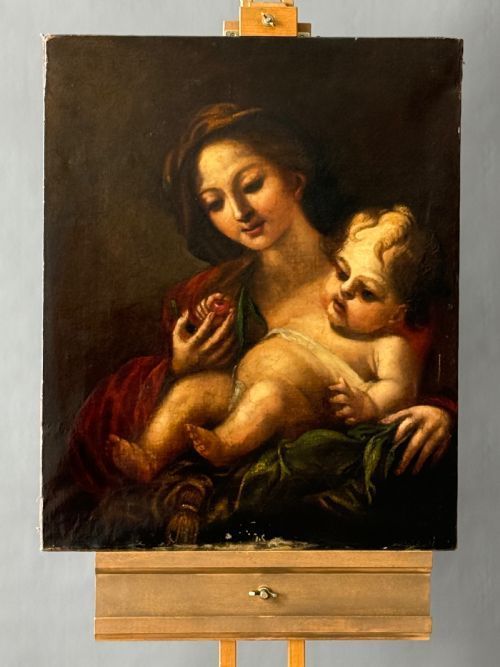
Archive II An XVII-XVIII century Italian School oil painting depicting the Madonna in a pink gown seated with the Christ child, flanked by two cherub angels in the upper corners. View II
Archive III An XVII-XVIII century Italian School oil painting depicting the Madonna in a pink gown seated with the Christ child, flanked by two cherub angels in the upper corners. View III
Archive IV An XVII-XVIII century Italian School oil painting depicting the Madonna in a pink gown seated with the Christ child, flanked by two cherub angels in the upper corners. View IV
Archive V An XVII-XVIII century Italian School oil painting depicting the Madonna in a pink gown seated with the Christ child, flanked by two cherub angels in the upper corners. View V
Enlarged Archival View
Telephone 07466 158064
Location
Northwest London
United Kingdom
Verified Since May 2025
Items For Sale 32
Items Sold 12
Westcoast Fine Art
Westcoast Fine Art
Verified Since May 2025
View Dealer Info
Location: Northwest London, United Kingdom
Verified
May 2025
For Sale
32
Sold
12
An XVII-XVIII century Italian School oil painting depicting the Madonna in a pink gown seated with the Christ child, flanked by two cherub angels in the upper corners.
Italia School Painting of the Madonna and Child with Two Angels, (XVII-XVIII) Follower of Orsola Maddalena Caccia
Ref: SA1145254
An XVII-XVIII century Italian School oil painting depicting the Madonna in a pink gown seated with the Christ child, flanked by two cherub angels in the upper corners.
Detail View 1
Detail View 2
Detail View 3
Detail View 4
Archival Detail
Every single antique dealer on our platform is individually approved by our internal team. We verify their professional trade history, ethical standards, and photographic quality to ensure a secure, high-standard buying environment. Upon joining, every dealer agrees to a strict 9-point code of conduct. While issues can occasionally arise, our dealers typically resolve them swiftly and directly with the buyer. In fact, since our founding in 2002, Sellingantiques has only had to step in to help resolve an issue on roughly five occasions—a true testament to the quality of our dealers and their dedication to your happiness.
Our dealers are highly experienced in packing and shipping fragile, high-value antiques. Because you are in direct contact with the dealer, you will be able to easily go through all available shipping and insurance options together to ensure your item arrives safely.
Antiques are the ultimate green purchase. By choosing historical pieces over newly manufactured goods, you completely eliminate the carbon footprint of modern mass production while preserving exceptional, timeless craftsmanship.

Italian Baroque religious artwork from the seventeenth and eighteenth centuries is characterised by dramatic lighting effects, rich colour palettes, and strong devotional imagery. Artists often employed chiaroscuro to emphasize figures against dark backgrounds, creating dynamic compositions intended to evoke spiritual contemplation.

Paintings from this era were primarily executed using oil pigments mixed with linseed or walnut oil, applied onto hand-woven linen or hemp canvas stretches. Frames were typically crafted from carved wood, often finished with gold leaf or dark hand-applied lacquers.

Authentication involves inspecting the age-appropriate craquelure across the paint surface, examining hand-forged nails or wooden pegs on the stretcher frame, and observing natural pigment oxidation. Technical analysis, such as ultraviolet light inspection, can also reveal historical restoration and period-correct paint layers.

A Baroque painting can serve as a focal point above a minimalist console table or fireplace mantel. Combining historical fine art with clean architectural lines creates a curated contrast, while dedicated picture lighting enhances the deep tonal variations.

Preservation requires displaying the artwork away from direct sunlight, heating sources, and areas of variable humidity. Dusting should be conducted gently with a soft dry brush, and any structural stabilization or cleaning should strictly be handled by a professional art conservator.
items
Add keywords to the filter
Price
£100
£250000
Era
Movements
Material
Origin
Stock Location
Freshness
Online Payments
Categories