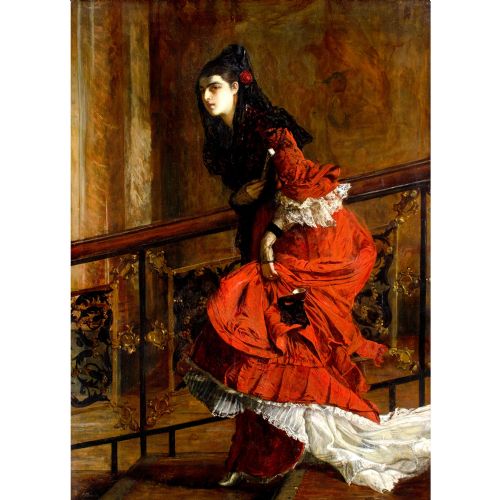
Brave Fine Art has dated this piece to the 1870s.
It’s discussed at length in his 1908 biography, where it’s reproduced as the first plate.
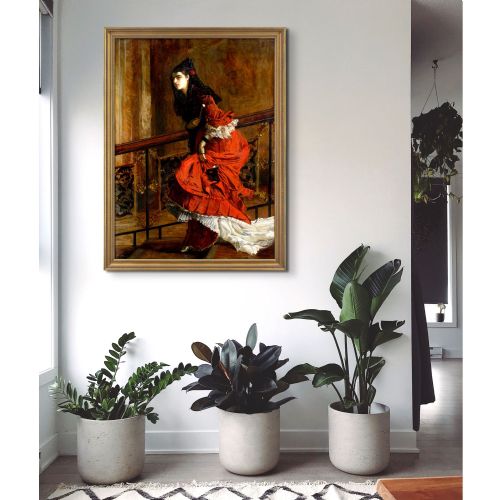
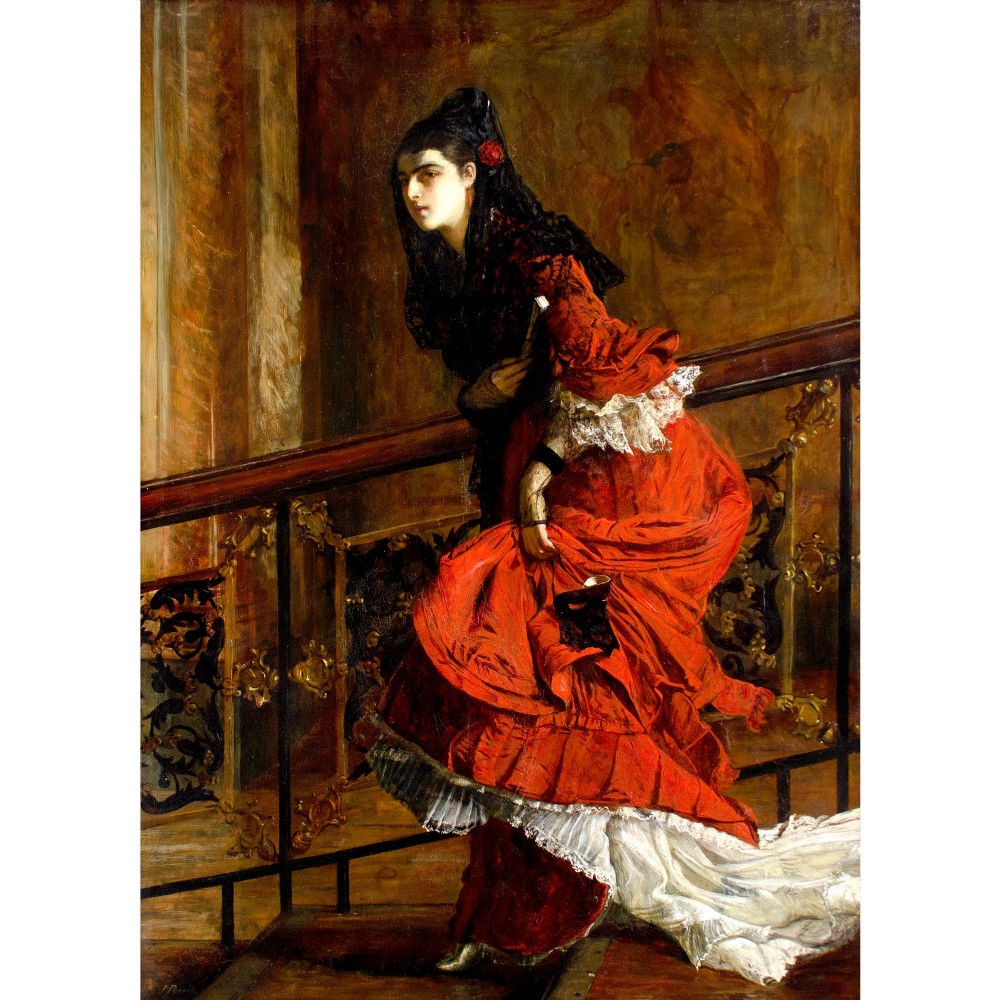
“…he glories in red, handling a scheme of colour whose richness and fulness is gained by impetuous and unlaboured brushwork”. Martin Hardie.
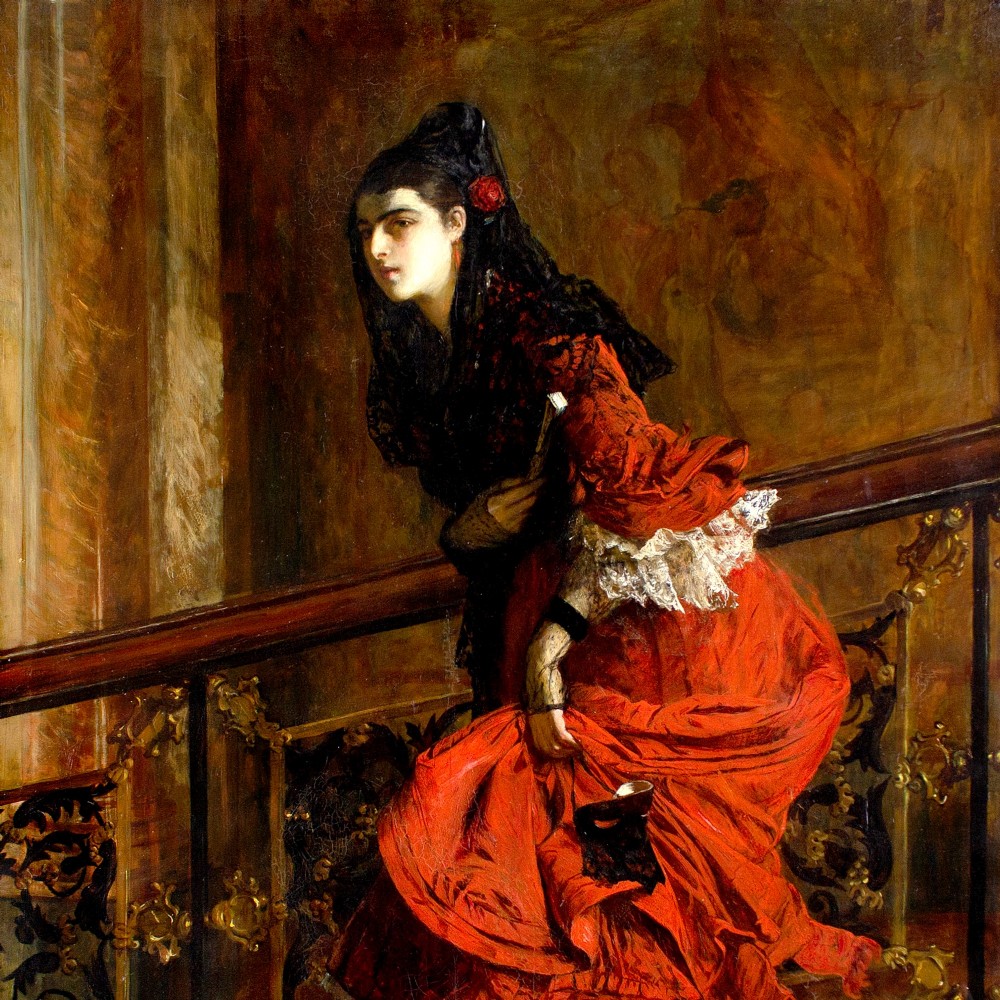
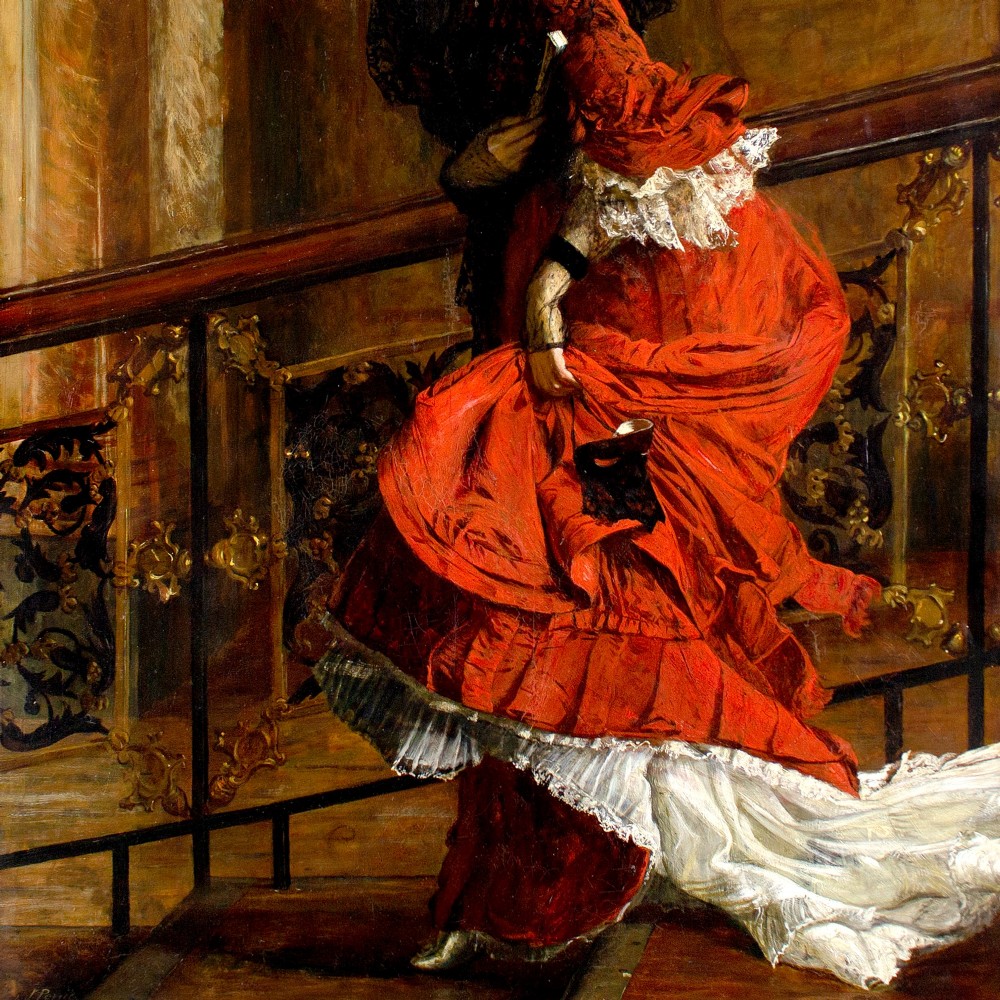
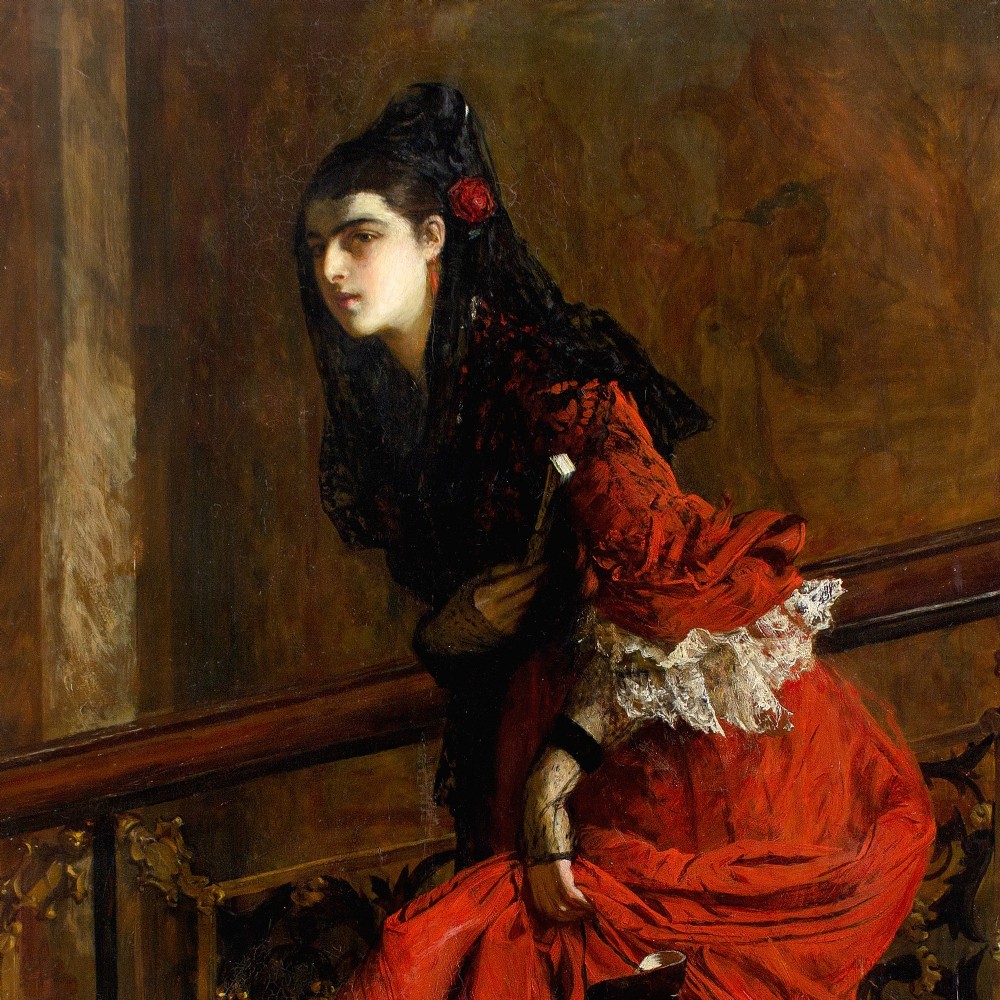
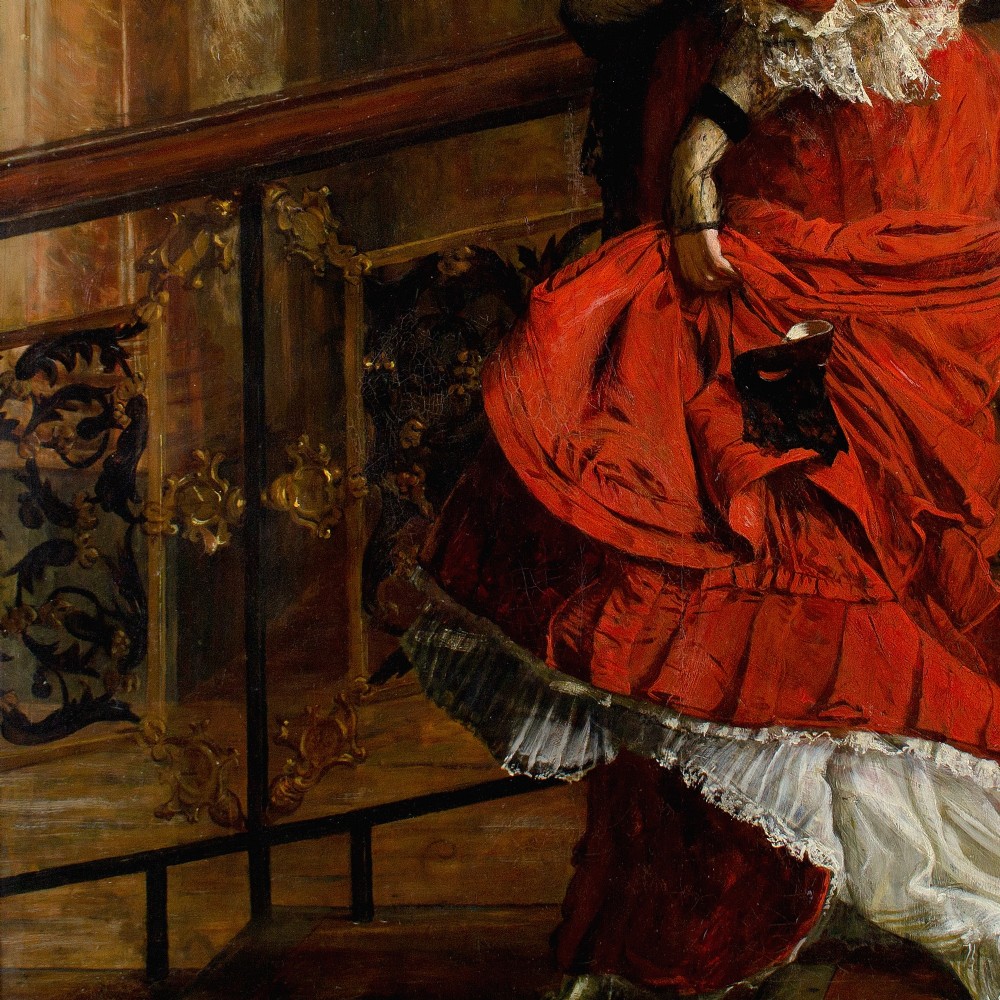
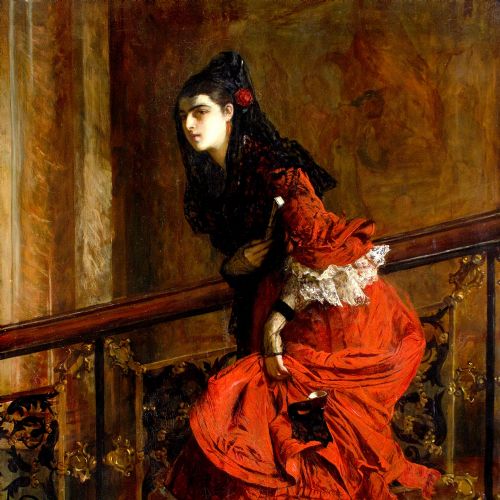
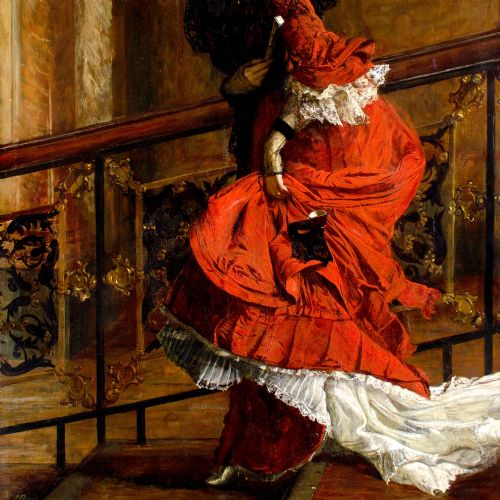
Travelling stealthily, yet with speed, she glances into the distance. Her eyes are alive, transfixed and eager. Her outfit suggests she’s exiting a masquerade ball, but why the sudden departure? Is she meeting another? An illicit love affair? Or escaping the clutches of a devilish rogue? The painting was discussed by several Victorian art critics and we’ve published a selection of reviews in our directory. It was formerly in the collection of the distinguished art collector Thomas McArly, the Consul of Nicaragua at Glasgow, and a sketch exists at the Auckland Art Gallery.
Pettie was born and spent the first thirteen years of his life in Edinburgh, before his family moved to East Linton in Haddingtonshire. Here, his father Alexander Pettie purchased the village shop, from which he supplied an array of disparate goods to the local village folk. Evidently with aspirations that his son would follow suit, his father tasked the young lad with various errands, such as fetching stock from the cellar or storeroom. However, much to his dismay, he often discovered him covering lids of boxes with surreptitious sketches, oblivious to the task at hand.
From an early age, he was imbued with a free spirit and captivated by dramatic fiction, such as the books of Sir Walter Scott. These were particularly appealing for their romance, intrigue and masterful portrayal of character, and would form the basis of several of his works.
Keen to impress his parents, he produced numerous portraits of family members in crayon, along with copies (interpreted in his own way) of contemporary paintings, until his mother finally capitulated and took him to Edinburgh to meet James Drummond RSA. Drummond was well-versed in such introductions and initially discouraged the downbeat young aspirant from his artistic pursuits, stating to his mother, "much better make him stick to business". However, upon perusing an eagerly assembled parcel of drawings, paused, and exclaimed, “Well, madam, you can put that boy to what you like, but he'll die an artist!"
In 1855, Pettie enrolled at the Trustees’ Academy in Edinburgh where he studied under Robert Scott Lauder, who would become a key influence. It was a particularly strong assemblage of students, which included Sir William Quiller Orchardson RA (1832-1910), William McTaggart (1835-1910) and George Paul Chalmers RSA (1833-1878). By all accounts, Lauder was an excellent teacher, offering a framework of ideas without stifling individual creativity. One of his key tenets, impressed upon his students, was to consider a group of figures rather than each one in isolation. Generally, students are put through their paces in life drawing classes and taught to observe and evaluate light as it falls upon a single form. But Lauder taught them to view a collective as a single entity, thus teaching them ‘to see’. Many of the artists who studied with him would later be regarded as the ‘Edinburgh School’ and known for their alternative approach to genre painting. Nearly all of them were from working-class backgrounds.
Aside from his tuition, Pettie also found various delights at the Scottish National Gallery, which offered a seemingly endless assortm
Brave Fine Art has dated this piece to the 1870s.
Exquisite antique paintings that capture the imagination.
You can view the stock and full dealer information on the Brave Fine Art Profile Page
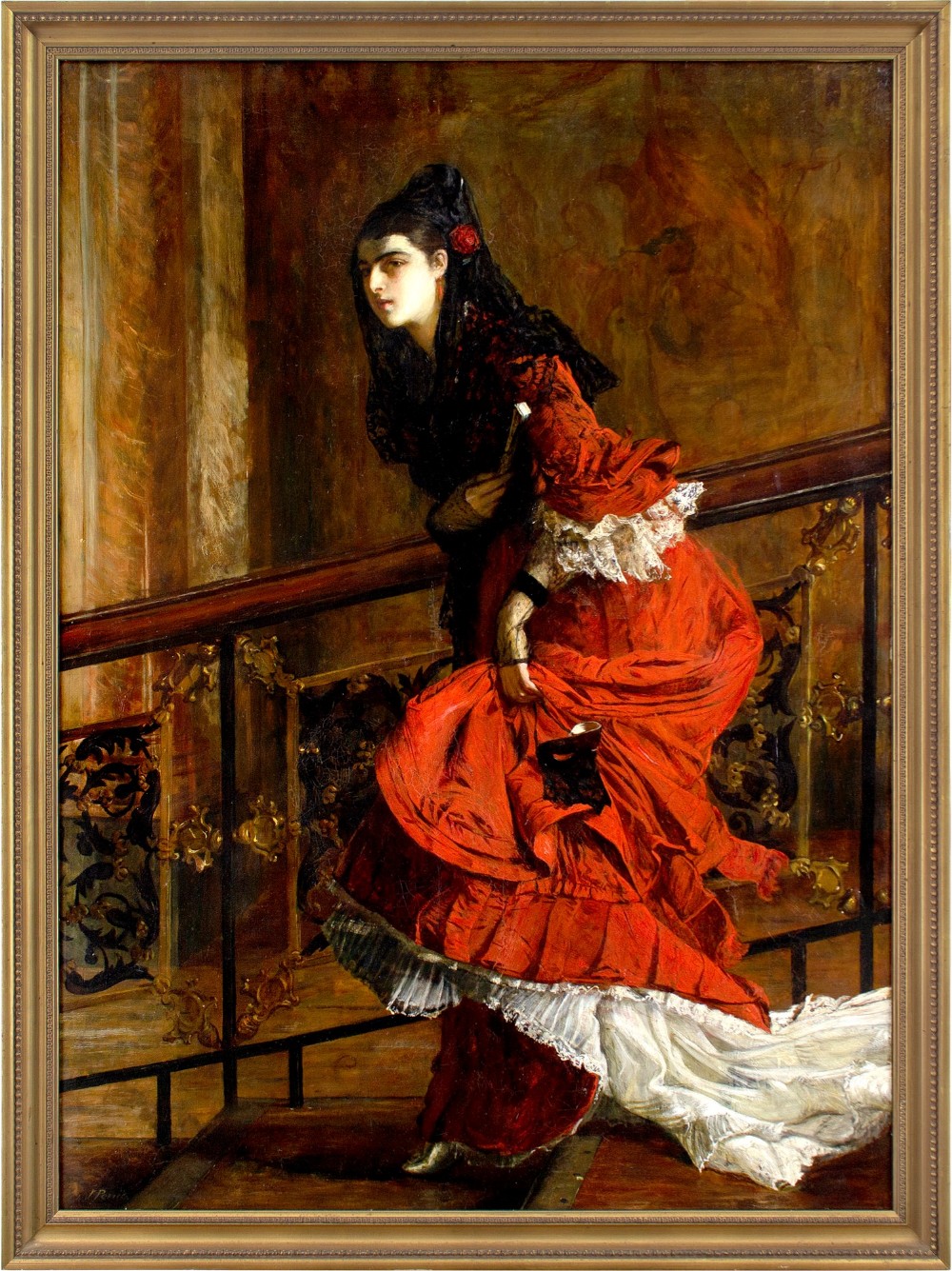
John Pettie Ra Hrsa, the Hour - Antique Oil Painting