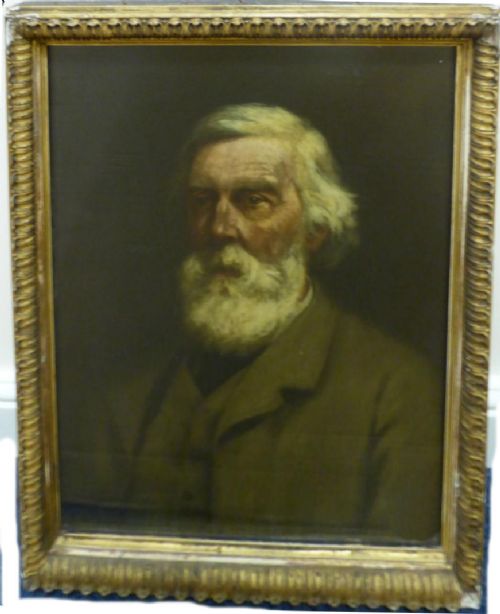
Artware Fineart has dated this Victorian Male Portrait Painting to the 1890s.
Professor Alexander William Williamson FRS (1824-1904)
signed and dated "1894"
oil on canvas
24 x 20 in. (61 x 51 cm.)
Provenance : By descent in the family
Notes
Williamson, Alexander William (1824–1904), chemist, was born on 1 May 1824 in Wandsworth, Surrey, the second of three children of Alexander Williamson, a clerk in the East India House, and Antonia McAndrew Williamson, daughter of a London merchant.
He was a friend of the economist and utilitarian philosopher James Mill, who worked in the same office and who lived close by in Wright's Lane, Kensington, after the Williamson family moved there in 1831. About 1840 Williamson resigned his position, and thereafter the family went to live in France and Germany.
As a boy Williamson had weak health, exacerbated by inappropriate medical care; he suffered from blindness in the right eye and myopia in the left, and a stiff and largely useless left arm. Despite these infirmities, he later developed a sturdy constitution. After attending day schools in Kensington, Paris, and Dijon, in 1841 he enrolled at the University of Heidelberg, intending to study medicine. He was, however, soon attracted to chemistry through the lectures and kind personal attention of Leopold Gmelin (1788–1853). In 1844 Williamson transferred to the University of Giessen in order to study under the world-famous chemist Justus Liebig (1803–1873). Here he made a minor sensation with his first published paper, on a subject (the reactions in solution of ‘bleaching salts’) which Liebig had assigned as a simple analytical exercise. Concerning this research, he commented presciently in a letter to his father: ‘the great difficulty in a research such as that I am now pursuing consists not so much in performing the experiments once fixed upon, as in inventing and choosing from those most calculated to attain the desired object’ (Divers, xxvi).
Williamson received his PhD from Giessen in 1845 and the following year took up temporary residency in Paris. Here he became acquainted with the principal French chemists, including Jean-Baptiste Dumas, Adolphe Wurtz, Auguste Laurent, and Charles Gerhardt. He also took private lessons in mathematics from Auguste Comte, the founder of French positivism, who had been recommended to him by John Stuart Mill. Williamson was for a time a committed positivist, and Comte had high hopes that he would establish an English beachhead for his philosophical system. However, Williamson soon fell away from Comtean orthodoxy.
Although Williamson published no research during this period, it appears that it was in Paris that he began his fundamental investigations in etherification and reaction mechanics. In 1849, supported by the eminent chemist Thomas Graham, Williamson successfully applied for the professorship of analytical and practical chemistry at University College, London, which was vacant following George Fownes's death. This was one of the earliest academic laboratories in Great Britain in which students were required to perform practical exercises. Williamson's pedagogical impact was substantial during the thirty-eight years he spent in the Birkbeck laboratory at University College. He had strong opinions on teaching technique—he regarded it as vital to lead from individual facts to general principles, rather than the reverse—and his students seem to have responded enthusiastically, describing him as a splendid teacher. In 1865 he published a successful elementary textbook, Chemistry for Students.
Williamson's novel reaction by which ethers could be synthesized was first announced on 3 August 1850 at the Edinburgh meeting of the British Association
Artware Fineart has dated this Victorian Male Portrait Painting to the 1890s.
You can view the stock and full dealer information on the Artware Fineart Profile Page

William Biscombe Gardner, Ra, 1847-1919 Professor Alexander William Williamson Frs (1824-1904)