14,397  PAGES BROWSED TODAY PAGES TODAY 36  ANTIQUES UPLOADED TODAY NEW ARRIVALS
ID #SA299650
FOR SALE
£2,000
Email
Save
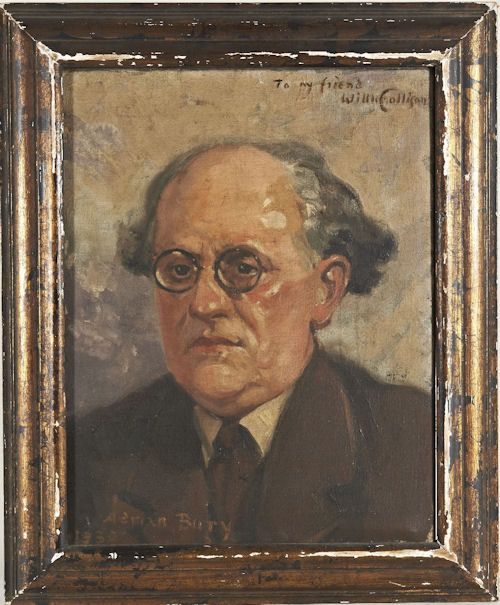
Adrian Bury 1891-1991 Portrait of William Collison 1865-1938
Artware Fineart
for sale €2,340     $2,540
£2,000

Artware Fineart

Sellingantiques Verified Since Sep 2008
View Dealers Stock Page
Id #SA299650
PDF SHARE
SAVE

Adrian Bury 1891-1991 Portrait of William Collison 1865-1938

1920 - 1940
For Sale by Artware Fineart
Description

Adrian Bury 1891-1991

Portrait of William Collison 1865-1938

signed and inscribed and dated " To My Friend/William Collison/1930"

oil on canvas

18.1/4 x 14.1/4 in. (46 x 36 cm.)

William Collison, (1865–1938), workers' leader, was born on 22 June 1865 at 22 Greenfield Street, Mile End, London, the eldest of twelve children of William Collison, policeman, and his wife, Leah (née Brett). Collison's formal education did not progress beyond elementary school; it must be presumed that his later fluency with the pen was the result of his own efforts at self-improvement. A long series of casual jobs, punctuated by a two-year period of service in the British army, took him into the world of London's dockland. His talents as an agitator and as an organizer soon became apparent. In 1886 he was elected as a delegate to the Mansion House Unemployed Relief Committee, where he was befriended by Cardinal Manning. Later he became a paid official of the Tramway and Omnibus Employees' Trade Union.
Collison's early enthusiasm for trade unions began to wane. In 1890 he declined to support a strike called by the Tramway Union in protest against moves by the employers to counter dishonesty among their workers. He left the union, and attempted to obtain casual work again in the London docks, but was refused employment. This was because he was not a member of the dockers' trade union formed the previous year, when the great dock strike had marked the beginning of trade union organization (the so-called ‘new unionism’) among unskilled manual workers. Collison's anti-union views now took on a definite shape. He resented the manner in which (as he argued) professional socialists were exploiting the plight of the poor for their own political ends. The tactics of the closed shop, of which he now found himself a victim, were one of the hallmarks of new unionism; another was the use of the strike as a weapon of first rather than last resort. Collison regarded new unionism as a form of socialist tyranny, and he determined to fight it. He knew that there were many other like-minded members of the working classes who shared his views. On 16 May 1893, at Ye Olde Roebuck public house, Aldgate, he called a ‘General Conference of men interested in Free Labour’: this became the National Free Labour Association (NFLA).

Collison hoped that the NFLA would become the free labour equivalent of the Trades Union Congress. The NFLA held annual conferences, open to the press and lavishly advertised. It is clear from revelations subsequently made by some of Collison's former associates that these annual gatherings were heavily stage-managed. But the Free Labour Gazette (later Free Labour Press) which the NFLA published between 1894 and 1907 was professionally produced, its editor from 1896 being John Charles Manning, an experienced journalist. Collison himself branched out into journalism of a sort: it was he who supplied The Times with the material used in the sensational series of attacks on trade union practices which appeared anonymously in that paper between 18 November 1901 and 16 January 1902.

The ostensible purpose of the NFLA was to maintain a network of free labour exchanges, by means of which non-union labour might be supplied wherever it was needed. In practice, this network acted as the major supplier of blackleg labour to British industry in the period from the NFLA's foundation until the First World War. Most of Collison's interventions were small-scale; he could not hope to replace craftsmen, though the sight of his blacklegs, protected by the police, undoubtedly had an effect on the morale of strikers. In 1900, however, he scored a coup. Asked by the Taff Vale Railway Company to organize a supply of railwaymen to break a strike called by the Amalgamated Society of Railway Servants, Collison made certain that every free labourer had signed an agreement to enter into the service of the company, which was thus enabled to ob

Physical Dimensions
Height
54cm (21.26")
Width
44cm (17.32")
Depth
4cm (1.57")
Declaration

Artware Fineart has dated this 20th Century Portrait Painting to the 1930s.

Reference Numbers
Sellingantiques Reference
SA299650
Dealers Internal Reference
3678
Description
Adrian Bury 1891-1991

Portrait of William Collison 1865-1938

signed and inscribed and dated " To My Friend/William Collison/1930"

oil on canvas

18.1/4 x 14.1/4 in. (46 x 36 cm.)

William Collison, (1865–1938), workers' leader, was born on 22 June 1865 at 22 Greenfield Street, Mile End, London, the eldest of twelve children of William Collison, policeman, and his wife, Leah (née Brett).

Collison's formal education did not progress beyond elementary school; it must be presumed that his later fluency with the pen was the result of his own efforts at self-improvement.
Artware Fineart

A long series of casual jobs, punctuated by a two-year period of service in the British army, took him into the world of London's dockland. His talents as an agitator and as an organizer soon became apparent. In 1886 he was elected as a delegate to the Mansion House Unemployed Relief Committee, where he was befriended by Cardinal Manning. Later he became a paid official of the Tramway and Omnibus Employees' Trade Union.

fig 1. An oil portrait on canvas depicting a gentleman with round spectacles in brown tones, signed and dated by Adrian Bury.
fig 1. Adrian Bury 1891-1991 Portrait of William Collison 1865-1938

Collison's early enthusiasm for trade unions began to wane. In 1890 he declined to support a strike called by the Tramway Union in protest against moves by the employers to counter dishonesty among their workers. He left the union, and attempted to obtain casual work again in the London docks, but was refused employment. This was because he was not a member of the dockers' trade union formed the previous year, when the great dock strike had marked the beginning of trade union organization (the so-called ‘new unionism’) among unskilled manual workers. Collison's anti-union views now took on a definite shape. He resented the manner in which (as he argued) professional socialists were exploiting the plight of the poor for their own political ends. The tactics of the closed shop, of which he now found himself a victim, were one of the hallmarks of new unionism; another was the use of the strike as a weapon of first rather than last resort. Collison regarded new unionism as a form of socialist tyranny, and he determined to fight it. He knew that there were many other like-minded members of the working classes who shared his views. On 16 May 1893, at Ye Olde Roebuck public house, Aldgate, he called a ‘General Conference of men interested in Free Labour’: this became the National Free Labour Association (NFLA).

Collison hoped that the NFLA would become the free labour equivalent of the Trades Union Congress. The NFLA held annual conferences, open to the press and lavishly advertised. It is clear from revelations subsequently made by some of Collison's former associates that these annual gatherings were heavily stage-managed. But the Free Labour Gazette (later Free Labour Press) which the NFLA published between 1894 and 1907 was professionally produced, its editor from 1896 being John Charles Manning, an experienced journalist. Collison himself branched out into journalism of a sort: it was he who supplied The Times with the material used in the sensational series of attacks on trade union practices which appeared anonymously in that paper between 18 November 1901 and 16 January 1902.

The ostensible purpose of the NFLA was to maintain a network of free labour exchanges, by means of which non-union labour might be supplied wherever it was needed. In practice, this network acted as the major supplier of blackleg labour to British industry in the period from the NFLA's foundation until the First World War. Most of Collison's interventions were small-scale; he could not hope to replace craftsmen, though the sight of his blacklegs, protected by the police, undoubtedly had an effect on the morale of strikers. In 1900, however, he scored a coup. Asked by the Taff Vale Railway Company to organize a supply of railwaymen to break a strike called by the Amalgamated Society of Railway Servants, Collison made certain that every free labourer had signed an agreement to enter into the service of the company, which was thus enabled to ob

Height
54cm (21.26")
Width
44cm (17.32")
Depth
4cm (1.57")
Date of Manufacture

Artware Fineart has dated this 20th Century Portrait Painting to the 1930s.

Reference Numbers
Sellingantiques Ref
SA299650
Dealers Internal Ref
3678
Artware Fineart
Sellingantiques verified Since Sep 2008
Dealer Profile

You can view the stock and full dealer information on the Artware Fineart Profile Page
PDF SHARE
SAVE
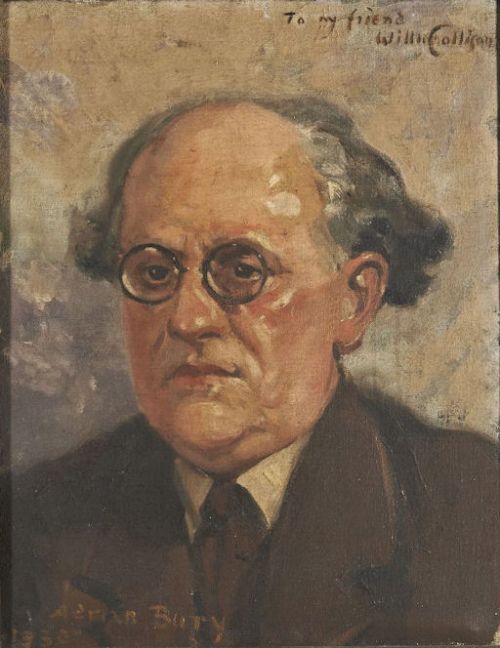
An oil portrait on canvas depicting a gentleman with round spectacles in brown tones, signed and dated by Adrian Bury.
1 / 2
Archive I An oil portrait on canvas depicting a gentleman with round spectacles in brown tones, signed and dated by Adrian Bury.

Adrian Bury 1891-1991 Portrait of William Collison 1865-1938

Archive II An oil portrait on canvas depicting a gentleman with round spectacles in brown tones, signed and dated by Adrian Bury. View II
Enlarged Archival View
Telephone 07958 699 645
Location
18 La Gare
51 Surrey Row
London
SE1 0BZ
United Kingdom
Verified Since Sep 2008
Items For Sale 243
Items Sold 223
Artware Fineart
Verified Since Sep 2008
View Dealer Info
Location: 18 La Gare , 51 Surrey Row , London , SE1 0BZ , United Kingdom
Verified
Sep 2008
For Sale
243
Sold
223
An oil portrait on canvas depicting a gentleman with round spectacles in brown tones, signed and dated by Adrian Bury.
Adrian Bury 1891-1991 Portrait of William Collison 1865-1938
Ref: SA299650
An oil portrait on canvas depicting a gentleman with round spectacles in brown tones, signed and dated by Adrian Bury.
Detail View 1
Archival Detail
Every single antique dealer on our platform is individually approved by our internal team. We verify their professional trade history, ethical standards, and photographic quality to ensure a secure, high-standard buying environment. Upon joining, every dealer agrees to a strict 9-point code of conduct. While issues can occasionally arise, our dealers typically resolve them swiftly and directly with the buyer. In fact, since our founding in 2002, Sellingantiques has only had to step in to help resolve an issue on roughly five occasions—a true testament to the quality of our dealers and their dedication to your happiness.
Our dealers are highly experienced in packing and shipping fragile, high-value antiques. Because you are in direct contact with the dealer, you will be able to easily go through all available shipping and insurance options together to ensure your item arrives safely.
Antiques are the ultimate green purchase. By choosing historical pieces over newly manufactured goods, you completely eliminate the carbon footprint of modern mass production while preserving exceptional, timeless craftsmanship.

Early 20th-century British portraiture frequently combined realistic anatomical observation with expressive brushwork influenced by Post-Impressionism. Artists focused on capturing the personality and social character of the sitter using controlled color palettes and structured lighting.

Paintings from this era were primarily executed using oil paint pigment bound with linseed oil, applied to stretched linen, cotton canvas, or wooden panels. Canvas surfaces were usually prepared with a chalk or gesso priming coat before paint application.

Authentic paintings from the 1930s often show natural surface craquelure, age-appropriate oxidation on the canvas backing, and period signatures or inscriptions. Art historical documentation, provenance research, and artist monographs also assist in verifying authenticity.

An antique portrait can be integrated into a contemporary space by mounting it on a minimalist background or pairing it with modern lighting fixtures. Placing a single vintage oil painting within a gallery wall creates contrast between historical subject matter and modern decor.

Oil paintings should be displayed away from direct sunlight, excess moisture, and extreme temperature fluctuations to prevent cracking or fading. Dust the surface gently with a dry soft brush and consult a professional conservator for cleaning or varnish restoration.
items
Add keywords to the filter
Price
£100
£250000
Era
Movements
Material
Origin
Stock Location
Freshness
Online Payments
Categories