8,892  PAGES BROWSED TODAY PAGES TODAY 36  ANTIQUES UPLOADED TODAY NEW ARRIVALS
ID #SA1027175
FOR SALE
£7,000
Email
Save
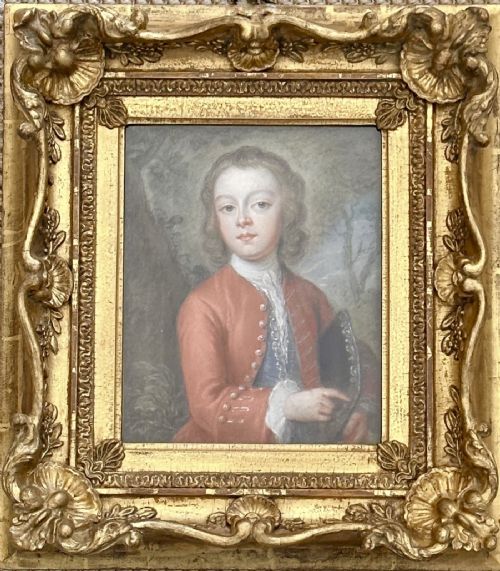
18th Century Pastel Portrait of a Young Boy in a Red Jacket, Circle of Arthur Pond (1710-1758)
Isherwood Fine Art
for sale €8,190     $8,890
£7,000
Isherwood Fine Art

Isherwood Fine Art

Sellingantiques Verified Since Oct 2023
View Dealers Stock Page
  • About Us
    16th to 19th century old master, british and european paintings and sculpture, specialising in period portraiture. Member BADA, LAPADA.
  • Trade Associations
    Isherwood Fine Art is a registered member of LAPADA  BADA 
Id #SA1027175
PDF SHARE
SAVE

18th Century Pastel Portrait of a Young Boy in a Red Jacket, Circle of Arthur Pond (1710-1758)

18th century
Description

This little jewel of a pastel of a young boy in his smart red jacket and silver trimmed waistcoat is by an artist working in the circle of Arthur Pond and dates to circa 1740. It came from a family with connections to the famous Pulteney family of Bath in Somerset.

There were many portrait artists working in pastel in Bath in the 18th century but the fine quality suggests that this work could possibly be by a pupil of Pond’s, such as the female pastellist Rhoda Delaval.

Pastel on paper under glass, in an ornate 18th century giltwood frame

Arthur Pond (1701-1758) was a painter, engraver, print-seller, dealer and collector. he was baptized on 2 August 1701 in the parish church of St Magnus the Martyr, London. He was the oldest surviving son of John Pond (d. 1749), a wealthy surgeon of London Bridge, and his wife, Mary Marshall. His artistic education may have begun under the portrait painter John Vanderbank, whose name appears near Pond's in the first subscription list of the St Martin's Lane Academy, founded in 1720. There Pond must have met William Hogarth and the painter George Knapton, probable source of a crucial introduction to Jonathan Richardson senior, portrait painter, author, and art theorist, whose books were published by John and Paul Knapton. Pond's subsequent career in the world of art, letters, and learning might be considered a realization of Richardson's visions of the learned artist, the gentlemanly connoisseur, and the revival of Italian artistic greatness in England. In 1725 Pond visited Italy in the company of the scholar Daniel Wray and John Dyer, painter and poet, and returned to England in 1727. The prestige of his Roman experience gave Pond access to important British art patrons, and his main successes occurred with pastel portraits influenced by the Venetian artist Rosalba Carriera and the Swiss Jean-Étienne Liotard. He became one of the first pastellists to become fashionable in England.

Pond was also an astute collector and dealer in old master paintings and drawings and had prints made of many these works which he then sold.

Pastels were a popular medium favoured by fashionable young female artists who sought to emulate professional portrait artists such as Pond or his colleague George Knapton. As well as providing tuition, the lessons provided Pond with an opportunity to demonstrate his skills which would open up new avenues for patronage. Pond's earliest mention of his pupil Rhoda Delaval was in February 1744 when he entered the sum of four guineas in his journal 'for Miss Delaval a month's learning'. Pond was in his early forties and Rhoda in her teens. The tuition continued until 1750, by which time Rhoda was portrait painting independently. In 1751 Rhoda married Sir Edward Astley of Melton Constable Hall in Norfolk and of 11 Downing Street in London.

Literature:

Martin Postle, 'Arthur Pond, Doddington and the patronage of the Delavals', Art and the Country House, 20 November 2020

Neil Jeffares, 'Dictionary of pastellists before 1800', online edition.

Physical Dimensions
Height
37cm (14.57")
Width
33cm (12.99")
Declaration

Isherwood Fine Art has dated this 18th Century Pastel Portrait to the 18th Century.
Reference Numbers
Sellingantiques Reference
SA1027175
Dealers Notes

Isherwood fine art

Description
This little jewel of a pastel of a young boy in his smart red jacket and silver trimmed waistcoat is by an artist working in the circle of Arthur Pond and dates to circa 1740. It came from a family with connections to the famous Pulteney family of Bath in Somerset.
fig 1. An eighteenth-century pastel portrait depiction of a young boy wearing a red coat and white cravat against an outdoor background.
fig 1. 18th Century Pastel Portrait of a Young Boy in a Red Jacket, Circle of Arthur Pond (1710-1758)

There were many portrait artists working in pastel in Bath in the 18th century but the fine quality suggests that this work could possibly be by a pupil of Pond’s, such as the female pastellist Rhoda Delaval.

Pastel on paper under glass, in an ornate 18th century giltwood frame

Arthur Pond (1701-1758) was a painter, engraver, print-seller, dealer and collector. he was baptized on 2 August 1701 in the parish church of St Magnus the Martyr, London. He was the oldest surviving son of John Pond (d. 1749), a wealthy surgeon of London Bridge, and his wife, Mary Marshall.

His artistic education may have begun under the portrait painter John Vanderbank, whose name appears near Pond's in the first subscription list of the St Martin's Lane Academy, founded in 1720.
Isherwood Fine Art

There Pond must have met William Hogarth and the painter George Knapton, probable source of a crucial introduction to Jonathan Richardson senior, portrait painter, author, and art theorist, whose books were published by John and Paul Knapton. Pond's subsequent career in the world of art, letters, and learning might be considered a realization of Richardson's visions of the learned artist, the gentlemanly connoisseur, and the revival of Italian artistic greatness in England. In 1725 Pond visited Italy in the company of the scholar Daniel Wray and John Dyer, painter and poet, and returned to England in 1727. The prestige of his Roman experience gave Pond access to important British art patrons, and his main successes occurred with pastel portraits influenced by the Venetian artist Rosalba Carriera and the Swiss Jean-Étienne Liotard. He became one of the first pastellists to become fashionable in England.

Pond was also an astute collector and dealer in old master paintings and drawings and had prints made of many these works which he then sold.

Pastels were a popular medium favoured by fashionable young female artists who sought to emulate professional portrait artists such as Pond or his colleague George Knapton. As well as providing tuition, the lessons provided Pond with an opportunity to demonstrate his skills which would open up new avenues for patronage. Pond's earliest mention of his pupil Rhoda Delaval was in February 1744 when he entered the sum of four guineas in his journal 'for Miss Delaval a month's learning'. Pond was in his early forties and Rhoda in her teens. The tuition continued until 1750, by which time Rhoda was portrait painting independently. In 1751 Rhoda married Sir Edward Astley of Melton Constable Hall in Norfolk and of 11 Downing Street in London.

Literature:

Martin Postle, 'Arthur Pond, Doddington and the patronage of the Delavals', Art and the Country House, 20 November 2020

Neil Jeffares, 'Dictionary of pastellists before 1800', online edition.

Height
37cm (14.57")
Width
33cm (12.99")
Date of Manufacture

Isherwood Fine Art has dated this 18th Century Pastel Portrait to the 18th Century.

Reference Numbers
Sellingantiques Ref
SA1027175
Isherwood Fine Art
Isherwood Fine Art
Sellingantiques verified Since Oct 2023

16th to 19th century old master, british and european paintings and sculpture, specialising in period portraiture. Member BADA, LAPADA.

Dealer Profile

You can view the stock and full dealer information on the Isherwood Fine Art Profile Page

Trade Associations

Isherwood Fine Art is a registered member of LAPADA  BADA 

PDF SHARE
SAVE
An eighteenth-century pastel portrait depiction of a young boy wearing a red coat and white cravat against an outdoor background.
1 / 2
Archive I An eighteenth-century pastel portrait depiction of a young boy wearing a red coat and white cravat against an outdoor background.

18th Century Pastel Portrait of a Young Boy in a Red Jacket, Circle of Arthur Pond (1710-1758)

Archive II An eighteenth-century pastel portrait depiction of a young boy wearing a red coat and white cravat against an outdoor background. View II
Enlarged Archival View
Telephone 07984 699799
Location
Bath and London
United Kingdom

By appointment only.
Verified Since Oct 2023
Items For Sale 43
Items Sold 32
Isherwood Fine Art
Isherwood Fine Art
Verified Since Oct 2023
View Dealer Info
Location: Bath and London, United Kingdom, , By appointment only.
Verified
Oct 2023
For Sale
43
Sold
32
An eighteenth-century pastel portrait depiction of a young boy wearing a red coat and white cravat against an outdoor background.
18th century pastel portrait of a young boy in a red jacket, Circle of Arthur Pond (1710-1758)
Ref: SA1027175
An eighteenth-century pastel portrait depiction of a young boy wearing a red coat and white cravat against an outdoor background.
Detail View 1
Archival Detail
Every single antique dealer on our platform is individually approved by our internal team. We verify their professional trade history, ethical standards, and photographic quality to ensure a secure, high-standard buying environment. Upon joining, every dealer agrees to a strict 9-point code of conduct. While issues can occasionally arise, our dealers typically resolve them swiftly and directly with the buyer. In fact, since our founding in 2002, Sellingantiques has only had to step in to help resolve an issue on roughly five occasions—a true testament to the quality of our dealers and their dedication to your happiness.
Our dealers are highly experienced in packing and shipping fragile, high-value antiques. Because you are in direct contact with the dealer, you will be able to easily go through all available shipping and insurance options together to ensure your item arrives safely.
Antiques are the ultimate green purchase. By choosing historical pieces over newly manufactured goods, you completely eliminate the carbon footprint of modern mass production while preserving exceptional, timeless craftsmanship.

During the eighteenth century, pastel portraiture gained immense popularity in Britain due to its speed of execution and luminous finish compared to traditional oil paintings. Artists utilized compressed powdered pigments to create soft, blended flesh tones and rich fabric details, predominantly depicting aristocracy and wealthy gentry.

Georgian pastels were composed of dry ground pigments mixed with chalk, clay, or gum binders, formed into sticks. These were applied directly onto specialized textured paper, vellum, or toned board, which was often mounted onto canvas stretched over a timber strainer for stability.

Authentic eighteenth-century pastels typically exhibit age-appropriate paper darkening, subtle foxing, and fine hand-drawn linework without modern dot-matrix printing patterns. Original works often retain period framing, handmade glass with air bubbles, and hand-forged hanging hardware.

A classic portrait work on paper can be mounted above a console table or incorporated into an eclectic gallery wall alongside contemporary line drawings. Pairing historical art with clean, minimalist interiors creates a striking visual contrast that anchors the space.

Pastels are extremely delicate unfixed pigments that require protection under UV-filtering glass, ideally elevated with a museum mount to prevent dust contact. The artwork must be kept in a climate-controlled environment away from direct sunlight, high humidity, and vibration.
items
Add keywords to the filter
Price
£100
£250000
Era
Movements
Material
Origin
Stock Location
Freshness
Online Payments
Categories