





Yorkshire Dales Painting
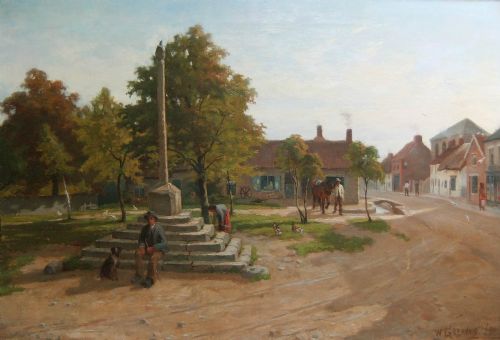
When you seek a yorkshire dales painting, you find works capturing northern river valleys, stone barns, and high moorlands across the early and mid twentieth century.
Yorkshire Dales Painting
A yorkshire dales painting typically portrays recognisable northern landmarks such as Wensleydale, Wharfedale, Swaledale, and Castle Bolton under changing moorland light.
The selections encountered here range from intimate watercolour studies on paper to robust oil paintings executed on canvas, board, and timber panels.
Most examples originate from the late Victorian era through the Edwardian period and into the mid twentieth century, reflecting a sustained regional school of landscape recording.
Materials and Technique
Artists on this page predominantly applied oil paint or watercolour pigments to paper, stretched canvas, or prepared timber boards.
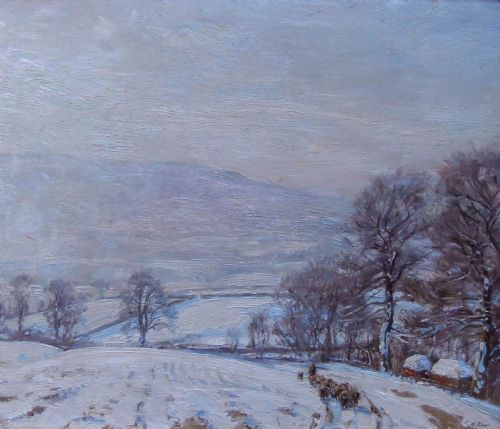
Watercolour works rely on fluid washes and precise brushwork to capture the damp atmosphere of dales rivers and winter snowfalls.
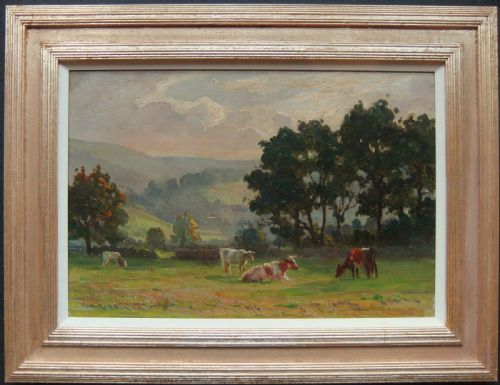
Oil paintings employ heavier impasto and layered brushstrokes, lending physical texture to depictions of stone walls, farmhouses, and hillside pastures.
The listings encompass works executed in oil paint and watercolour across paper, canvas, and timber panels.
Distinctions in Execution
Quality rests upon the artist's ability to render the specific topography and characteristic northern light of the dales rather than relying on generic pastoral formulas.
Superior works demonstrate confident handling of medium, whether capturing the transparency of a river in watercolour or the heavy atmosphere of a winter moor in oil.
William Greaves·Fred Lawson·Arthur Reginald Smith·Reginald Grange Brundrit·John Frederic Greenwood·Herbert Royle·Fred Stead·Ernest Higgins Rigg·Walter H. Allcott·Joseph Pighills·Kershaw Schofield·John Smith Atherton·Amy E. Antill·Harold Wharfe·Joseph Appleyard·Claude Horsfall·Ethel May Mallinson·William Maxwell Reekie·George Graham·James Hardaker·David R. Anderson·Arnold Denby·Frederick Dove Ogilvie·Walter Cecil Horsnell·Muriel Metcalfe
The Yorkshire Dales Painting Glossary
- Watercolour
- A painting method where fine pigment is suspended in a water-soluble binder and applied to paper. This medium suits the quick recording of changing weather across northern hills.
- Impasto
- Paint applied thickly to a canvas or board so that it stands out from the surface. This technique brings a tangible texture to foliage, stone, and clouds.
- British Impressionism
- A painting style focusing on everyday scenes and transient effects of natural light. Practitioners of this movement worked outdoors to capture immediate atmospheric conditions.
- Panel
- A rigid support for painting, commonly made of timber or prepared board rather than fabric. Many regional artists favoured wooden panels for smaller plein air landscape studies.
Yorkshire Dales Painting: Frequently Asked Questions
What periods do these paintings date from?
The works recorded here span from the late nineteenth century through the Edwardian era, the interwar years, and into the nineteen-fifties.
This timeline illustrates a continuous tradition of regional artists turning their attention to the Yorkshire landscape across several decades.
Are these works original or prints?
Every piece featured is an original painting executed by hand, utilising oil or watercolour on supports such as paper, canvas, or timber.
These are unique historical artworks rather than modern reproductions or printed editions.
How do watercolours and oils differ here?
Watercolour pieces utilise paper supports to achieve translucent effects, often capturing lighter atmospheric conditions like snow or mist.
Oil paintings employ canvas or wood panels, allowing for thicker pigment application and deeper tonal contrasts suited to heavy skies and rolling pastures.
Which locations are most commonly depicted?
Artists frequently returned to specific northern valleys and landmarks, notably Wensleydale, Wharfedale, Swaledale, and Bolton Castle.
Views often incorporate local stone bridges, remote farmhouses, and familiar river bends along the Whare and Swale.