


Vintage Agricultural Painting
These pieces celebrate rural labour and livestock, bringing the grounded rhythm of the countryside directly into your interior.
Vintage Agricultural Painting
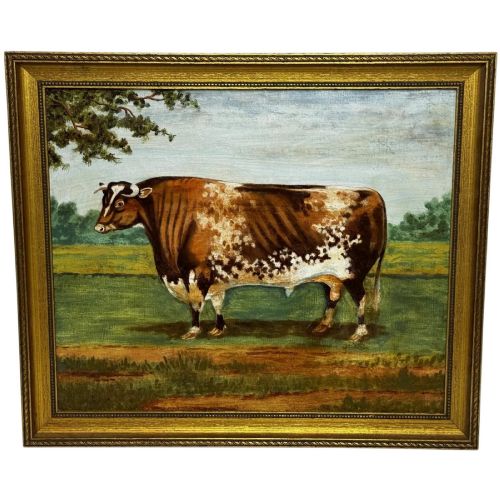
A vintage agricultural painting captures the traditional rhythms of farming life, depicting heavy horses, harvesting scenes, and prize livestock in rural landscapes. When exploring this selection, buyers frequently encounter works framed by the Victorian era through to the mid-twentieth century, embracing styles from British Impressionism to Victorian Realism.
The subjects range from quiet equine portraits in ploughing fields to bustling harvest scenes and detailed studies of shorthorn bulls. These canvases and watercolours record a disappearing rural heritage, created by artists working within the British School and regional traditions.
Materials and methods
Artists relied primarily on oil paint applied to canvas or wood panels, alongside delicate watercolours on paper. These traditional mediums allowed painters to capture the shifting light of rural fields, whether through the heavy impasto of an oil landscape or the translucent washes of a watercolour sketch.
Framing forms an integral part of these works, utilising ebonised timber, gilt mouldings, and burr wood frames that complement the earthy palettes of the scenes within. The physical support often includes hand-stretched canvas or heavy card, typical of studio practices from the nineteenth and early twentieth centuries.
Listings span from the nineteenth century through the 1960s, uniting canvas, paper, and wood supports in traditional rural styles.
Assessing quality in rural art
Quality rests upon the artist's command of light, anatomical precision in depicting animals, and the atmospheric depth of the landscape. Superior works demonstrate a confident handling of brushwork that brings movement to a hay cart or weight to a shire horse, avoiding stiff or formulaic composition.
The integrity of the original canvas, the preservation of the pigment without excessive restoration, and the appropriateness of the period frame elevate certain pieces above standard decorative works. Hand-signed signatures and documented provenance further distinguish the finest examples.
James William Booth·Herbert Royle·George Soper·William Sidney Cooper·Ernest Higgins Rigg
The Vintage Agricultural Painting Glossary
- British Impressionism
- A style of painting focusing on light and loose brushwork, often capturing outdoor rural scenes. This movement influenced many early twentieth-century painters of agricultural life.
- Oil on Canvas
- Pigment mixed with drying oil applied to a woven fabric stretched across a wooden frame. This durable medium allows for rich colour depth and textured application.
- Watercolour
- A painting method where fine pigment is suspended in a water-based solution, typically applied to paper. It yields luminous, transparent washes suited to atmospheric landscapes.
- Victorian Realism
- An artistic approach emphasising accurate, unidealised depictions of everyday subjects and rural workers. It forms the foundation for many nineteenth-century farmyard scenes.
- Ebonised Frame
- Timber treated with a dark finish to resemble ebony, providing a stark, elegant border. These frames frequently enclose mid-century and nineteenth-century canvases.
Vintage Agricultural Painting: Frequently Asked Questions
What subjects feature in a vintage agricultural painting?
These works focus primarily on rural labour, featuring haymaking scenes, ploughing horses, and prize shorthorn cattle in pastoral landscapes.
Artists aimed to record the daily realities of farming life, capturing horses, farm hands, and seasonal harvests across the British countryside.
How do I date a vintage agricultural painting?
Dating relies on stylistic clues, clothing of the figures, framing materials, and signatures that link to known active periods of the artists.
Victorian works tend to show formal realism, while twentieth-century pieces often adopt looser brushwork characteristic of British Impressionism.
Are these paintings executed in oil or watercolour?
Both mediums appear frequently, with artists choosing oil paint on canvas for textured durability and watercolour on paper for lighter atmospheric studies.
Larger landscapes often use oil, whereas detailed rural studies and intimate field sketches are typically rendered in watercolour.
How should I display a vintage agricultural painting?
These pieces suit traditional or transitional interiors, hanging well against panelled walls or neutral plaster where their earthy tones can ground the room.
Direct sunlight should be avoided to protect both the painted pigments and the period wood or gilt frames from fading.