
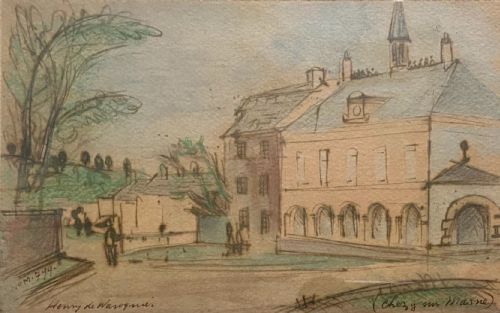


Paper Ink Landscape Painting
These paper ink landscape painting examples capture topography and atmosphere through delicate wash and draughtsmanship, offering an intimate connection to historic terrain.
Paper Ink Landscape Painting
A paper ink landscape painting brings together linear precision and fluid tonal work on a portable support, recording rural scenes, townscapes, and natural vistas. When searching for paper ink landscape painting, collectors encounter original works ranging from Georgian topographical views to mid-twentieth-century British and French compositions.
The selections span distinct creative traditions, including works on paper presented individually or gathered within bound albums bearing artist seals. Regional English scenes, French rural views, and mountain lakes dominate the formats found in this collection.
Dating stretches from the eighteenth century through the 1960s, capturing shifting attitudes toward landscape representation across British, French, and American hands.
Quality and Execution
Distinction across these works lies in the sureness of the draughtsmanship and the control of tone within the ink and wash. Superior examples demonstrate a confident economy of line that defines architectural detail or foliage without heavy correction.
The interaction between ink outlines and translucent watercolour determines visual balance, separating hurried sketches from fully resolved compositional statements.
Listings incorporate works from 1850 and earlier Georgian periods alongside mid-century 1960 creations, utilising paper, ink, wash, and wood.
Henry de Waroquier·Stanley Orchart·Edward Dayes·YA MING·Fred Lawson·Thomas Rowlandson·Thomas Lound
The Paper Ink Landscape Painting Glossary
- Wash
- A diluted layer of ink or watercolour applied evenly across paper to create transparent shadows or tonal backgrounds. This technique establishes atmospheric distance in landscape compositions.
- Topographical
- Representing specific real-world locations with a focus on accurate geographical and architectural detail. Many eighteenth and nineteenth-century works served this descriptive function.
- Album
- A bound collection of drawings or paintings compiled by the artist or an early owner. These books often preserve related studies or travel sketches in uniform presentation.
- Sepia
- A brownish pigment originally derived from the ink sac of the cuttlefish, widely used for monochrome drawing and wash during the Georgian era.
- Mixed media
- The combination of two or more artistic materials, such as ink, watercolour, and crayon, within a single work on paper.
Paper Ink Landscape Painting: Frequently Asked Questions
How should I frame a paper ink landscape painting?
Works on paper require conservation mounting with acid-free materials to prevent discolouration over time. Glazing protects the delicate watercolour and ink pigments from airborne pollutants and ultraviolet light.
Keeping the paper separated from the glass by a mat or spacer ensures moisture cannot cause the medium to adhere to the surface.
What periods do these landscape paintings cover?
The available selection spans from the Georgian era and the eighteenth century through nineteenth-century Victorian examples, extending into mid-twentieth-century British, French, and American modernism.
Earlier pieces often focus on topographical accuracy, while later twentieth-century works lean towards expressive interpretations of light and atmosphere.
How do ink and wash techniques differ from pure watercolour?
Ink and wash relies on linear definition provided by pen work, supplemented by monochromatic or subtle colour washes to denote shadow and form. Pure watercolour prioritises brush-applied pigment and water to build both structure and colour simultaneously.
Many pieces in this category combine both approaches, using ink lines to anchor the composition before applying fluid washes.
Where were these landscape scenes usually created?
Artists produced these works both on location as direct observations of nature and back in the studio from preliminary field sketches. Regional British views, French rural landscapes, and alpine settings frequently served as primary subjects.
Travel albums compiled by artists often document journeys across specific European counties and provinces.