
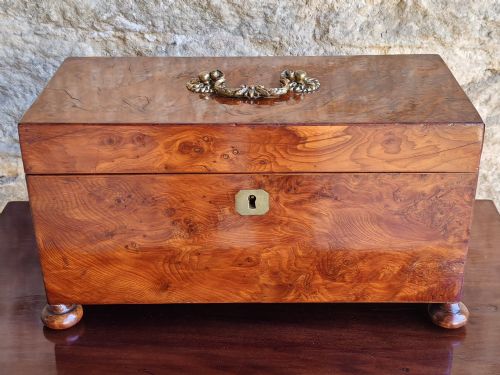
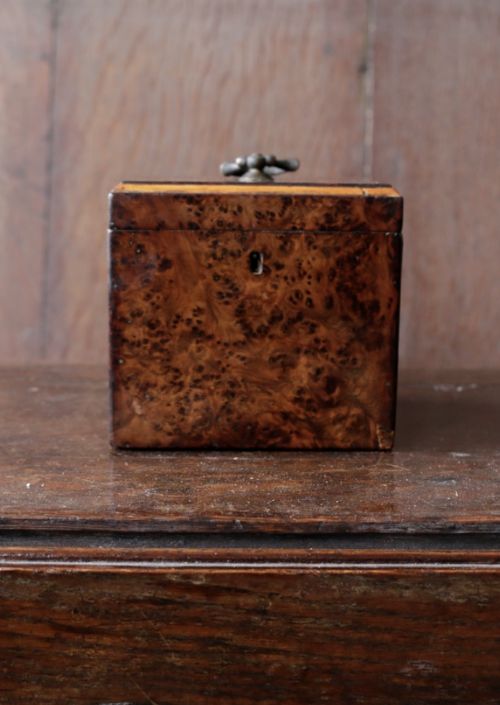


Yew Wood Tea Caddy
A yew wood tea caddy is a compact wooden container made to store dry tea leaves, prized for its distinctive figured grain.
Yew Wood Tea Caddy
When you search for a yew wood tea caddy, you are looking at small domestic boxes fashioned during the eighteenth and nineteenth centuries. These vessels held expensive loose tea leaves under lock and key in Georgian and Regency parlours.
You will most commonly meet rectangular, cube, octagonal, or hexagonal boxes alongside larger tea chests and teapoys. Many examples combine straight-grained yew with highly figured burr yew panels.
The surviving pieces bridge the Georgian and Regency periods, showing how cabinet makers utilised native timber for decorative storage.
How they were made
Cabinet makers built these caddies using timber such as yew wood and burr yew, frequently applying contrasting stringing in ebony and boxwood. They shaped the timber into geometric forms including cubes, octagons, and semi-circular boxes.
Surviving examples incorporate brass hinges, escutcheons, and internal fittings of bone or glass, demonstrating disciplined joinery. The exterior surfaces rely entirely upon the natural swirls and knots of the burr timber rather than painted decoration.
Geometric forms dominate the record, featuring rectangular, cube, octagonal, hexagonal, and semi-circular box shapes.
What varies in quality
The quality of a yew wood tea caddy rests in the selection and book-matching of the burr grain across its faces. Boxes with tightly swirled, evenly matched timber display a superior visual depth.
Construction precision also divides standard work from the finest pieces, seen in crisp stringing inlay, tight mitred joints, and the retention of original interior fittings like canisters and glass bowls.
The Yew Wood Tea Caddy Glossary
- Burr Yew
- A growth deformity in a yew tree that produces highly figured, knotty wood. It is sliced into veneers to cover box surfaces.
- Teapoy
- A larger tea storage chest mounted on a central pillar or legs. These stand on the floor rather than resting on a table.
- Escutcheon
- A small protective brass plate surrounding the keyhole. It prevents the wood from splitting around the lock.
- Stringing
- Thin lines of contrasting wood inlay used to outline panels. Boxwood and ebony provide the light and dark accents.
- Canister
- A fitted interior container for holding leaf tea. Some boxes retain original vessels made from metal or wood.
Yew Wood Tea Caddy: Frequently Asked Questions
How were tea caddies used?
Tea was an expensive commodity in the Georgian period, kept locked away by the lady of the house. Servants brought the caddy to the parlour for tea preparation.
Leaf tea went into internal canisters while sugar was broken from a loaf and stored in a glass bowl.
How do I spot a Georgian caddy?
Georgian pieces display restrained proportions, often utilising straight lines, octagonal shapes, or delicate stringing inlay. The construction relies on solid timber framing and simple brass hardware.
Later Regency examples introduce bolder forms like cubes and sarcophagus shapes with more pronounced burr veneers.
Can I use these for modern tea?
These boxes function well for storing bagged or loose tea if the interior compartments remain clean and dry. Many owners repurpose them to hold jewellery or small keepsakes.
Care should be taken to protect the antique wood and interior linings from moisture.
What is a teapoy?
A teapoy is a floor-standing tea chest, distinct from a tabletop caddy. They often feature a lidded compartment atop a pedestal base.
Some examples include internal mixing bowls alongside compartments for green and black tea.