

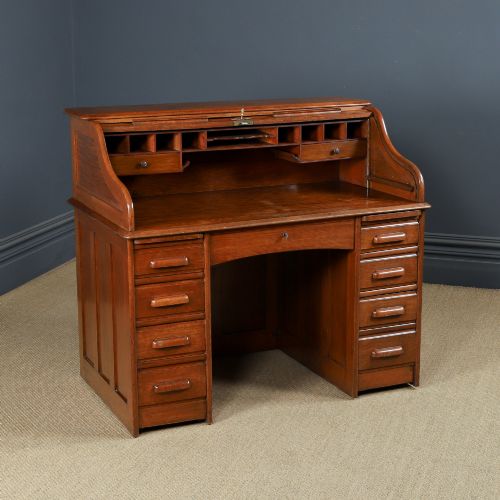
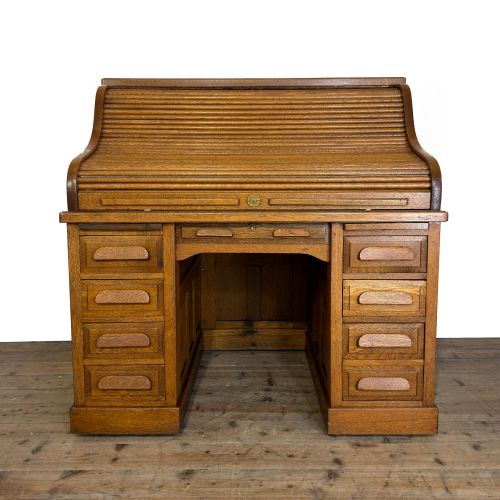
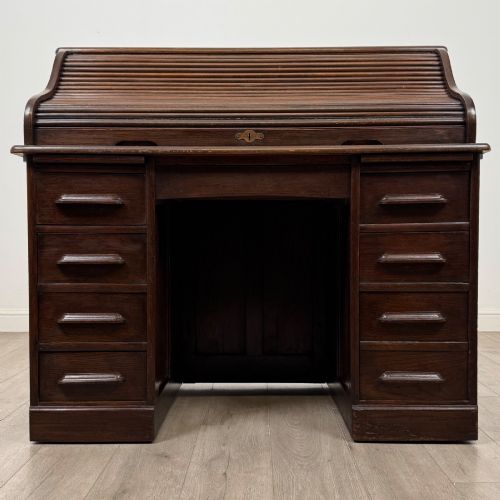
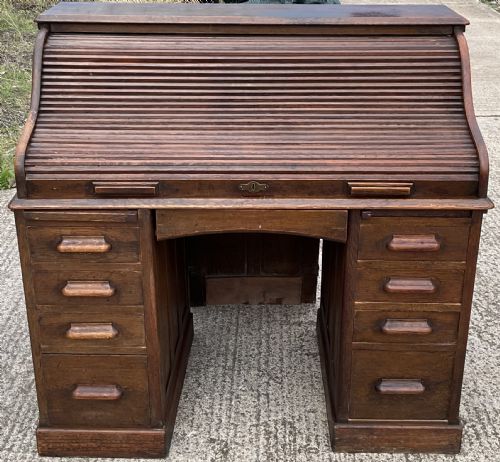

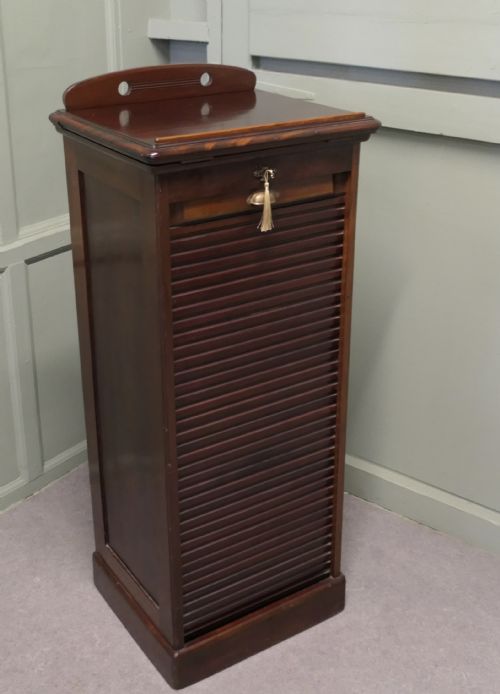


Wooden Tambour Office Desk
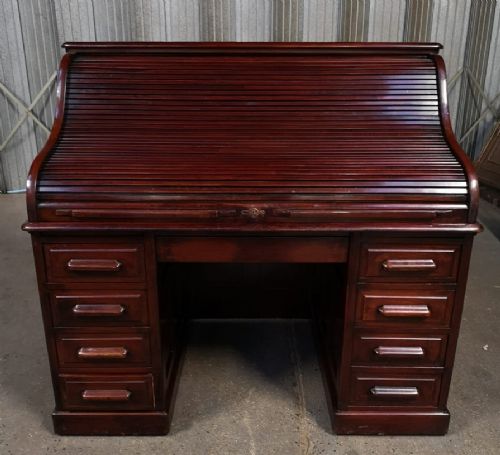
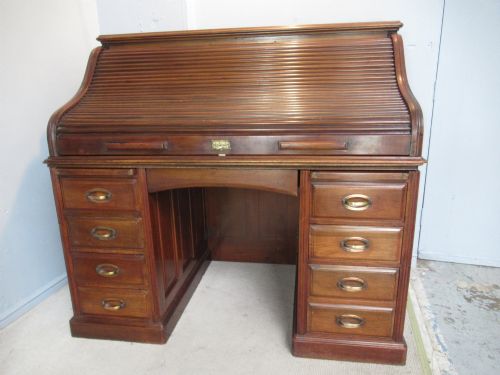
These wooden tambour office desks offer clever slatted closures and deep pedestals, giving a working workspace that hides away cleanly.
Wooden Tambour Office Desk
A wooden tambour office desk brings together deep pedestal banks and flexible slatted shutters that slide down to secure the workspace. Buyers searching this phrase meet sturdy Edwardian and Victorian pieces designed for heavy administrative work.
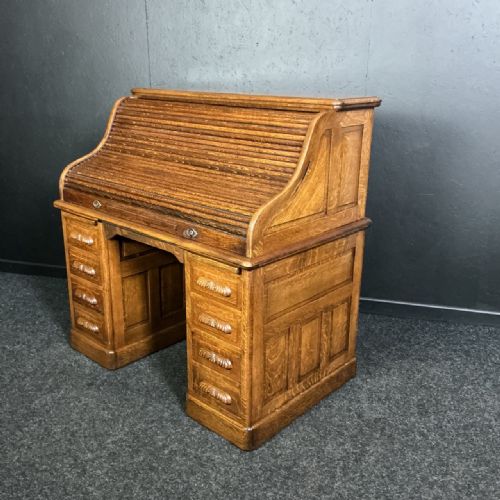
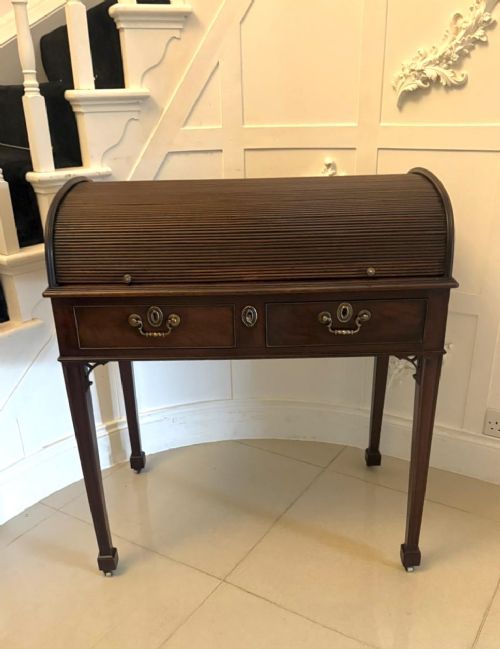
The form appears most frequently in panelled oak and mahogany, often arranged as a large pedestal or cylinder desk. These units provide numerous small drawers and pigeonholes behind the rolling tambour curtain.
Originating in the nineteenth and early twentieth centuries, these writing tables served as private workstations in professional offices and homes. The listings here span from late Georgian cylinder variants to robust Edwardian roll-top formats.
How they were made
Makers constructed the flexible tambour shutters by gluing narrow strips of wood onto a sturdy canvas or fabric backing. This allowed the wooden curtain to curve smoothly around tracks built into the desk carcass.
Solid timber such as oak and mahogany formed the primary structural carcases, while brass fittings reinforced the keyholes and drawer pulls. Interiors often featured secondary woods for drawer linings and pigeonhole dividers.
Wooden Tambour Office Desk Retail Price Guide 2026
Typical asking prices for wooden tambour office desk among the pieces listed under this phrase on Sellingantiques today, from the lower quarter to the upper quarter. They describe what is for sale here now, not the wider market.
Listings feature solid oak and mahogany across Edwardian and Victorian periods, alongside specialised filing cabinets.
What varies in quality
The smooth operation of the slatted shutter marks a primary distinction between standard utility items and superior workshop output. A well-fitted tambour glides evenly along its tracks without catching or sagging.
Timber selection and panel construction determine the overall substance of the piece, with solid oak and figured mahogany sitting above simpler variants. The complexity of the internal pigeonhole arrangement and the presence of pull-out writing slides also alter the character of the desk.
The Wooden Tambour Office Desk Glossary
- Tambour
- A flexible shutter made from narrow strips of wood glued to canvas, allowing it to slide around a curved track. This mechanism conceals the desk surface when closed.
- Pedestal desk
- A heavy table form featuring two banks of drawers supporting the main writing surface. These units often split into sections for easier moving.
- Cylinder desk
- A piece featuring a quarter-cylinder rolling lid that covers the writing slide and interior fittings. Georgian and Victorian makers often used mahogany for these refined forms.
- Pigeonhole
- A small vertical compartment fitted inside the desk superstructure for sorting correspondence and papers. These sections remain hidden behind the closed tambour front.
Wooden Tambour Office Desk: Frequently Asked Questions
How do tambour shutters work?
The shutter consists of wooden laths fixed to a flexible fabric backing. This allows the curtain to bend around a curved channel within the desk frame.
When pushed, the slats slide away behind the writing surface or down into the body of the desk to reveal the interior compartments.
What wood was mostly used?
Oak and mahogany appear most frequently across these pieces, reflecting the standard timber choices of Victorian and Edwardian cabinetmakers. Solid oak versions often display pronounced grain patterns and panelled sides.
Mahogany was frequently selected for finer cylinder desks and late Victorian office furniture.
How do I care for the surface?
Keep the wood away from direct heat sources and strong sunlight to prevent the timber from drying out or warping. Regular dusting with a dry cloth maintains the finish.
Apply a traditional beeswax occasionally to nourish the wood and protect the polish without building up residue.
Are these desks easy to move?
Most pedestal forms separate into multiple parts, including the two drawer pedestals, the top writing section, and the tambour superstructure. This modular construction helps when transporting heavy timber items.
Larger solid oak units require multiple people to lift due to their substantial weight and dense construction.