
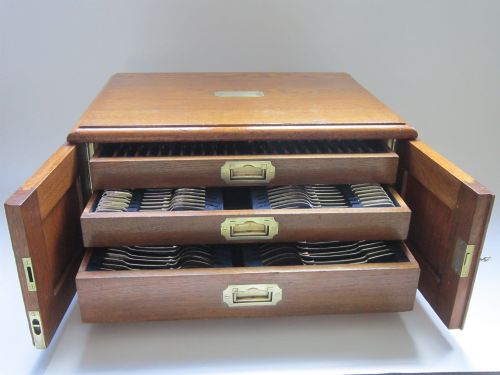


Wooden Silver Storage Chest
A wooden silver storage chest is a robust box built to protect precious tableware during travel and estate storage.
Wooden Silver Storage Chest
A wooden silver storage chest encompasses heavy utilitarian trunks and fitted domestic boxes designed to safeguard flatware and valuables. The pieces found on this page span the Georgian, Victorian, and Edwardian periods, reflecting the shifting demands of household security and travel.
The most common examples are oak trunks reinforced with iron or steel bands, alongside mahogany and walnut cases. These heavy storage chests often feature fitted interior trays designed to hold silver cutlery or tea services.
Smaller tabletop vessels such as tea caddies and workboxes also appear, constructed from exotic woods like burr maple, tortoiseshell, and rosewood. These smaller pieces offer compartmentalised storage for domestic treasures rather than bulk travel protection.
Materials and construction
Construction relies heavily on durable hardwoods like oak and mahogany, selected for structural strength. Metal reinforcement in the form of iron or steel banding, alongside brass handles and locks, protects corners and secures heavy lids during transit.
Interiors are typically lined with textiles such as velvet to cushion silver contents against friction and tarnish. Cabinetmakers utilised dovetail joints for stability in fine caddies, while heavy iron straps on shipping trunks were secured with robust fixings.
Listings span from the mid-eighteenth century through the Edwardian era, featuring oak, mahogany, tortoiseshell, and iron.
Quality markers
Quality rests upon the choice of timber and the integrity of the original hardware. Superior examples display dense, well-figured oak or mahogany, paired with heavy forged iron or cast brass mounts that show purposeful smithing rather than decorative simulation.
Internal arrangement dictates utility and grade, with bespoke fitted tiers and original velvet linings marking out superior pieces. The precision of the joinery and the survival of functioning locks and handles distinguish utilitarian transit boxes from finer country house vessels.
Walker & Hall·Parkins and Gotto
The Wooden Silver Storage Chest Glossary
- Cutlery canteen
- A fitted box or chest designed specifically to hold a set of matching flatware. These compartments prevent the silver from scratching during storage.
- Campaign chest
- Portable furniture built for travel, featuring recessed brass handles and reinforced corners to withstand rough transit. These pieces were constructed for mobility.
- Fiddle pattern
- A traditional cutlery handle shape featuring a narrow stem that broadens at the end into a flattened shoulder resembling a fiddle. This design appears frequently in Victorian canteens.
- Tea caddy
- A small vessel designed to store dry tea leaves securely, often featuring internal lidded compartments to separate different varieties. These boxes were frequently lined with foil or paper.
- Silver strung
- Inlaid thin lines of contrasting wood or metal around the edges of a box to create a decorative border. This technique highlights the geometric form of the case.
Wooden Silver Storage Chest: Frequently Asked Questions
What is a silver chest?
A silver chest is a heavy wooden box reinforced with metal bands, built to store and transport valuable tableware securely. They were utilised in large households and on ships.
These containers feature sturdy handles and internal trays designed to organise flatware and prevent damage during movement.
How do I date an oak chest?
Dating relies on construction methods, timber choice, and the style of the metal hardware. Earlier pieces from the eighteenth century display hand-cut joinery and simpler forged iron fittings.
Victorian and Edwardian examples often incorporate mass-produced steel bands, campaign handles, and fitted internal partitions designed for specific flatware sets.
Were these chests used for travel?
Many heavy oak and iron-bound chests functioned as shipping trunks or campaign luggage for estate owners. Their robust construction protected valuable silver collections during transit.
Other lighter boxes remained stationary in dining rooms and country houses, serving as permanent storage for domestic silver.
What woods were used for caddies?
Tabletop caddies and smaller boxes utilise decorative timbers such as mahogany, burr maple, walnut, and rosewood. Some examples incorporate tortoiseshell and mother-of-pearl inlay.
These ornamental materials suited domestic settings where appearance mattered more than heavy structural protection.