

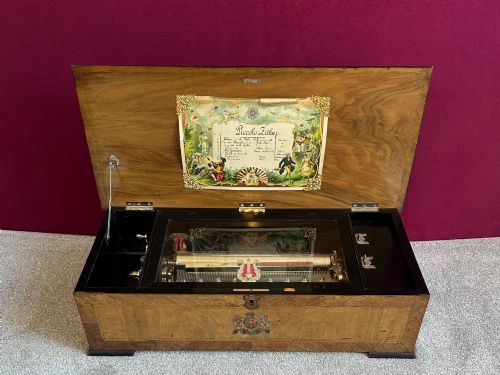


Wooden Cylinder Music Box
A wooden cylinder music box brings the mechanical magic of the nineteenth century into a room with every turn of its brass pin.
Wooden Cylinder Music Box
A wooden cylinder music box represents a pinnacle of Victorian and nineteenth century mechanical ingenuity, housed in finely constructed wooden cases. When searching for a wooden cylinder music box, buyers encounter examples originating primarily from Swiss workshops alongside domestic Victorian pieces.
The most common form on this page is the Victorian Swiss musical box, often featuring marquetry inlay and multiple airs played upon tuned steel teeth. These items combine acoustic performance with cabinetry, utilising timber cases to resonate the melodies produced by rotating pinned cylinders.
How they were made
Cases utilise dense hardwoods including rosewood, walnut, and ebonised wood, frequently decorated with boxwood and marquetry inlay to create geometric or floral patterns on the exterior lid. Glass internal lids often protect the precision mechanics while allowing the movement to remain visible during play.
The internal mechanism relies on brass cylinders set with tiny steel pins that pluck tuned steel combs to produce sound. Some variants incorporate brass bells in view, requiring careful synchronisation between the revolving cylinder and the percussion components.
Wooden Cylinder Music Box Retail Price Guide 2026
Typical asking prices for wooden cylinder music box among the pieces listed under this phrase on Sellingantiques today, from the lower quarter to the upper quarter. They describe what is for sale here now, not the wider market.
Some boxes hide tiny brass bells that ring out merrily alongside the steel comb while you watch the cylinder turn.
What varies in quality
The distinction between ordinary and superior pieces rests on the complexity of the pinned cylinder and the number of airs it can play. Boxes with multiple airs, additional components like bells, and works by notable makers demonstrate higher levels of mechanical precision.
Cabinetry execution dictates much of the visual appeal, where crisp marquetry inlay and well-preserved rosewood or walnut grain distinguish finer boxes. The clarity and resonance of the sound produced by the steel comb and brass pins ultimately separate standard musical boxes from exceptional ones.
Langdorff And Fils·Nicole Freres·B A Bremond
The Wooden Cylinder Music Box Glossary
- Cylinder
- The rotating brass barrel set with precise steel pins that determine the notes of the tune. It turns against the comb to create the music.
- Air
- A distinct musical tune or melody programmed onto the revolving cylinder. Boxes are often categorized by the total number of airs they can play.
- Comb
- The tuned plate of steel with individual teeth plucked by the pins on the cylinder. Its condition and material directly govern the tonal quality.
- Marquetry inlay
- Decorative woodwork created by fitting contrasting veneers into timber surfaces. This technique frequently adorns the lids of Victorian cases.
- Bells
- Tuned percussion elements mounted inside select musical boxes to accompany the steel comb. They are often visible beneath protective glass covers.
Wooden Cylinder Music Box: Frequently Asked Questions
How do cylinder music boxes work?
A wound spring turns a pinned brass cylinder, causing the protruding pins to strike the tuned teeth of a steel comb in a precise sequence.
This mechanical rotation translates physical pins into audible melodies, often playing multiple distinct airs before the cylinder repeats its cycle.
What is an air on a music box?
An air refers to an individual musical tune or song programmed onto the revolving brass cylinder by the arrangement of its pins.
Boxes listed on this page range from standard selections up to twelve airs or more, increasing the variety of music played during a single winding.
How should I care for a wooden music box?
Keep the wooden case away from direct sunlight and fluctuating humidity to protect the delicate rosewood, walnut, and marquetry veneers from cracking.
Wind the spring mechanism gently and avoid forcing the stop or change levers, allowing the internal brass and steel components to operate naturally.
How do I identify a Victorian music box?
Victorian musical boxes are typically identified by nineteenth-century construction traits, including rosewood or walnut cases, hand-crank or key-wound mechanisms, and Swiss movements.
Many examples feature decorative marquetry inlay on the exterior and informative labels or serial numbers relating to the workshop of origin.