

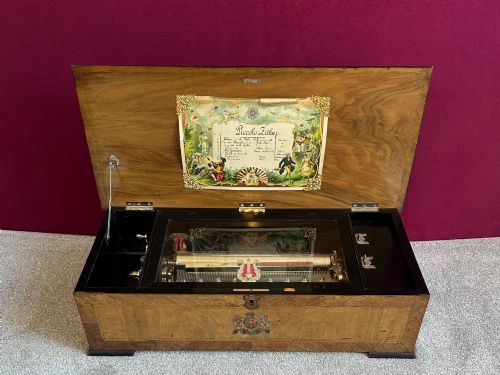


Walnut Music Box
A walnut music box brings mechanical melody into the room, combining rich timber cases with intricate brass and steel works.
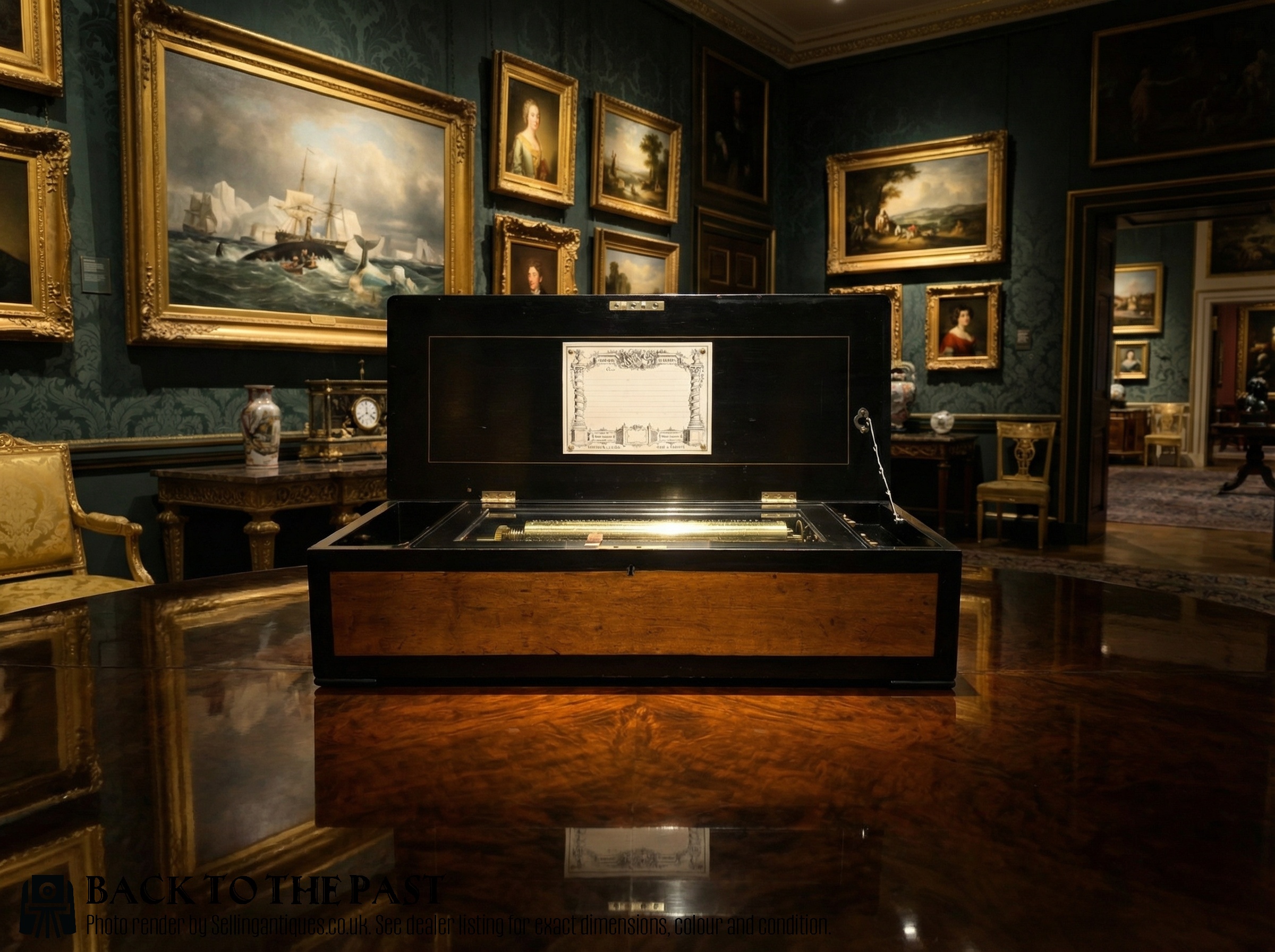
Walnut Music Box
A walnut music box is a mechanical instrument housed in a timber enclosure, most commonly appearing as a Victorian or Edwardian cylinder box with marquetry inlay or a later disc-playing cabinet.
The selection ranges from traditional Swiss cylinder movements playing multiple airs to larger disc-playing boxes by makers such as Polyphon and Symphonium, alongside occasional related seat furniture and cabinets.
Victorian examples dominate the selection, spanning decades from the mid-nineteenth century onwards, often featuring intricate boxwood stringing or pictorial marquetry on the lid.
How they were made
Cases combine walnut and burr walnut veneers over secondary timbers, frequently decorated with contrasting boxwood and ebonised wood marquetry inlay.
Internal mechanisms rely on precision steel combs tuned to specific notes, driven by brass cylinders set with pins or interchangeable metal discs.
Walnut Music Box Retail Price Guide 2026
Typical asking prices for walnut music box among the pieces listed under this phrase on Sellingantiques today, from the lower quarter to the upper quarter. They describe what is for sale here now, not the wider market.
Some musical boxes doubled as novelty sewing companions or miniature pianos, hiding tunes inside unexpected domestic furniture.
What varies in quality
Quality depends upon the complexity of the musical movement, measured in the number of airs played and the precision of the brass cylinder or disc mechanism.
Cabinetwork distinguishes finer pieces, where book-matched burr walnut veneer, crisp marquetry, and original interior glazing or transfer panels elevate the visual presence.
Langdorff And Fils·B A Bremond·Nicole Freres·Lochmanns
The Walnut Music Box Glossary
- Cylinder
- A rotating brass barrel set with tiny pins that pluck the teeth of a steel comb to produce melody. It forms the core of traditional Swiss musical boxes.
- Comb
- A flat piece of tuned steel with multiple teeth that vibrate when struck by pins or stars. The graduation of the teeth determines the musical scale.
- Air
- A distinct musical tune or movement played by the mechanism. Boxes are often categorized by the total number of airs they can perform.
- Marquetry
- Decorative veneer work using contrasting wood types to create pictorial scenes or geometric patterns on the lid. This technique is typical of Victorian walnut cases.
- Polyphon
- A brand of mechanical disc player that uses perforated metal discs rather than pinned cylinders to produce sound. These table-top or cabinet instruments appeared towards the end of the nineteenth century.
Walnut Music Box: Frequently Asked Questions
How do I operate a cylinder music box?
Wind the internal spring mechanism gently using the attached crank or key, then release the lever to start the cylinder rotation.
Ensure the mechanism finishes playing its current tune before engaging the stop lever to prevent jamming the comb teeth.
Can I play different tunes on a cylinder box?
The pinned brass cylinder is fixed to play a specific sequence of airs, typically six or twelve tunes.
Changing the repertoire requires a completely different cylinder, whereas disc boxes allow easy swapping of flat metal plates.
Where should I place a music box in my home?
Position the box on a stable, level surface away from direct sunlight and strong temperature fluctuations to protect the walnut veneer and internal glue.
Dry interior conditions prevent warping of the timber case and corrosion on the delicate steel comb.
How do I distinguish a Victorian box from an Edwardian one?
Victorian examples frequently display elaborate marquetry inlay and Swiss cylinder movements housed in figured walnut.
Edwardian pieces often take the form of larger cabinets or incorporate disc-playing mechanisms with transfer-printed door panels.