
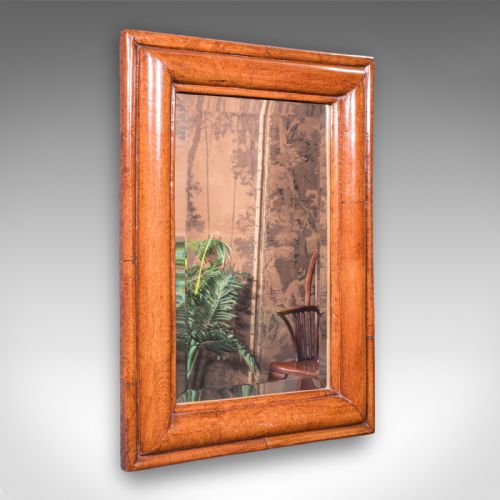


Wooden Cushion Frame Mirror
A wooden cushion frame mirror offers deep, swelling profiles that catch the light from every angle, bringing rich warmth and tactile depth to any room.
Wooden Cushion Frame Mirror
A wooden cushion frame mirror presents a distinct swelling, convex moulding that pushes outward from the wall toward the glass plate. Buyers searching for a wooden cushion frame mirror encounter wall mirrors and overmantel mirrors spanning several centuries of craftsmanship.
The selection ranges from early examples utilising oyster veneer to later interpretations in burr walnut, burr maple, rosewood, and scrubbed oak. Regional variations include English, French, and Italian origins, demonstrating diverse decorative traditions.
Most examples originate from the Georgian, Regency, and 19th century periods, alongside select Edwardian and 17th-century pieces. These items function primarily as wall hangings or substantial overmantel fixtures designed to anchor a room's interior scheme.
How they were made
Cabinetmakers constructed the pronounced profile by building up timber foundations before applying fine veneers such as walnut, burr maple, and oyster cut sections. These veneers were carefully arranged to display the natural grain patterns of the wood across the sweeping convex surfaces.
Alternative finishes include carved wood and gesso, painted surfaces, ebonised details, and giltwood highlights. Silvered mirror glass was then fitted into the rebate, often secured behind deep bevelled edges or held with traditional backing methods.
Early branchwood slices reveal tree rings that have quietly witnessed centuries of domestic life from their spot on the wall.
What varies in quality
The choice of timber veneer dictates the visual impact, with figured burr timbers and uniform oyster cuts representing higher levels of artisanal selection. The execution of the mitred corners and the smoothness of the cushion sweep reveal the skill of the maker.
Originality of the glass plate and the integrity of the underlying wooden frame contribute significantly to the character of each piece. Surface patination, whether from old polish or distressed painted finishes, determines the depth of historical authenticity.
The Wooden Cushion Frame Mirror Glossary
- Cushion frame
- A convex, rounded frame moulding that swells outward from the wall, resembling a soft cushion. This distinctive profile creates strong plays of light and shadow.
- Oyster veneer
- Circular or oval cross-sections of small branches sliced across the grain to resemble oyster shells. Cabinetmakers arranged these patterns tightly across seventeenth-century surfaces.
- Burr walnut
- A figured wood grain obtained from growths on walnut trees, prized for its swirling, organic patterns. It frequently appears on high-status veneered furniture and frames.
- Gesso
- A plaster-like mixture applied to wood as a base for painting or gilding. It provides a smooth surface for intricate carved details.
- Overmantel mirror
- A large mirror specifically designed to hang above a fireplace mantelpiece. These pieces often feature horizontal proportions to complement the fireplace surround.
Wooden Cushion Frame Mirror: Frequently Asked Questions
Where should I hang a cushion mirror?
These pieces suit entrance hallways, living rooms, and above fireplaces where their sculptural frames can catch ambient light.
Ensure the wall structure can support the weight of solid timber and glass constructions.
How do I identify a 17th-century cushion mirror?
Look for oyster veneers, early pine or oak carcases, and hand-bevelled glass plates secured with old fixings.
Construction details on the reverse often reveal historic joinery methods distinct from later nineteenth-century manufacturing.
Are these mirrors heavy?
Solid wood frames combined with thick mirror glass create substantial weight that requires secure wall fixings.
Professional installation using appropriate wall anchors ensures the piece hangs safely.
What is burr maple?
Burr maple is a highly figured hardwood timber featuring swirling, knotty grain formations.
Cabinetmakers utilised it on luxury surfaces to create striking visual texture.