


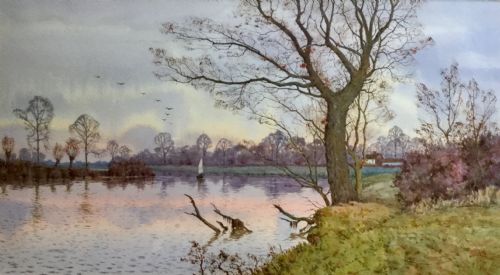


Winter Landscape Watercolour
A winter landscape watercolour captures snow, ice and frost through fluid pigment on paper, offering subtle atmosphere and quiet seasonal charm.
Winter Landscape Watercolour
A winter landscape watercolour presents scenes of snow, bare trees and frost through the medium of water-based pigment on paper. These paintings range from nineteenth-century views to mid-century modernist interpretations.
The works appear in various forms, including framed paintings and original art, often created during the Edwardian period or the early twentieth century. Common subjects include Yorkshire dales, snowy farmsteads and rural twilight scenes.
British Impressionism and Scottish Impressionist styles frequently emerge among the listings, showing how artists captured cold light and muted seasonal tones. Many pieces arrive framed under glass, preserving the delicate paper surfaces.
Materials and technique
Artists painted these scenes using watercolour pigment and gouache applied directly to paper. Gouache provided opaque highlights for snow and frost, contrasting with translucent washes for winter skies.
Paper serves as the primary support, occasionally supplemented by pastel to add texture to snow-covered ground. The works rely on the natural white of the paper to render light through thin layers of pigment.
Framing typically involves wood and glass to protect the absorbent paper and water-soluble pigments from moisture and environmental damage over time.
Winter Landscape Watercolour Retail Price Guide 2026
Typical asking prices for winter landscape watercolour among the pieces listed under this phrase on Sellingantiques today, from the lower quarter to the upper quarter. They describe what is for sale here now, not the wider market.
Several winter scenes feature resilient farmers and their dogs braving snowy Yorkshire dales.
Evaluating quality
Quality rests on the artist's ability to handle the medium's fluidity while conveying the specific chill and light of winter. Stronger works display confident brushwork and tonal balance rather than heavy reworking.
Condition plays a central role, distinguishing works preserved under glass with minimal fading from examples affected by dampness or acidic framing materials. The integration of paper, pigment and frame determines the visual integrity of the piece.
Gaston Cornil·Fred Lawson·Ernest Uden·W. Tatton Winter·George Graham·Arthur Anderson Fraser
The Winter Landscape Watercolour Glossary
- Watercolour pigment
- Finely ground colour mixed with a water-soluble binder, used to create transparent washes on paper. This medium allows light to reflect from the paper surface beneath.
- Gouache
- An opaque water-based paint containing pigment, water, and a binding agent such as gum, often used to add solid highlights of snow.
- Impressionism
- A style focusing on the accurate depiction of light and its shifting qualities, visible in British and French works from this selection.
- Pastel
- A dry medium of powdered pigment and a binder, sometimes combined with watercolour to build textured winter landscapes.
Winter Landscape Watercolour: Frequently Asked Questions
How should I hang a watercolour?
Watercolours require placement away from direct sunlight to prevent the pigments and paper from fading over time.
Maintaining stable indoor humidity levels also protects the paper and framing materials from warping or deterioration.
What periods do these paintings span?
The works span from the nineteenth century through the Edwardian era and into the mid-twentieth century.
Stylistic shifts reflect developments from traditional nineteenth-century landscapes to early twentieth-century and mid-century modern interpretations.
Are gouache and watercolour the same?
Watercolour relies on transparent washes where the white paper illuminates the pigment layers.
Gouache includes chalk or white pigment, making the paint opaque and suitable for solid highlights of snow.
Why are most works framed under glass?
Glass protects the porous paper and water-soluble pigments from dust, atmospheric pollutants, and accidental moisture contact.
Without this physical barrier, works on paper remain vulnerable to surface staining and environmental wear.