
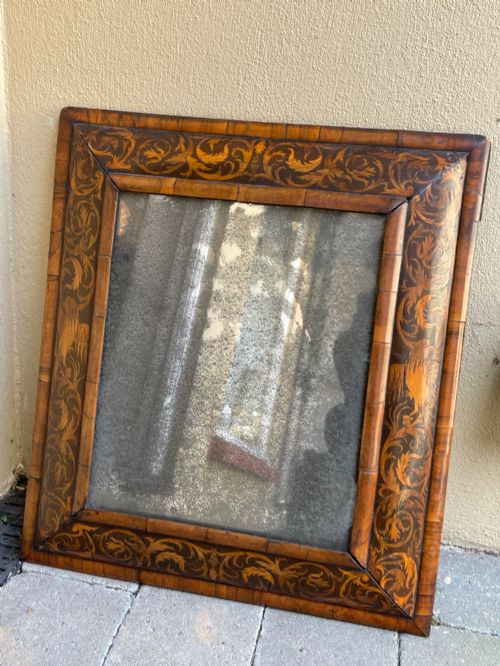


William and Mary Mirror
A william and mary mirror brings bold baroque symmetry and rich timber figuring to any room.
What these pieces are
A william and mary mirror is a wall-hung looking glass defined by the distinct tastes of the late seventeenth century. These pieces most commonly appear as cushion mirrors, taking their name from the rounded, sloping profile of the timber frame.
The form relies on architectural proportion and deep bevelling rather than excessive ornamentation. Originating around the turn of the eighteenth century, they present an austere yet luxurious presence on the wall.
How they were made
Cabinet makers built these frames using native and exotic timbers such as walnut, oak, and yew, often laid out as circular oyster veneers. Boxwood inlay, ebonised wood, gesso, and marquetry added intricate linear contrast across the flat and curved surfaces.
The glass plates themselves were hand-blown or cast, showing characteristic slight distortions and heavy bevelling at the edges. Giltwood and carved elements further enriched select frames, combining traditional joinery with high baroque decoration.
Retail Price Guide 2026
Typical UK retail prices for william and mary mirror, calculated from the Sellingantiques database of over a million retail prices indexed since 2003. This retail price guide relies exclusively on Sellingantiques data; no external sources or auction records are used, so the figures do not describe the wider market.
Listings for this phrase include walnut, oak, yew, laburnum, and boxwood.
What varies in quality
The quality of a william and mary mirror rests entirely on the intricacy of its timber work and the survival of its original surfaces. Finely cut oyster veneers with symmetrical grain patterns command attention, whereas coarser alignments lack the same optical depth.
Preservation of the original glass plate and cresting elevates an example significantly. Pieces that retain their historic finish without modern intervention display the intended warmth and texture of the period.
The William and Mary Mirror Glossary
- Cushion mirror
- A wall glass featuring a wide, rounded frame that slopes outward toward the edge, creating a pillow-like profile.
- Oyster veneer
- Cross-sections of small branches sliced to reveal concentric growth rings, arranged across a surface in decorative patterns.
- Marquetry
- Elaborate veneer work using various tinted woods and boxwood to form floral or geometric pictures.
- Ebonised wood
- Timber treated with a dark stain or finish to imitate expensive ebony.
- Gesso
- A plaster-like mixture applied to wood surfaces as a smooth base for gilding or painting.
Frequently Asked Questions
How do I hang a heavy antique mirror?
These heavy frames require secure fixings anchored directly into wall studs or masonry.
Professional hanging hardware distributes the substantial weight safely across the structure.
Are these mirrors original to the seventeenth century?
Many survive from the late seventeenth and early eighteenth centuries, while others follow the same decorative style.
Construction details and timber ageing help determine the exact period of manufacture.
What woods were used in these frames?
Cabinet makers utilised walnut, oak, yew, and laburnum for their rich natural grain.
Ebonised wood and boxwood were frequently added for contrast and inlay work.