
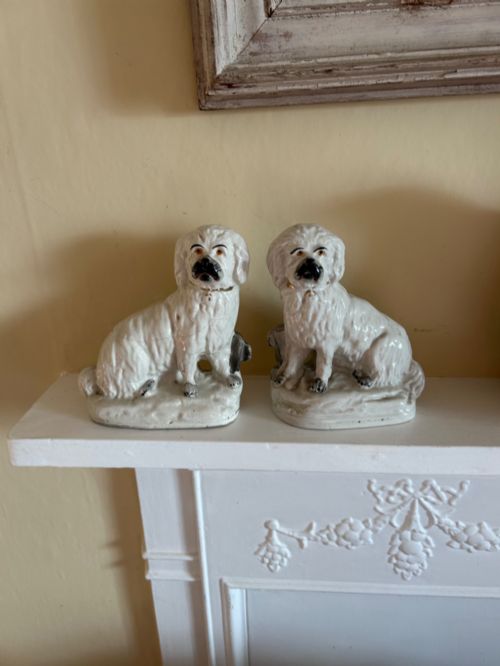


White Pottery Spaniels
White pottery spaniels are traditional mantelpiece ornaments that bring character to a room.
White Pottery Spaniels
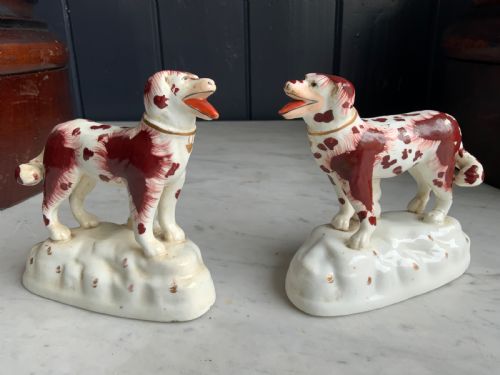
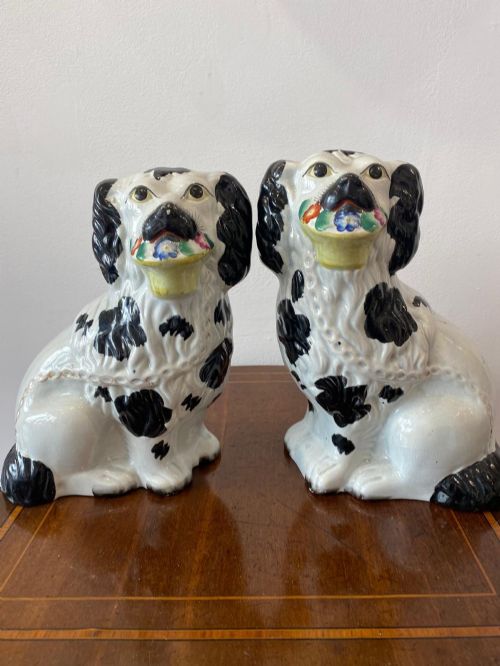
White pottery spaniels are decorative figures traditionally made in pairs to sit on either side of a fireplace. These earthenware dogs appear frequently in Victorian styles, often modelled as seated spaniels with distinct markings.
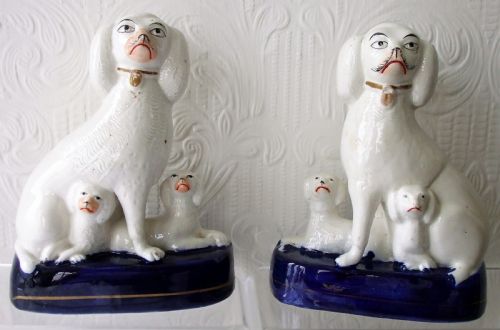
The selections on this page span the nineteenth century, including examples from the eighteen-sixties and eighteen-eighties. Alongside standard seated pairs, the listings include money boxes, Toby jugs, and figures with puppies or blue cushions.
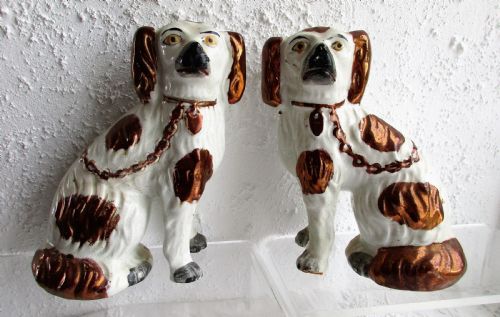
Makers produced these ceramic figures in various forms, including quill holders and clock groups. While many adopt a plain white glaze, others incorporate gilt, gold leaf, or painted details in black, red, and copper lustre.
How they were made
Kiln firing set the ceramic body and fixed the surface glaze. Artisans then applied gilt highlights or coloured paints, sometimes requiring a secondary lower-temperature firing to bond the enamel decoration.
The listings show earthenware and ceramic figures spanning the Victorian era, including pieces decorated with copper lustre, gilt, and enamel paints.
What varies in quality
The application of glaze and gilding also sets pieces apart, with rich copper lustre or bright gold leaf retaining its lustre better than worn paint. Complete pairs showing balanced proportions command more attention than single survivors or mismatched sets.
Beswick
The White Pottery Spaniels Glossary
- Earthenware
- A porous type of pottery fired at lower temperatures, commonly used for nineteenth-century figurines and glazed to hold moisture.
- Lead glaze
- A glossy coating applied to ceramic ware before firing, giving a smooth and shiny finish to the surface.
- Copper lustre
- A metallic glaze technique producing a coppery, reflective sheen on the pottery surface.
- Comforter spaniels
- A term for Staffordshire pottery dogs traditionally placed on mantelpieces as household companions.
- Gilt
- A thin layer of gold leaf or gold paint applied to decorate the pottery details.
White Pottery Spaniels: Frequently Asked Questions
How were these spaniel figures used?
These ceramic dogs served as decorative ornaments in Victorian parlours and living rooms, traditionally displayed facing each other on the mantelpiece.
Beyond standard decorative figurines, some pieces served practical purposes such as money boxes, quill holders, or components of clock groups.
How do I date a Staffordshire dog?
Dating these figures relies on stylistic details, glazing techniques, and the type of ceramic body used. Pieces from the mid-nineteenth century often display careful hand painting and rich copper lustre.
Later Victorian and turn-of-the-century examples may feature different glaze formulations and bolder enamel colours, though many traditional styles persisted across decades.
Are these dogs always sold in pairs?
Many of these ceramic spaniels appear as original pairs intended to sit symmetrically on a mantelpiece. Potters manufactured them together using matching moulds to ensure a balanced appearance.
Individual figures and larger collections also occur, reflecting how these decorative objects survived and travelled through the years.