





White Porcelain Table Ornaments
White porcelain table ornaments bring crisp, sculptural presence to a room, ranging from delicate Georgian stag figures to robust Victorian lamp bases.
White Porcelain Table Ornaments
White porcelain table ornaments encompass a variety of decorative ceramic objects designed for display on furniture surfaces. When exploring white porcelain table ornaments, collectors encounter forms such as figural groups, animals, and miniature furniture pieces.
The selections span distinct historical eras, incorporating Georgian examples alongside 19th-century and Victorian pieces. Makers utilised materials including soft-paste porcelain, hard-paste porcelain, and earthenware to shape these sculptural items.
Stylistic influences vary significantly across the inventory, reflecting French Rococo Revival tastes, Dutch Delftware traditions, and German factory designs. Figures of animals, human harvesters, and birds dominate the physical forms available for interior placement.
How they were made
Potters shaped these ornaments using soft-paste or hard-paste porcelain clay bodies, often firing them to achieve a smooth white glaze finish. Moulding and manual modelling allowed artisans to create intricate details such as feathered bird plumage and leafy bocage backgrounds.
Certain pieces received additional hand-painted touches in blue or polychrome enamel alongside the dominant white glaze. Biscuit porcelain required firing without a glaze, leaving a matte, marble-like surface texture favoured by French factories.
White Porcelain Table Ornaments Retail Price Guide 2026
Typical asking prices for white porcelain table ornaments among the pieces listed under this phrase on Sellingantiques today, from the lower quarter to the upper quarter. They describe what is for sale here now, not the wider market.
A porcelain Spitz dog wears an expression of absolute vigilance while moonlighting as a Victorian table lamp.
What varies in quality
The refinement of the modelling dictates the visual success of a figure, separating crisp, lifelike anatomy from soft or heavy contours. Artisans who invested time in undercutting foliage, drapery, and facial expressions produced pieces with greater depth and liveliness.
The purity and consistency of the white glaze or biscuit body also influence the overall appearance on the table. Factory execution matters greatly, distinguishing standard production runs from ambitious sculptural works produced by notable European ceramic centres.
Derby·Vion and Baury·KPM·Chantilly·Meissen·Sitzendorf
The White Porcelain Table Ornaments Glossary
- Bocage
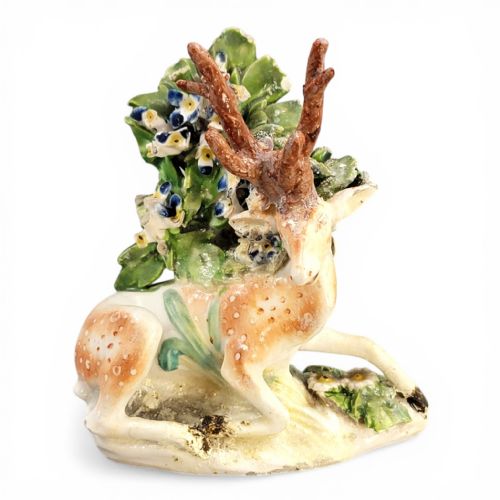
- An ornamental background of leaves, branches, and flowers applied behind ceramic figures. This leafy arbor work is typically modelled in high relief and painted or glazed.
- Biscuit porcelain
- Unglazed ceramic fired once to create a fine, matte, white surface resembling marble. French factories frequently utilised this technique for sculptural figures.
- Soft-paste porcelain
- An artificial porcelain composition fired at lower temperatures than hard-paste. It possesses a warm tone and a distinctive vitreous body popular in 18th-century European manufactories.
- Patch mark
- A small unglazed scar on the underside of a porcelain piece resulting from the triad of supports used in the kiln. These marks help identify specific 18th-century English manufacturing periods.
White Porcelain Table Ornaments: Frequently Asked Questions
What periods do these ornaments cover?
The available pieces span from the Georgian era through the mid and late 19th century. Victorian and 1880 styles appear frequently alongside earlier Georgian items.
Collectors find both English works from factories like Derby and continental European pieces from German and French workshops.
Are these ornaments purely decorative?
Most pieces function strictly as visual table ornaments, including figural groups, animal studies, and miniature furniture. Some unusual examples, such as the Spitz dog lamp, integrate functional lighting elements.
They were intended to adorn mantelpieces, side tables, and cabinets in historic interiors.
How do I identify biscuit porcelain?
Biscuit porcelain lacks the glossy vitreous glaze found on standard ceramic items. It presents a tactile, matte white finish that resembles carved marble.
This technique highlights the fine sculptural details modelled by the artisan without surface glare.
What is bocage?
Bocage refers to the applied floral and foliage background wrapping around porcelain figures. It creates a naturalistic arbor effect behind animals or human subjects.
This decorative technique requires delicate hand-modelling and careful kiln firing to survive intact.