
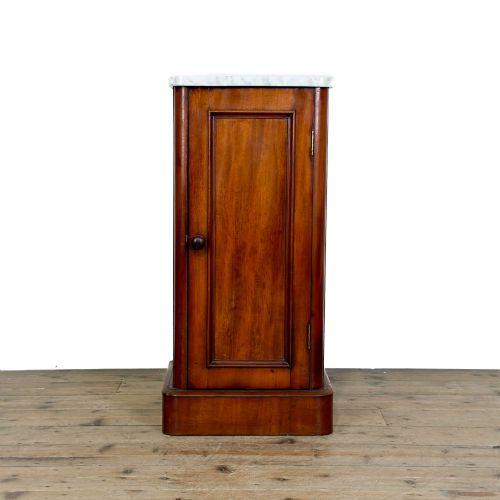

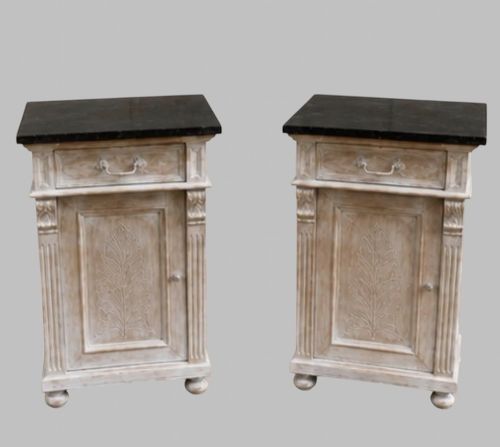


White Marble Nightstands
White marble nightstands bring a cool stone surface and timber construction to the bedroom, spanning Victorian designs to 1930s French pairs.
White Marble Nightstands
White marble nightstands encompass bedside tables, bedside cabinets, side tables, and night tables found across various periods from the mid-nineteenth century through the 1930s. Buyers searching for white marble nightstands encounter items originating primarily from French and English workshops, with several examples sold as pairs.
The selections on this page draw from the Victorian era, Edwardian period, and the early twentieth century, including the 1900s, 1910s, 1920s, and 1930s. Styles range from Victorian and Neoclassical Revival to French Louis XV Revival, Louis XVI style, and French Provincial.
Cabinets and tables form the primary silhouettes, utilising enclosed cupboard space or open bedside surfaces topped with white marble. Painted finishes sit alongside exposed timber grains in oak, mahogany, walnut, satinwood, pine, and metal.
How they were made
Construction relies on traditional cabinetmaking timber frames paired with fitted stone inserts. Woods such as mahogany, walnut, oak, satinwood, and pine provide the structural carcase and legs.
Surface treatments combine painted wood finishes with decorative metal mounts and brass details, particularly on French Louis XVI and revival models. White marble slabs sit recessed or flush into the wooden tops of cabinets and lamp tables.
The site listings feature white marble combined with brass, metal, mahogany, walnut, oak, and painted wood across Victorian, Edwardian, and 1920s periods.
What varies in quality
Quality differentiates through the selection of timber veneers and solid hardwoods, ranging from standard pine and painted surfaces to figured mahogany, walnut, and satinwood. The thickness and figuring of the white marble top also influence the distinction between standard items and fine quality pieces.
Execution shows in the refinement of brass mounts, the precision of panel joinery in bedside cabinets, and the execution of painted decorative details. Matching pairs display a higher degree of uniformity in timber grain and marble veining than single tables.
The White Marble Nightstands Glossary
- Bedside cabinet
- A small enclosed piece of furniture with a door or drawer designed to sit beside a bed. These often feature marble tops to protect the wood from water jugs and glasses.
- Night table
- An alternative term for a bedside table or cabinet originating largely from French and American traditions. They provide a surface for bedside lighting and small personal items.
- Louis XVI style
- A neoclassical design vocabulary characterised by straight tapered legs, rectilinear forms, and restrained classical ornament. Pieces from this tradition often utilise painted finishes and brass accents.
- Satinwood
- A dense exotic timber with a lustrous, golden sheen utilised for fine furniture making. It appears in Edwardian and early twentieth-century cabinetwork.
- Neoclassical Revival
- A late nineteenth and early twentieth-century style drawing inspiration from classical Greek and Roman architecture. It prioritises symmetry, clean lines, and architectural proportions.
White Marble Nightstands: Frequently Asked Questions
What woods were used for these cabinets?
Makers utilised a variety of timbers including mahogany, walnut, oak, satinwood, and pine. Painted wood finishes also appear frequently across French and English examples.
Selection depended on the period and regional workshop traditions, ranging from local pine carcasses to imported tropical hardwoods.
Are most of these tables sold in pairs?
Several listings feature matched pairs of bedside cabinets and lamp tables, particularly from French workshops of the early twentieth century. Single items also appear alongside these.
Buyers searching for symmetrical bedside placement will find multiple paired options dating from the 1900s to the 1930s.
Which periods do these nightstands come from?
The pieces span from the mid-nineteenth century Victorian era through Edwardian times and into the 1920s and 1930s. Early twentieth-century French production is particularly well represented.
Stylistic influences include Louis XVI Revival, French Provincial, and Neoclassical designs.
How do cabinets differ from open tables?
Cabinets provide enclosed storage space behind a door, often with internal shelving, while lamp tables and side tables offer open surfaces or lower shelves. Both share the characteristic white marble top.
Choice between the two depends on whether concealed bedside storage or an open frame is preferred.