


White Marble Clock Set
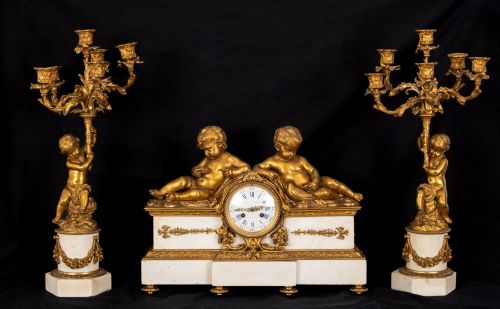
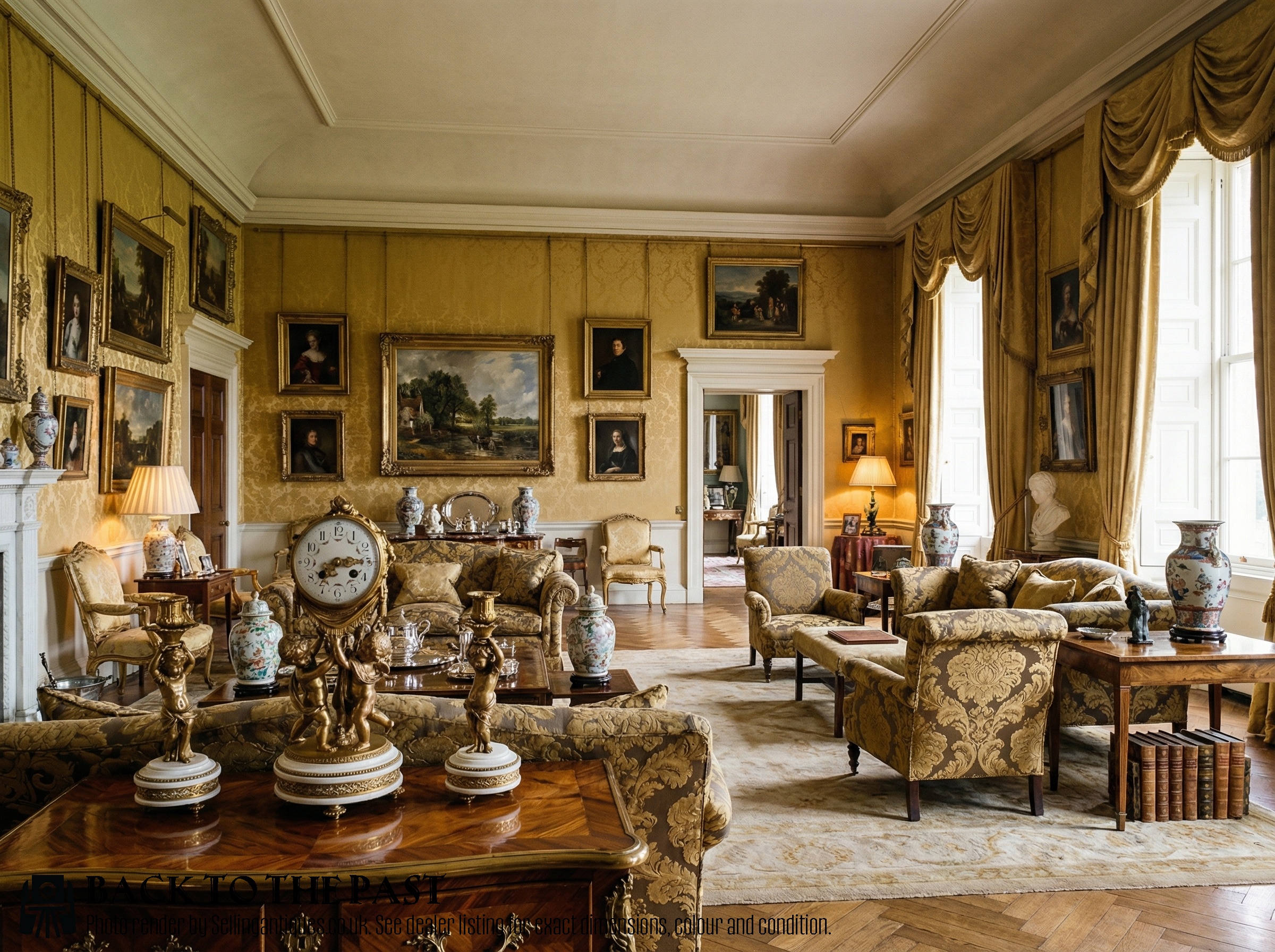
A white marble clock set brings together pale stone and gleaming metal, offering a balanced centrepiece of classical design.
White marble clock set
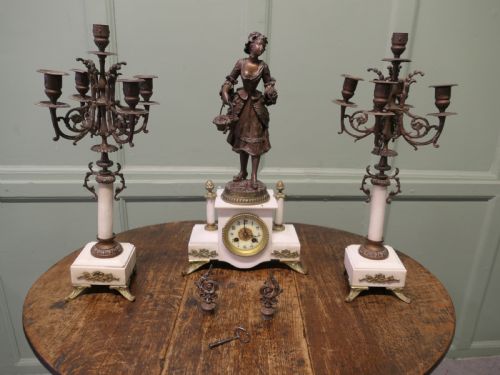
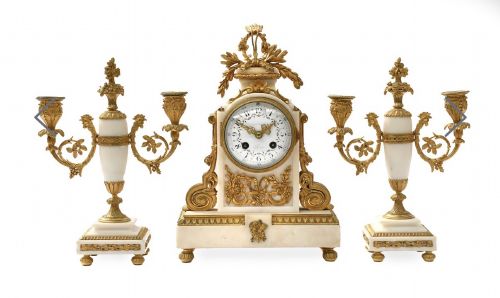
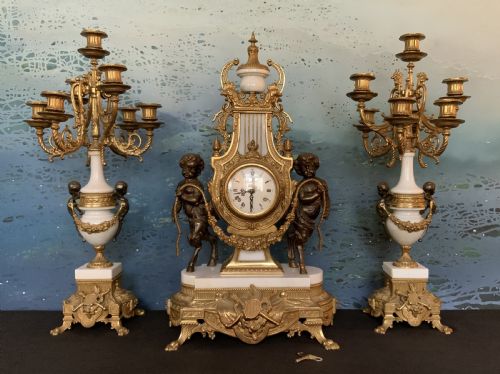
A white marble clock set typically comprises a central mantel timepiece accompanied by matching side ornaments such as candelabras or urns. These three-piece ensembles originate predominantly from the nineteenth century, reflecting enduring European tastes for neoclassical decoration.
The central clock usually sits upon a polished stone base, often supported by small feet and framed by metallic mounts. Surrounding garniture pieces echo the primary materials and decorative motifs of the main timepiece to create a unified display.
Buyers frequently encounter French workshop productions, spanning styles from Louis XVI revival to portico architecture. Proportions vary from petite boudoir arrangements to substantial pillar designs intended for grand reception rooms.

Materials and construction
Makers fashioned the structural bodies from solid white marble, shaping the stone through sawing, turning and hand-polishing to achieve smooth surfaces. This pale mineral chassis provides a crisp contrast to the warm metallic elements.
Gilt bronze, ormolu and brass components were cast, chased and fire-gilt to produce decorative mounts, bezels and figural details like cherubs. Enamel dials, often featuring delicate numeric markings, sit protected behind curved glass plates.
Retail Price Guide 2026
Typical UK retail prices for white marble clock set, calculated from the Sellingantiques database of over a million retail prices indexed since 2003. This retail price guide relies exclusively on Sellingantiques data; no external sources or auction records are used, so the figures do not describe the wider market.
Listings feature nineteenth-century French and Italian productions, spanning the Edwardian era up to mid-century Neoclassical revivals.
Markers of quality
The selection and purity of the marble also dictate the grade of an ensemble, with uniform white mineral blocks commanding greater regard than those with heavy grey veining or visible flaws.
H Luppens Paris·Vincenti·Japy Freres·A D Mougin
The White Marble Clock Set Glossary
- Ormolu
- Gilt bronze produced through a mercury gilding process that leaves a durable, rich golden surface. This technique was widely employed on nineteenth-century French clock mounts.
- Garniture
- A matching set of ornamental objects designed for display together, typically a clock flanked by two candelabras or urns. Such groupings decorated nineteenth-century mantelpieces.
- Portico clock
- A timepiece built with an architectural frame resembling a classical porch, supported by columns over a raised base. These structures are frequently executed in white marble and gilt bronze.
- Enamel dial
- A clock face created by fusing powdered glass to a metal substrate at high temperatures, producing a glossy white surface for painted numerals. These dials provide a legible and lasting finish.
Frequently Asked Questions
How do these clock sets work?
Most examples house an eight-day mechanical movement driven by a spring, requiring a key wind at regular intervals.
The mechanism typically strikes on the hour and half-hour using a bell or a gong mounted inside the case.
Where should I place a garniture?
These sets suit prominent locations such as a drawing room mantelpiece, a large sideboard or a wide console table where the matching pieces can be arranged symmetrically.
Ensure the supporting surface is level and sturdy enough to bear the considerable weight of the stone and metal components.
How do I identify the period?
Makers often stamped their movement plates with factory marks and medals, which help date the production alongside stylistic clues like neoclassical revival motifs.
Nineteenth-century pieces generally show hand-cut brass gears and traditional escapements rather than mass-produced twentieth-century components.
Are these sets delicate?
The white marble is heavy and durable, but it can chip or stain if struck hard or exposed to acidic liquids.
The gilt bronze and enamel dials require gentle dusting with a dry cloth to preserve the finish without scratching the delicate surfaces.