
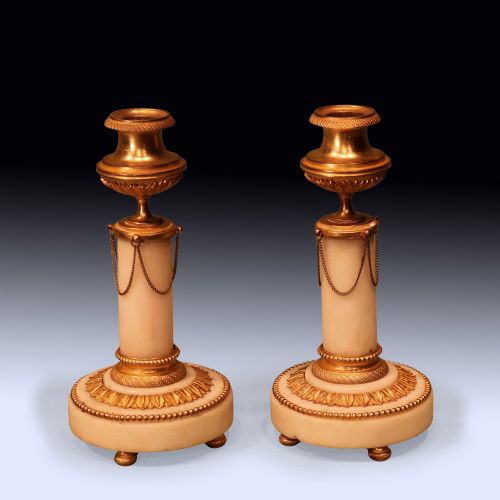


White Marble Candle Holder
White marble candle holder designs bring classical weight to a room, pairing polished stone with gilt metal and bronze figures.
White Marble Candle Holder
A white marble candle holder sits within a lineage of nineteenth-century decorative arts, frequently taking the form of paired candlesticks, multi-arm candelabra, or parts of a clock garniture. Most pieces encountered on this page originate from nineteenth-century France or Victorian Britain, drawing heavily on Neoclassical and Louis XVI design vocabulary.
Buyers frequently encounter pairs featuring cast bronze figures, cherubs, putti, or winged putti mounted directly onto turned or architectural white marble bases. The presence of ormolu, gilt bronze, or patinated bronze combined with the stone defines the core of what is available.
Materials and construction methods
The fabrication relies on a partnership between stonemasonry and metal casting, where solid white marble is lathe-turned or squared into columns, urns, and plinths. This stone body is then fitted with cast bronze or brass components, which are frequently gilded, given an ormolu finish, or patinated.
Makers integrated these disparate elements using threaded rods, concealed nuts, and pinned joints that secure the bronze arms, nozzles, and sculptural cherubs to the marble foundations. Additional decorative enrichment comes from applied enamel details and chiseled surface chasing on the metal mounts.
Listings feature white marble combined with gilt bronze, ormolu, and patinated bronze across nineteenth-century periods.
Distinguishing finer examples
The integration between stone and metal also separates standard production from superior work. Better pieces feature seamlessly fitted joins where the gilt bronze meets the polished marble without unsightly gaps, uneven seating, or mismatched patination across the arms of a pair.
Claude Clodion
The White Marble Candle Holder Glossary
- Ormolu
- A technique of applying finely ground high-carat gold to a bronze object using a mercury amalgamation process. This finish provides a warm, lasting lustre distinct from modern electroplating.
- Candelabra
- A branched candlestick holding multiple candles on separate arms. These pieces often feature removable top sections or central finials.
- Clock Garniture
- A matching set consisting of a central mantel clock flanked by matching candle holders or vases. They were designed to sit symmetrically on a fireplace mantel.
- Louis XVI Style
- A neoclassical revival aesthetic characterised by straight lines, symmetry, and classical architectural motifs like fluting and urns. It influenced many nineteenth-century decorative metalworks.
- Patinated Bronze
- Bronze treated with chemicals or heat to produce a stable surface colour ranging from brown to deep green. This treatment protects the metal and highlights sculptural relief.
White Marble Candle Holder: Frequently Asked Questions
How do I clean white marble?
Clean white marble surfaces using a soft, dry cloth or a slightly damp sponge with plain warm water. Avoid acidic cleaners, household detergents, or abrasive scouring pads, which can etch the polished stone finish or damage the surrounding gilt bronze mounts.
Dry the stone immediately after wiping to prevent water spots. Take extra care around any bronze or ormolu parts, as moisture can cause green oxidation to form on the metal.
How do I date a piece to the nineteenth century?
Dating relies on examining the casting quality of the bronze, the style of the screws or threaded fixings, and the overall aesthetic movement. Pieces styled in the French Empire or Louis XVI Revival idioms often date from the mid to late nineteenth century rather than the true eighteenth-century periods they emulate.
Look closely at the tool marks inside the bronze components and the weathering of the marble. Nineteenth-century castings typically exhibit hand-chased surface details rather than the uniform finish of twentieth-century reproductions.
What is a clock garniture set?
A clock garniture is a matched decorative ensemble designed to be displayed together on a mantelpiece or sideboard. The central mantel clock is flanked by a pair of matching multi-arm candelabra or urns that share identical materials, motifs, and patination.
These sets became immensely popular in nineteenth-century formal interiors to create visual symmetry. The individual candle holders were styled to echo the architectural and sculptural themes of the central clock.