

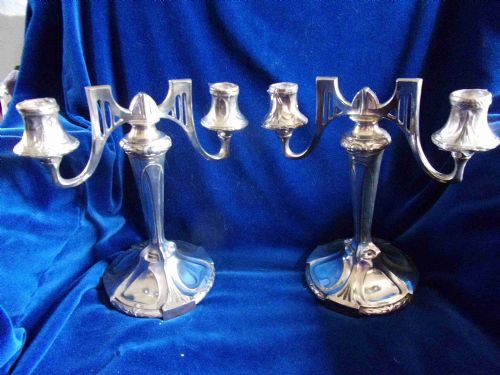


Two Branch Candle Holder
A two branch candle holder brings balanced symmetry and gentle illumination to a room, ranging from robust Victorian ormolu to sleek Art Deco forms.
Two Branch Candle Holder
A two branch candle holder provides the familiar form of a candelabrum or double arm candlestick, designed to support multiple lights from a single central stem. When searching for a two branch candle holder, buyers encounter examples spanning the Victorian era through the mid-twentieth century.
The selections on this page encompass various styles, including Victorian, Jugendstil, Art Deco, and revival designs like George I and Louis XVI. These pieces typically appear as matched pairs, offering symmetry for a mantelpiece, sideboard, or dining table.
Object types vary between formal candelabras and lower table candelabra, utilising metals such as sterling silver, silver plate, brass, and bronze. The evidence shows origins across the nineteenth and twentieth centuries, uniting utility with decorative presence.
Materials and construction
Makers utilised casting and silversmithing techniques to form the stems, arms, and drip pans of each two branch candle holder. Heavy metals like bronze and brass provided structural stability, often finished with silver plating, ormolu, or gilding.
Combinations of materials appear frequently, pairing gilt bronze or ormolu with marble bases to add weight and visual contrast. Hand wrought silver and sterling silver examples demonstrate traditional metalworking skills, incorporating hallmarks where English standards apply.
Cherubs occasionally peek from the branches, holding aloft extra lights as if keeping a watchful eye on the dining table.
Assessing quality and craftsmanship
Quality in a two branch candle holder rests on the crispness of casting detail, particularly in figural elements like cherubs or classical ornamentation. Superior examples display clean joints where the double arms meet the central column, maintaining balance and structural integrity.
The choice of base materials dictates the longevity and tactile feel of the piece, with substantial marble mounts and thick silver plating or solid sterling silver marking the upper tier of production. Finer items exhibit careful chasing and finishing work that softens harsh lines and enhances the decorative depth.
Barker Ellis·Claude Clodion·Robert Edgar Stone·Elkington and Company
The Two Branch Candle Holder Glossary
- Candelabra
- A large branched candlestick holding multiple candles on separate arms. It often serves as a prominent table centrepiece.
- Ormolu
- Gilded bronze, where finely ground high-carat gold is applied to a bronze base using a mercury amalgam. This technique was widely employed in French decorative arts.
- Jugendstil
- The continental European style of art nouveau, prominent around nineteen hundred. It is characterised by flowing, organic lines.
- Hallmark
- An official stamp or series of stamps applied to precious metals in Britain and other countries. It indicates the standard of purity, the maker, and the year of assay.
Two Branch Candle Holder: Frequently Asked Questions
How do I clean silver plated candle holders?
Use a soft cloth and a specialised silver polish designed to protect plated surfaces from excessive abrasion. Avoid harsh chemical dips that strip underlying base metals.
Store them in dry conditions to prevent tarnish accumulation in the detailed crevices of the arms and drip pans.
Can I use standard candles in these holders?
Most antique two branch candle holders accommodate standard taper candles, though variations in socket diameters can occur due to historical manufacturing standards. Measuring the nozzle width ensures a secure fit.
Using beeswax or dripless candles helps protect the metalwork and marble bases from stubborn wax runoff.
How do I date an antique two branch candle holder?
Examine the base, construction marks, and any accompanying hallmarks to establish an origin period. Stylistic indicators, such as Victorian ormolu or Art Deco geometry, provide further chronological context.
Comparing the manufacturing techniques with documented pieces from makers like Elkington or Barker Ellis helps narrow the production decade.