

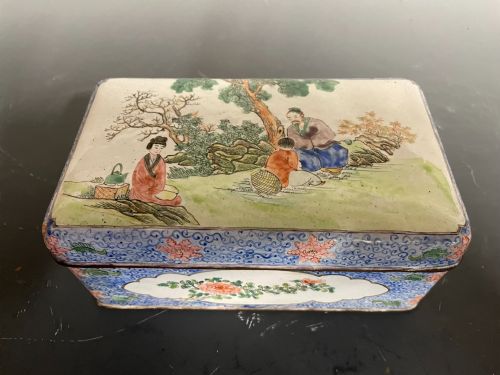
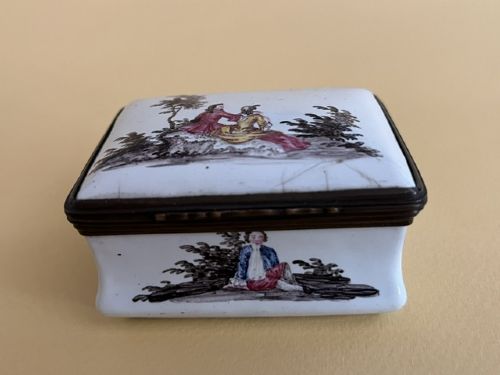


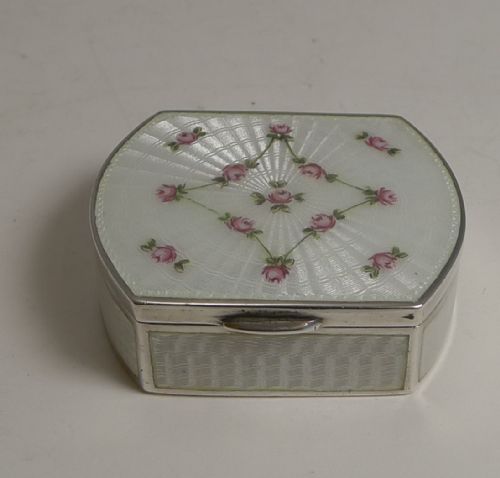


White Enamel Trinket Box
These white enamel trinket box examples combine utility and miniature art, offering portable containers made from copper, silver, and glass.
White Enamel Trinket Box
A white enamel trinket box serves to hold small personal items such as patches, snuff, pills, or jewellery. These containers appear across several periods, including the Georgian era and the eighteenth century, alongside later nineteenth and twentieth-century items.
The selection includes specific regional items like South Staffordshire and Bilston enamel patch boxes, as well as Japanese Taisho cloisonné jewellery boxes and Austrian guilloche pieces. Forms range from rectangular patch boxes and bonbonnieres to larger dressing table jars and table boxes.
Buyers will encounter eighteenth-century English enamel boxes painted with scenes alongside later silver-mounted glass jars and bronze champleve vessels. Each variation reflects the prevailing style of its decade, spanning Rococo Revival, Victorian, Edwardian, and Mid-Century Modern aesthetics.
Materials and construction methods
Construction typically involves fusing vitreous enamel to a metal base, most commonly copper for eighteenth-century English boxes. Artisans applied white enamel to the metal surface before painting decorative scenes or motifs directly onto the ground.
Other examples utilise sterling silver, brass, or gilt metal frames and mounts to secure glass bodies or hinge lids. Techniques such as guilloche and champleve involve incising or recessing patterns into the metal before applying coloured or white enamels.
Cloisonné work on Japanese pieces uses wire partitions soldered to a metal base to contain individual cells of enamel paste. Once fired and polished, these various metal and glass components form sturdy, enclosed vessels designed for daily personal use.
White Enamel Trinket Box Retail Price Guide 2026
Typical asking prices for white enamel trinket box among the pieces listed under this phrase on Sellingantiques today, from the lower quarter to the upper quarter. They describe what is for sale here now, not the wider market.
Musicians playing in miniature parkland scenes gaze out from eighteenth-century lids.
Assessing quality in enamelled boxes
Quality depends upon the precision of the enamel application and the delicacy of the painted detail on the surface. Finer eighteenth-century pieces display crisp miniature painting depicting figures or landscapes without blurring or firing flaws in the white ground.
The metalwork mounts contribute significantly to the overall standard of the piece, with heavier cast silver, gilt brass, or bronze hinges and bezels indicating superior manufacture. Well-fitted lids that close flush against the base demonstrate the skill of the original metalworker and box maker.
The White Enamel Trinket Box Glossary
- Enamel
- A glassy substance fused to a metal or glass substrate through high-temperature firing. It provides a smooth, durable coloured surface for decoration.
- Patch box
- A small container used in the eighteenth century to hold small fabric patches worn on the face. These patches concealed blemishes or displayed social statements.
- Guilloche
- A decorative technique where a mechanical lathe etches a precise, intricate geometric pattern into metal. Translucent enamel is often applied over the top to reveal the pattern beneath.
- Bonbonniere
- A small ornamental box intended to hold sweets or confections. They were popular luxury items among the European upper classes during the eighteenth century.
- Champleve
- An enamelling technique where troughs or cells are hollowed out of a metal surface and filled with enamel paste. The metal partitions remain visible between the coloured areas.
White Enamel Trinket Box: Frequently Asked Questions
What were white enamel trinket box pieces originally used for?
These boxes held small everyday luxuries including scented patches, pinches of snuff, or medicinal pills. People carried them in pockets or displayed them on dressing tables.
Over time, their contents shifted towards jewellery and keepsakes as social habits changed. Their compact size made them practical items for personal grooming and adornment.
How do I date an antique enamel box?
Dating relies on examining the shape, mount style, and painting technique relative to known manufacturing periods. Eighteenth-century Bilston and Staffordshire pieces often feature specific copper gauges and hand-painted enamel palettes.
Later Victorian and Edwardian examples incorporate machine-made hinges and alternative metal alloys like sterling silver or bronze. Comparing the stylistic markers against documented examples clarifies the era of production.
Are these boxes fragile for daily use?
Enamel is essentially glass fused to metal, meaning it can chip or crack if dropped against hard surfaces. Normal handling and gentle placement on soft dressing table trays protect the fragile glaze.
Keeping them away from moisture and extreme temperature changes preserves the metal mounts and prevents stress on the enamel layer.
What is the difference between Bilston and Staffordshire boxes?
Bilston was a prominent manufacturing centre for enamels in Staffordshire, England, during the eighteenth century. Items produced there are frequently referred to under both regional names interchangeably.
Specific attribution depends on stylistic traits, copper fabrication methods, and specific regional painting schools active during the Georgian period.