
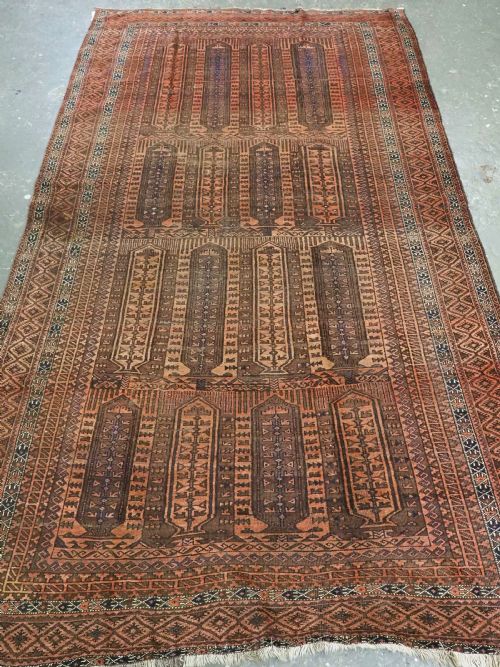


Western Afghan Carpet
A western afghan carpet brings robust tribal artistry and deep saturated colour into a room.
Western Afghan Carpet
A western afghan carpet embodies the rich weaving traditions of nomadic and tribal groups operating across western Afghanistan and the borderlands of north-eastern Persia. When searching for a western afghan carpet, buyers encounter authentic nineteenth-century examples produced by Timuri, Baluch, and Bahluli makers. These textiles span main carpets, area rugs, smaller tribal formats, and functional pieces such as salt bags.
The most common formats on this page date from the decades between eighteen seventy and nineteen hundred. These pieces frequently showcase distinct regional patterns like the kalam donneh motif, repeat star in octagon designs, and shrub layouts. Many of these rugs feature long kilim ends that highlight their nomadic utility.
What varies in quality
Quality in these carpets rests upon the fineness of the knotting and the complexity of the tribal design. Pieces displaying scarce motifs like repeat stars or detailed kalam donneh patterns command attention for their visual interest.
The integrity of the natural dyes and the survival of original kilim ends further elevate a piece. Handling resilient hand-spun wool and maintaining structural stability distinguish superior examples from standard specimens.
Listings feature wool, natural dyes, hand-spun wool, cotton, and goat hair across nineteenth-century tribal formats.
The Western Afghan Carpet Glossary
- Kalam donneh
- A traditional teardrop or shrub motif frequently found in tribal weaving. It appears repeatedly across nineteenth-century Baluch and Timuri formats.
- Kilim end
- Flat-woven sections of warp and weft extending beyond the knotted pile. These ends protected the rug from ground moisture in nomadic camps.
- Timuri
- A tribal group residing in the borderlands of north-eastern Persia and western Afghanistan. Their weavers produced distinctive main carpets and smaller rugs.
- Salt bag
- A utilitarian pouch woven by nomads for domestic storage. These smaller textiles display the same knotting techniques and natural dyes as large carpets.
- Baluch
- A broad designation for nomadic and semi-nomadic tribes inhabiting the border regions. Their carpets are noted for deep rich colours and geometric layouts.
Western Afghan Carpet: Frequently Asked Questions
Where were these carpets made?
These carpets originated in western Afghanistan and the adjacent borderlands of north-eastern Persia. Nomadic and tribal groups including the Timuri, Baluch, and Bahluli produced them.
Weavers worked within regional traditions that spanned the nineteenth century, utilising local materials and dyes.
How do I care for an antique rug?
Protect the wool pile by vacuuming gently without a rotating brush head. Keep the textile away from direct sunlight to preserve natural dyes.
Allow air circulation underneath the carpet and consult a specialist for professional cleaning when necessary.
What is a main carpet?
A main carpet refers to a large floor-covering format produced for domestic use within tribal dwellings. These pieces required substantial time and labour on nomadic looms.
They typically display complex border arrangements and repeat motifs across a central field.
How do I identify a Timuri piece?
Timuri carpets often incorporate specific design elements such as shrub patterns or distinctive colour palettes. Their attribution links them to the Timuri tribes of western Afghanistan.
Examination of the hand-spun wool and foundational materials helps confirm the tribal origin.