

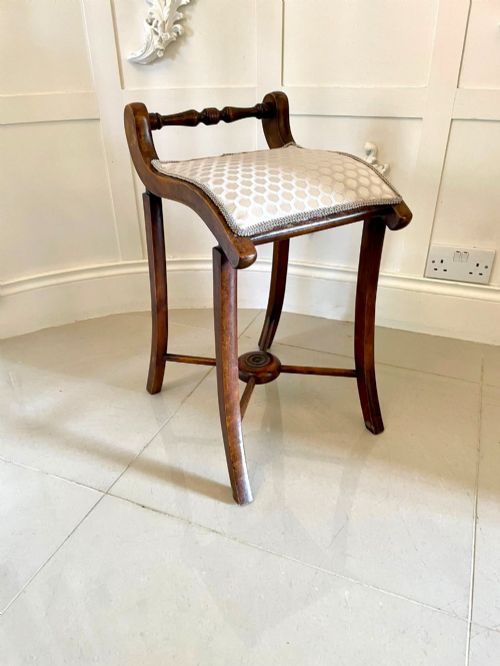
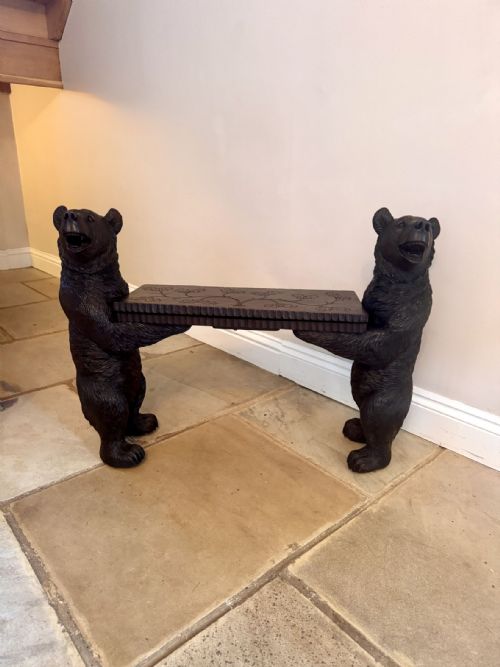
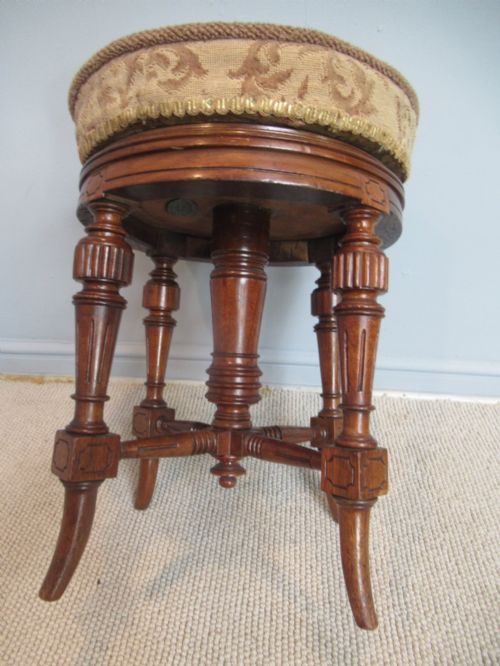
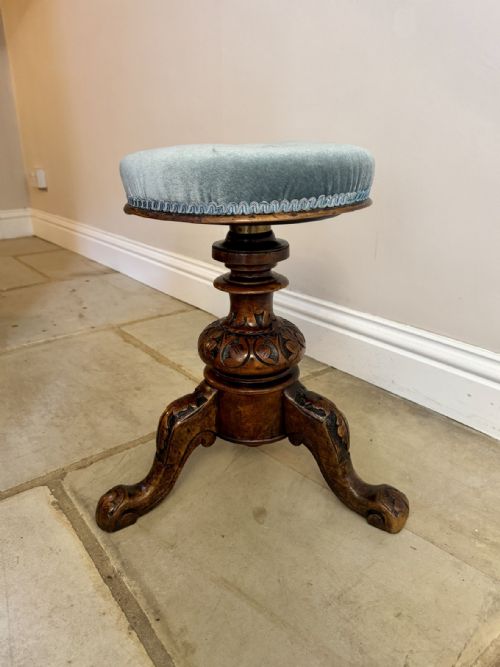

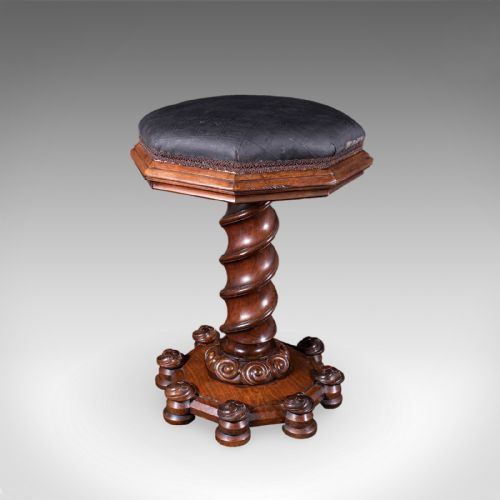


Walnut Music Seat
A walnut music seat brings practical charm to a room, offering adjustable height and swivel mechanics designed for the keyboard player.
Walnut Music Seat
A walnut music seat is primarily found in the form of a piano stool, revolving stool, or music chair originating across the nineteenth century. These pieces were built for functional use at the keyboard, featuring mechanisms for adjusting height or turning on a central screw.
Victorian examples dominate the selection, often featuring carved walnut frames, tripod bases, or pedestal supports. Variants include music cabinets with lockers, fall-front compartments, and upholstered seats covered in velvet, leather, or fabric.
Materials and construction
Cabinet makers utilised solid walnut and figured veneers for the structural frames, often enriching the design with hand-carved details or marquetry inlay. Iron, brass, and metal components formed the internal adjustable screws and mechanisms that allowed the seat height to rise and fall.
Upholstery was applied over webbing and stuffing, utilising textiles such as velvet, leather, and decorative fabric. Joinery combined traditional turning, pedestal columns, and tripod legs to support the weight and movement of the seated musician.
Walnut Music Seat Retail Price Guide 2026
Typical asking prices for walnut music seat among the pieces listed under this phrase on Sellingantiques today, from the lower quarter to the upper quarter. They describe what is for sale here now, not the wider market.
Listings span the nineteenth century, including Georgian, William IV, Victorian, and Art Deco periods, constructed primarily in walnut.
Distinguishing quality
Quality rests upon the crispness of the walnut carving, the weight of the timber, and the precision of the mechanical screw action. Superior pieces maintain smooth rotation and secure height adjustment without play in the central column.
Finer examples integrate useful storage such as lockers, fall-front compartments, or music risers alongside decorative marquetry and substantial pedestal tripod bases.
The Walnut Music Seat Glossary
- Revolving stool
- A seat featuring a mechanism that turns in a full circle on a central threaded iron screw. This allowed players to adjust their distance and height relative to the keyboard.
- Marquetry
- The art of applying pieces of veneer to a structure to form decorative patterns and pictures. Swiss and Victorian makers applied this technique to chair backs and lids.
- Fall-front
- A hinged panel that drops forward to reveal interior storage compartments for sheet music. This feature appears on late nineteenth-century cabinet and stool hybrids.
- Tripod base
- A three-legged support structure commonly found beneath pedestal piano stools. It provides stable footing on uneven floorboards.
Walnut Music Seat: Frequently Asked Questions
How do I adjust the height?
Most variants achieve height adjustment by rotating the upholstered top, which turns on a threaded metal screw concealed within the central column.
Turning the seat clockwise lowers the height, while anticlockwise rotation raises the surface for the player.
Where were they placed?
These seats sat beside upright and grand pianos in nineteenth-century parlours and drawing rooms to support musicians during practice.
Music cabinets and locker variants also served to store sheet music beneath the seat lid.
How do I identify the period?
Victorian and William IV examples display heavier carved walnut frames, tripod pedestal bases, and robust turning typical of mid-nineteenth-century cabinet making.
Later Edwardian and Art Deco pieces show simpler lines, enclosed storage lockers, and occasional inlay work.
What fabrics are correct?
Original upholstery typically employed durable textiles such as velvet, woven fabric, or leather secured with brass tacking.
Many surviving pieces have been recovered in matching period-appropriate materials during their lifetime.