
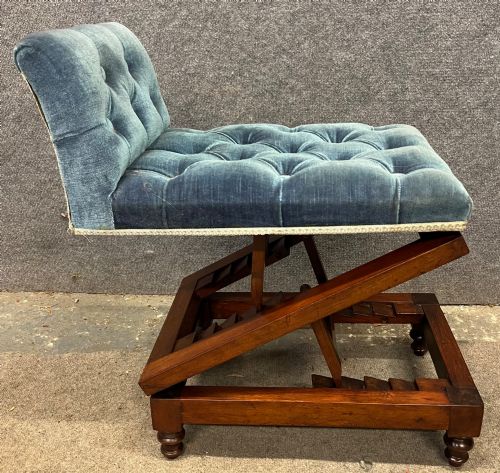
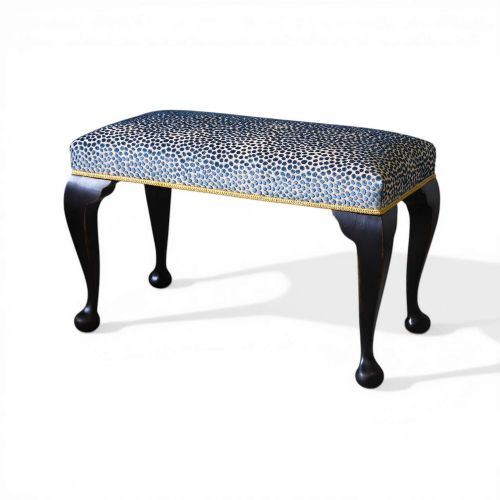
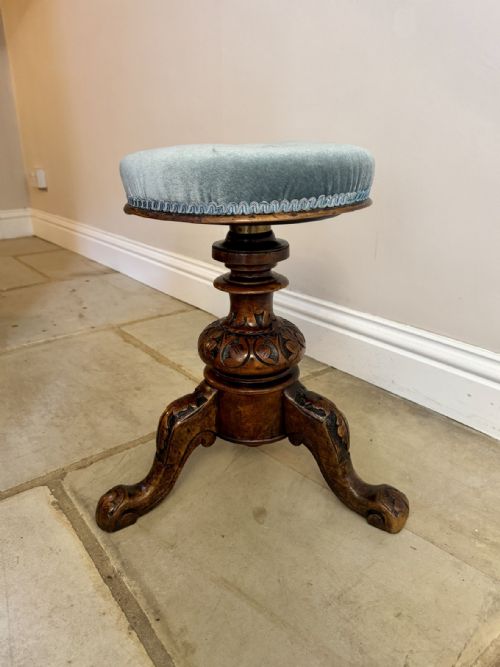


Blue Velvet Stool
A blue velvet stool brings rich texture and traditional seating to a room, ranging from compact footstools to grand window seats.
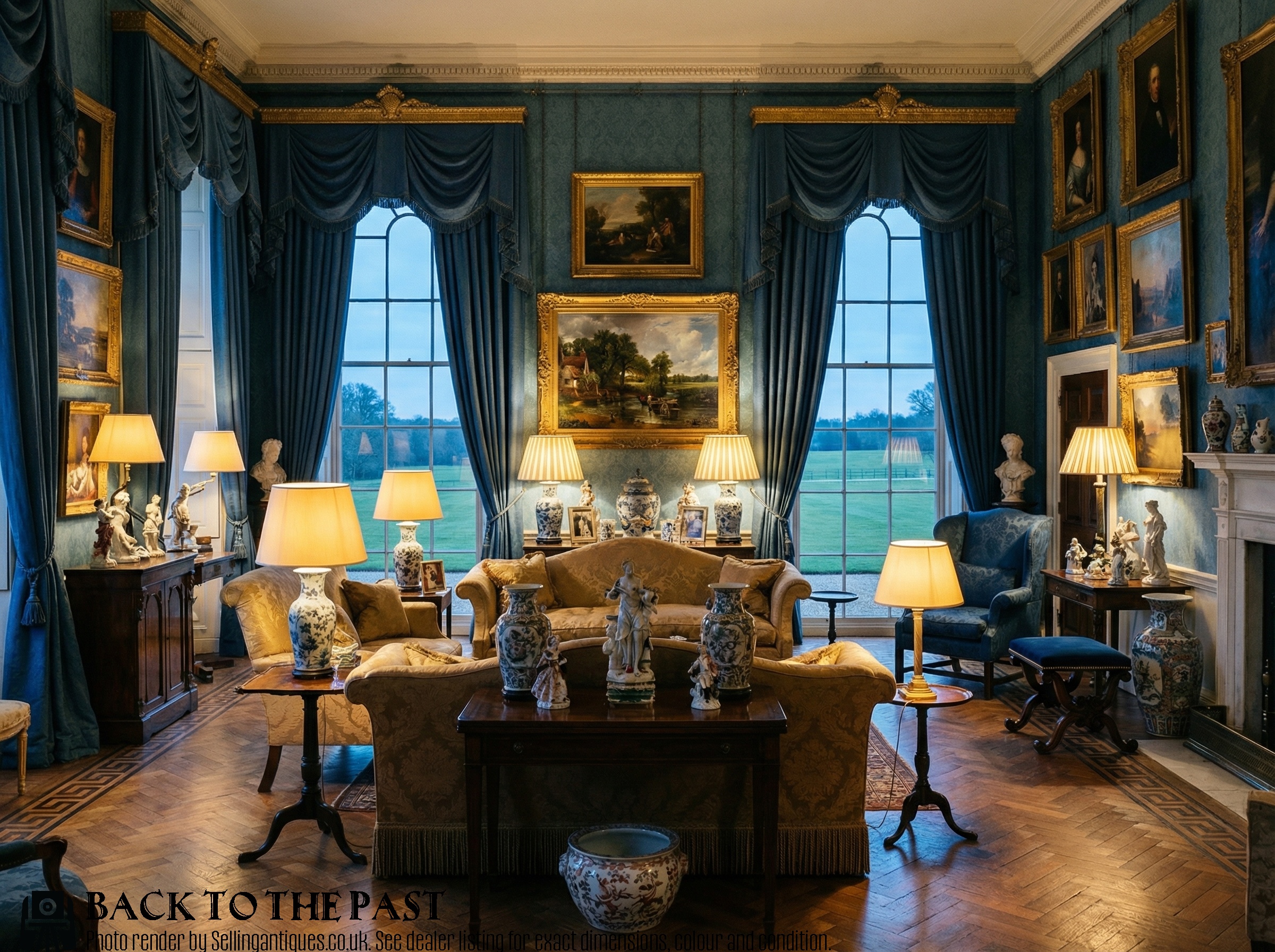
Blue Velvet Stool
When you search for a blue velvet stool, you encounter an array of seating forms spanning the nineteenth century, including footstools, ottoman stools, and window seats. These pieces range from simple Edwardian ebonised examples to elaborate Victorian carved walnut designs and early nineteenth-century French Empire ottomans.
Buyers are most likely to meet walnut and rosewood frames paired with soft pile fabrics, often finished with braid or textile trim.
How they were made
Cabinet makers utilised dense hardwoods such as walnut, rosewood, and ebonised wood to build sturdy frames capable of supporting intricate hand-carved details and turned legs.
Upholstery techniques involved securing rich velvet over internal padding, frequently edged with decorative braid or textile trim to finish the perimeter neatly.
Listings span the nineteenth century, including specific dates such as 1820, 1880, and 1890, alongside broader Edwardian, Victorian, and Regency periods.
What varies in quality
The distinction between standard and superior pieces rests upon the crispness of the timber carving, the depth of the wood grain in walnut or rosewood, and the structural integrity of the joinery in forms like the X-framed stool.
Attention to detail in auxiliary elements, such as the precision of turned legs, the application of ebonised finishes, and the quality of applied textile braid, defines the standing of individual examples.
Holland & Son
The Blue Velvet Stool Glossary
- Ebonised wood
- Timber treated to resemble ebony, providing a dark and uniform surface popular in Edwardian and nineteenth-century furniture.
- X-frame
- A structural furniture base formed by intersecting diagonal timbers, offering both support and a distinct profile.
- Sabre leg
- A concave sweeping leg tapering toward the foot, characteristic of Regency period design.
- Ottoman
- A low upholstered seat or bench without a back or arms, often built on a larger scale for domestic lounging.
- Braid
- A narrow woven textile band utilised to trim upholstery edges and conceal tacks.
Blue Velvet Stool: Frequently Asked Questions
Where were blue velvet stools placed historically?
These pieces functioned as flexible seating around drawing rooms, bedrooms, and music rooms, where they served near pianos or windows.
Larger ottoman forms stood centrally or alongside window seats to provide comfortable resting places for feet or extra occupants.
What is the difference between an ottoman and a footstool?
Footstools are generally smaller items designed primarily to support the feet while sitting in an armchair.
Ottomans offer a larger surface area and function as independent benches or low seats within a room.
How do I care for antique velvet?
Velvet requires gentle handling to protect the pile from crushing and to maintain the rich texture of the fabric.
Regular light brushing and keeping the textile away from direct sunlight help preserve the material over time.