
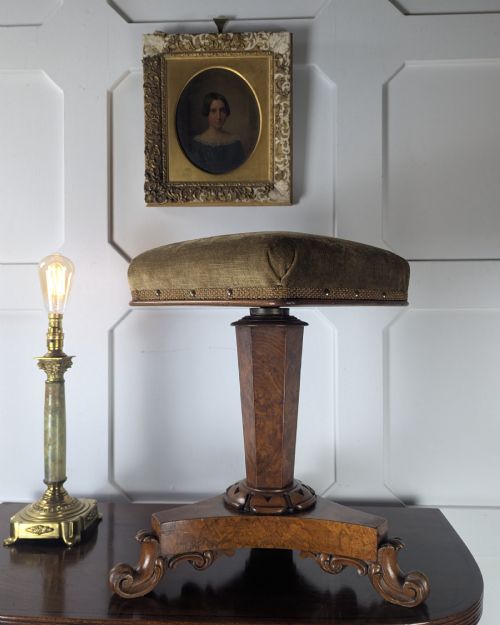
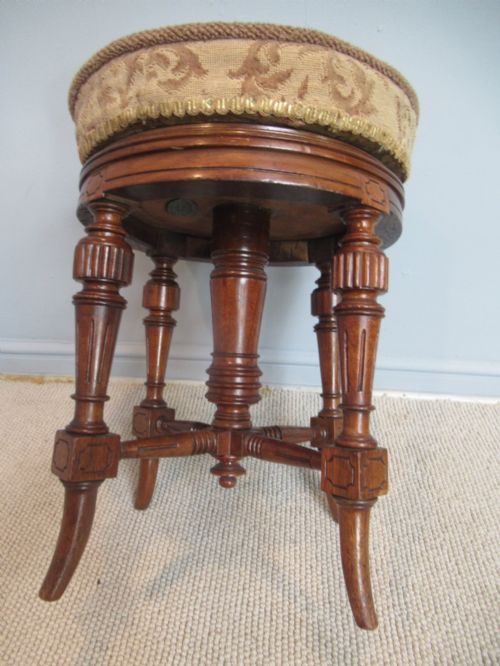
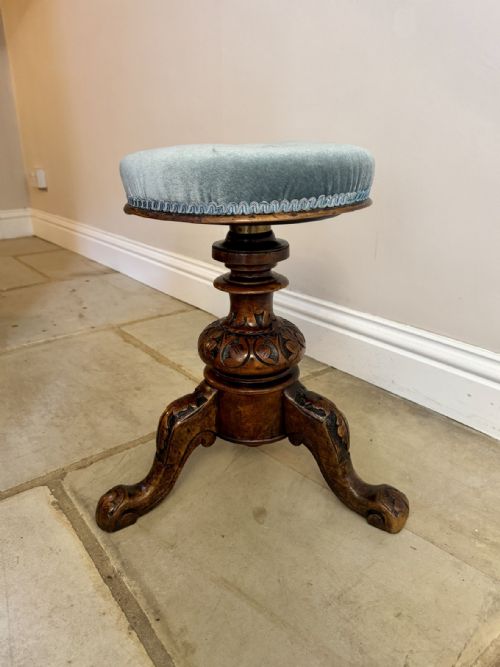
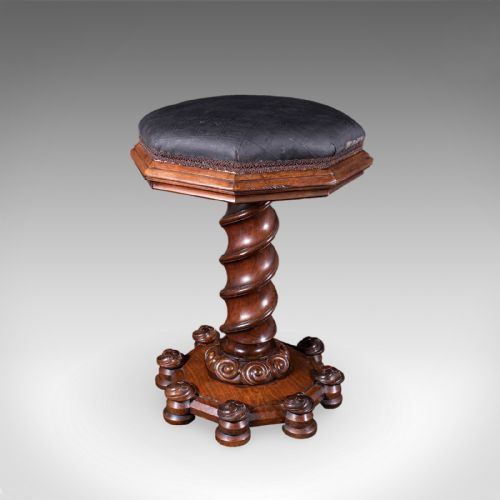


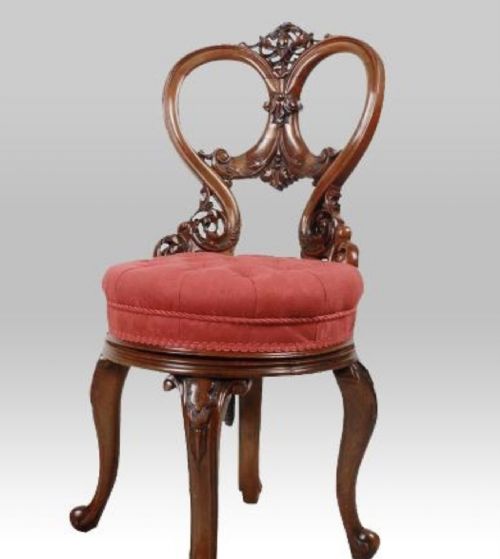


Carved Walnut Music Stool
These carved walnut music stool pieces are adjustable seating built for the piano or harp, combining solid timber frames with upholstered tops.
Carved Walnut Music Stool
A carved walnut music stool is a seated piece designed specifically for musicians at the piano, organ or harp, featuring adjustable mechanisms for height. When searching for a carved walnut music stool, buyers encounter formats ranging from simple revolving seats on pedestals to elaborate tripod and swivel designs.
The pieces visible across this selection date principally from the Victorian era, alongside examples from the Regency and William IV periods. Formats extend across piano stools, music chairs, Canterbury stools, and occasional ottomans, reflecting nineteenth-century domestic interior requirements.
Origin points span domestic workshops and international ateliers, including Italian grotto examples recorded in archive sales. The primary wood is walnut, frequently paired with secondary hardwoods and supported by iron, brass, or metal adjustment mechanisms.
Materials and construction
The primary structural timber is walnut, selected for its rich grain and suitability for detailed hand-carving along pedestals, legs, and aprons. Hardwoods provide internal stability, while iron and brass components form the internal rise-and-fall screws and swivel pivots.
Upholstery materials include velvet, leather, and assorted woven fabrics fitted over padded seats. These textile surfaces are secured to revolving or fixed frames, accommodating the movement and posture required by nineteenth-century musicians.
Listings span the nineteenth century, with Victorian production forming the majority alongside Regency and William IV pieces.
Quality factors in construction
The refinement of the hand-carving distinguishes standard production from exceptional examples, particularly in the depth and crispness of foliage and ornamental details on the pedestal or legs. Heavier, more sculptural frames such as Italian grotto walnut work demonstrate greater artisan labour.
The engineering of the revolving and adjustable height mechanisms dictates mechanical reliability. Smooth operation in the rise-and-fall screw or swivel joint indicates superior original manufacturing.
The Carved Walnut Music Stool Glossary
- Walnut
- A dense, dark hardwood prized for furniture making throughout the nineteenth century. It takes fine detail during carving.
- Revolving stool
- A seat mounted on a central threaded spindle or swivel pivot that turns through three hundred and sixty degrees. This allows the player to pivot toward sheet music cabinets.
- Canterbury stool
- A multifunctional piece combining a music seat with partitioned sections beneath for storing sheet music. It represents a practical space-saving item from the Victorian period.
- Rise and fall
- An internal mechanical screw mechanism operated by turning the seat top to adjust the playing height. It enables precise ergonomic positioning for different musicians.
Carved Walnut Music Stool: Frequently Asked Questions
How do these stools adjust in height?
Many examples utilise a central screw mechanism operated by rotating the upholstered seat top clockwise or anticlockwise. This raises or lowers the sitting surface along a threaded metal shaft.
Other variants employ mechanical levers or fixed pedestal pins, though the revolving screw remains the predominant method found on nineteenth-century music seating.
Where were these music stools placed?
They were positioned beside upright pianos, grand pianos, organs, or harp instruments in Victorian drawing rooms and music parlours. Their compact footprint allowed them to sit neatly beneath keyboard overhangs when not in use.
Beyond musical rooms, certain revolving or adjustable formats also doubled as dressing table seating in period bedrooms.
How do I distinguish Victorian from Regency styles?
Regency and William IV pieces often display heavier neoclassical influences, including simpler architectural turnings and bolder, blockier timber proportions. They generally date from the earlier decades of the nineteenth century.
Victorian pieces, particularly from the 1850s onward, tend toward more exuberant foliage carving, pierced walnut pedestal bases, and elaborate Italianate grotto motifs.
Are the upholstery fabrics original?
Most antique music stools feature later reupholstery because original nineteenth-century velvet, leather, and fabric naturally degraded from decades of friction and use. Modern replacement upholstery is standard practice to ensure functional daily use.
Underneath the top fabric layers, the webbing, stuffing, and foundational padding often combine original horsehair or springs with modern restoration work.
What is a grotto music stool?
A grotto music stool is an ornate Italian revival piece featuring naturalistic carved walnut elements shaped like seashells, coral, or rustic woodland branches. These sculptural items represent the most decorative end of nineteenth-century seating.
They appear infrequently in archives and offer a dramatic alternative to standard pedestal piano stools.