

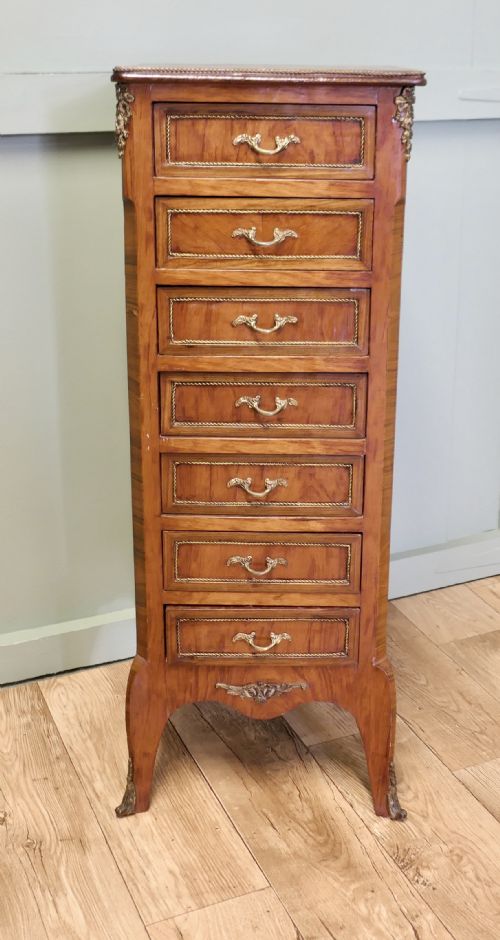
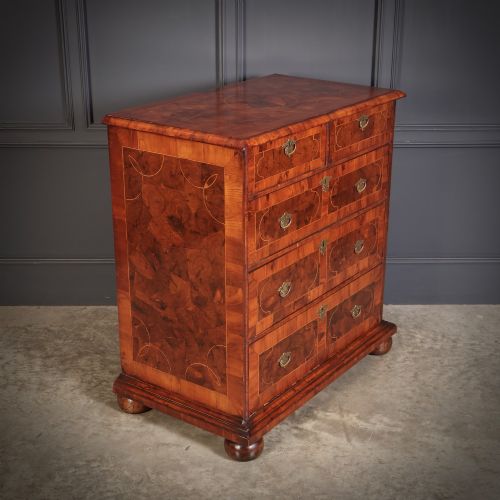
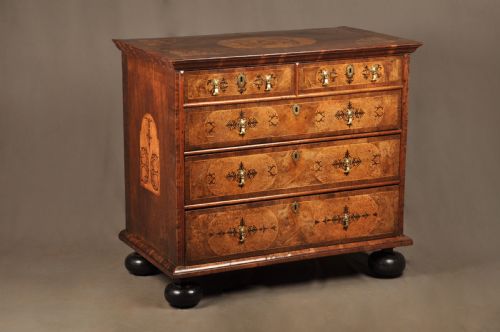
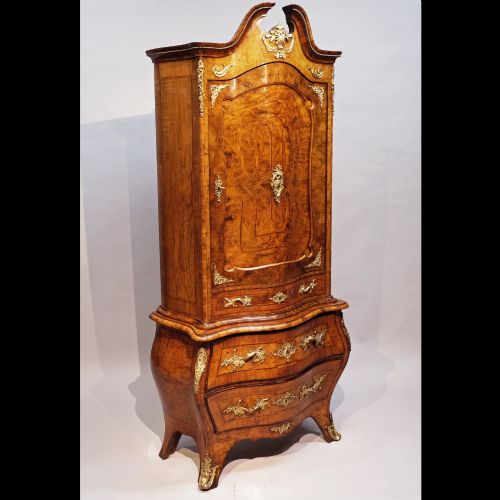


Walnut Marquetry Tallboy
A walnut marquetry tallboy brings floral and arabesque pattern to high-storage furniture through striking wood veneers.
Walnut Marquetry Tallboy
A walnut marquetry tallboy combines stacked drawer storage with intricate surface decoration, uniting large timber carcasses with delicate inlaid motifs. When you search for this phrase, you find tall chests, cabinets on chests, and linen presses designed to maximise vertical capacity while displaying complex pictorial or geometric veneers.
The versions met most frequently on this page originate from the seventeenth and eighteenth centuries, notably featuring Dutch and William and Mary styles. Alongside these, nineteenth-century interpretations appear, demonstrating how later makers adapted earlier inlay techniques for Victorian and continental tastes.
How they were made
Craftsmen built these pieces using solid oak or walnut carcases as a stable foundation for decorative surface veneers. Thin slices of walnut, burr walnut, fruitwood, and boxwood were carefully sawn and fitted together to create elaborate floral or arabesque patterns.
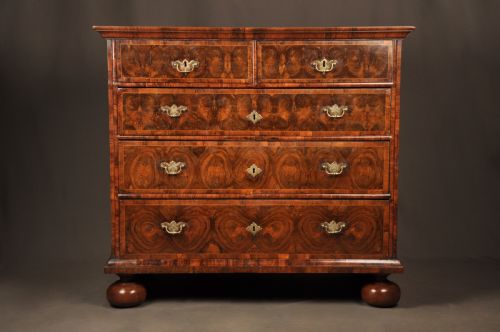
Inlaid brass hardware, ormolu mounts, and contrasting woods like boxwood or fruitwood added definition to the primary walnut ground. Oyster veneering, cut in circular cross-sections from smaller branches, created distinctive repeating circular patterns across seventeenth-century drawer fronts.
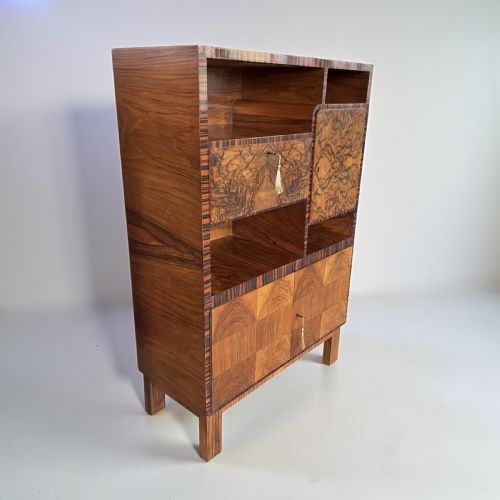
The listings span from seventeenth-century oyster veneered pieces to twentieth-century Art Deco cabinets, using walnut, brass, fruitwood, and oak.
What varies in quality
The finesse of the marquetry cutting distinguishes simpler panels from masterwork execution, where shading and diverse timber species create convincing depth in floral designs. Precision in matching the grain across drawer fronts and the alignment of complex arabesques reveal the maker's discipline.
The choice of primary timber also sets pieces apart, with highly figured burr walnut and rich olive oyster veneers demanding superior selection and preparation. Structural integrity, including original brass handles and well-fitted drawer linings, separates well-preserved examples from heavily restored instances.
Holland & Sons
The Walnut Marquetry Tallboy Glossary
- Marquetry
- Decorative veneer work forming pictorial or geometric patterns using various coloured woods applied to a carcase. This technique defines the visual surface of many seventeenth and eighteenth-century pieces.
- Oyster veneering
- Slices of wood cut across small branches to display circular grain patterns resembling oyster shells. It appears frequently on seventeenth-century walnut furniture.
- Tallboy
- A tall chest of drawers, often constructed in two sections with a smaller chest stacked upon a larger base. These pieces provide substantial vertical storage capacity.
- Arabesque
- Curvilinear scrollwork inlay derived from Islamic art, popular in late seventeenth-century marquetry designs. It often frames floral urns or central medallions on drawer fronts.
- Burr walnut
- Timber taken from a tree growth, producing swirling, highly figured grain patterns highly prized for cabinet fronts. It offers rich visual texture distinct from straight-grained walnut.
Walnut Marquetry Tallboy: Frequently Asked Questions
What is a walnut marquetry tallboy?
A tall chest of drawers or cabinet surfaced with decorative inlaid wood veneers arranged in floral or geometric patterns.
These pieces combine vertical storage with intricate craftsmanship using timbers like walnut, fruitwood, and boxwood.
How do I date a tallboy?
Examine the construction methods, handle hardware, and veneer types against known period styles like William and Mary or Dutch Baroque.
Seventeenth-century examples often feature oyster veneers and arabesques, while eighteenth-century pieces favour expansive floral marquetry.
Where were these cabinets made?
Production centred largely in England and the Netherlands, with distinct regional preferences in floral motifs and carcase proportions.
Dutch makers frequently employed lively floral marquetry, whereas English pieces often utilised structured oyster veneers.
How should I care for veneer?
Keep the wood away from direct sunlight and sudden temperature shifts to prevent the thin timber layers from lifting.
Apply traditional wax polish sparingly to maintain the natural lustre of the walnut without building up heavy residues.