
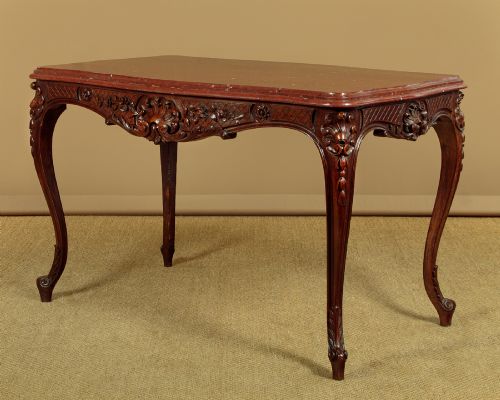
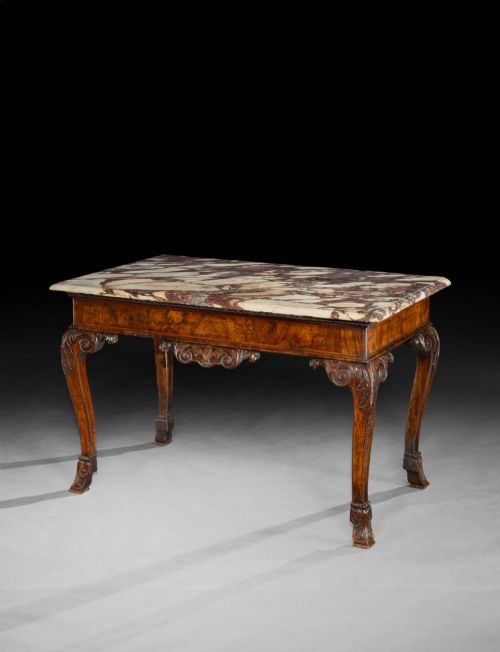
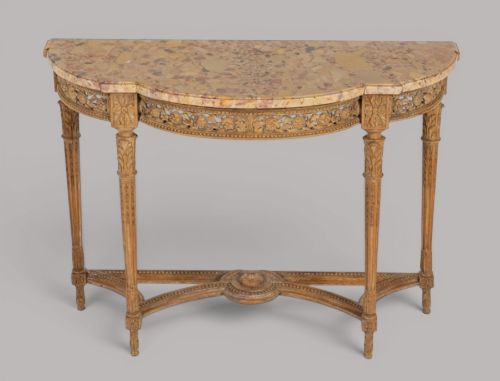
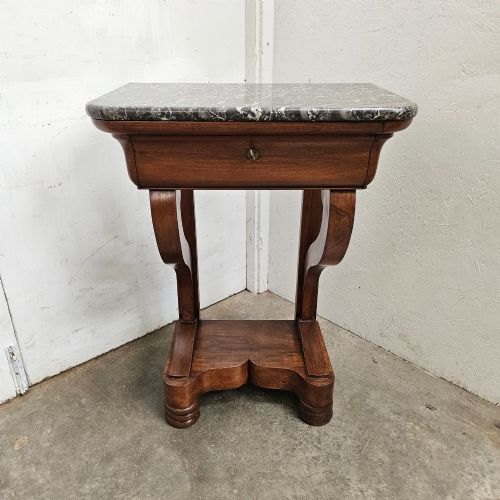



Walnut Marble Console Table
A walnut marble console table brings the sculptural weight of carved timber and the cool polish of stone together in a grand room.
Walnut Marble Console Table
A walnut marble console table is typically a side piece designed to stand against a wall, frequently paired with a matching pier mirror in nineteenth-century interiors. These furnishings span from the eighteenth century into the twentieth, drawing on French, Italian and British cabinet-making traditions.
The common form on this page pairs a substantial wooden base with a fitted stone slab, ranging from compact demi-lune shapes to grand reception room tables. Pieces appear across various revivals, including Louis XV, Louis XVI, George II and French Empire styles.
Makers utilised dense timber frames, often featuring burr walnut veneers or intricate marquetry patterns alongside parcel gilding. The stone tops vary from white and grey varieties to striking rouge and breccia marbles.
Materials and construction
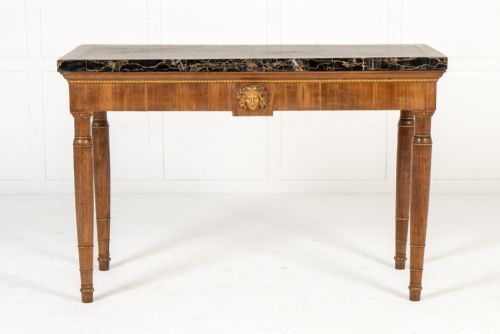
Makers built the heavy structural frames using European and American walnut, frequently applying figured or burr veneers to the primary surfaces for visual depth. Ormolu mounts, brass details and parcel gilt highlights provide decorative contrast against the dark timber.
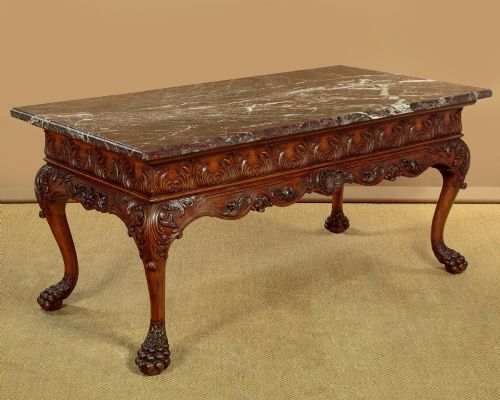
The stone slabs rest directly on the wooden carcass, shaped to follow straight, serpentine or demi-lune profiles. Heavy hand-carving defines the bases, featuring scrolled legs, floral motifs and occasionally figural supports.
Some nineteenth-century makers pushed whimsy to the edge by carving entire side table bases in the lifelike form of seated hounds.
Judging quality and character
The distinction between standard domestic pieces and top-tier examples lies in the crispness of the timber carving and the choice of stone. Superior tables display deep, hand-chiseled relief work on the walnut frame and thick, highly figured marble slabs.
Construction methods also separate the grades, with finer pieces showing precise marquetry inlay, well-matched burr walnut veneers, and robust structural joinery beneath the heavy top. Signed workshop pieces or those with documented regional origins carry additional distinction.
Gillows
The Walnut Marble Console Table Glossary
- Demi-lune
- Having a half-moon or semicircular shape designed to fit flat against a wall. This format was especially popular for French and Continental console tables.
- Marquetry
- The art of applying decorative veneer pieces to a structure to form intricate designs. Craftsmen used various tinted woods to create complex geometric or floral patterns.
- Ormolu
- Gilded bronze applied as mounts and decorative highlights on furniture frames. The technique involves coating cast bronze with a finely ground mercury and gold amalgam.
- Parcel gilt
- Partly gilded with gold leaf to accent specific carved details on the timber. This treatment highlights architectural elements like scrolls and acanthus leaves against dark walnut.
- Serpentine
- Having a wave-like front contour with a central outward curve flanked by inward curves. This flowing line adds movement and sophistication to the table base and marble top.
Walnut Marble Console Table: Frequently Asked Questions
Where should I place a console table?
These pieces suit entrance halls, drawing rooms and dining spaces where a shallow surface is practical.
They sit flat against a wall, frequently positioned beneath a tall mirror or artwork to anchor the room's proportions.
How do I care for the marble top?
Marble requires gentle cleaning with mild, pH-neutral soap and warm water to protect the polished surface.
Avoid acidic liquids like wine or citrus juice, which can etch the stone if left standing.
Are these tables freestanding?
Traditional console tables were designed to anchor against a wall, sometimes featuring simpler back legs or wall fixings for stability.
Centre tables, by contrast, are finished on all four sides for placement in the middle of a room.
How do I date a walnut console?
Dating relies on stylistic clues like the curve of a cabriole leg, the presence of marquetry, and the thickness of the timber framing.
Earlier eighteenth-century examples display robust proportion and hand-cut joinery, while later nineteenth-century revival pieces incorporate eclectic decorative motifs.