
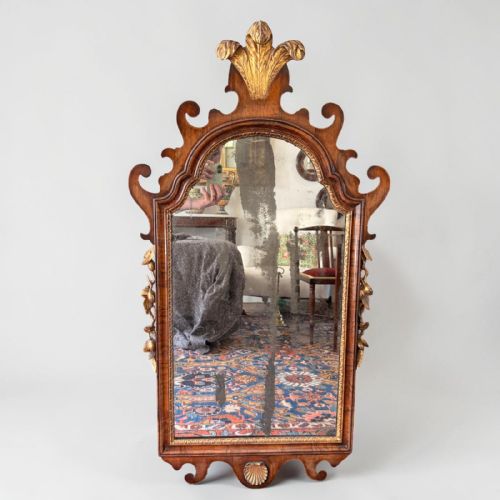

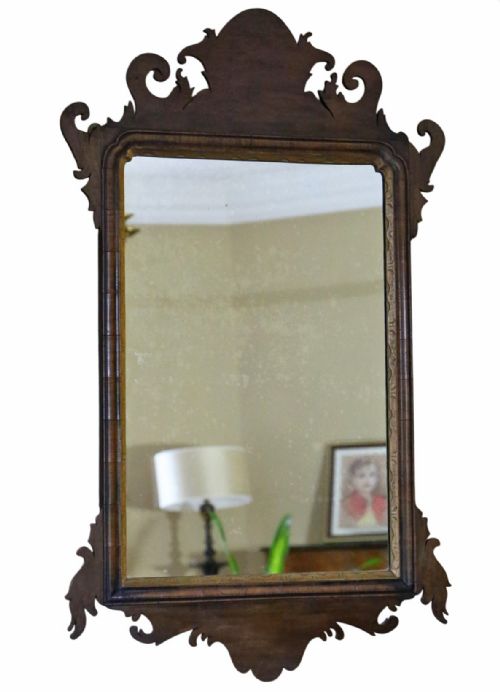


Walnut Fretwork Wall Mirror
A walnut fretwork wall mirror brings architectural line and deep, warm grain to a room, offering the refined proportions typical of eighteenth-century design.
Walnut Fretwork Wall Mirror
A walnut fretwork wall mirror is a hanging looking glass defined by its pierced, scroll-cut wooden frame. These pieces emerge primarily in eighteenth-century forms during the Georgian, George II, and George III periods, alongside later revivals from the nineteenth century and around nineteen-twenty.
The most common examples on this page follow Georgian and George II styles, frequently incorporating parcel-gilt details or the distinctive outlines associated with Chippendale designs. Makers utilised figured timbers, such as burr walnut and wood veneer, to give the flat surfaces visual depth.
Wall mirrors and pier-glasses of this type serve both utilitarian and decorative purposes, historically positioned above mantelpieces or between windows. Whether seventeenth-century in spirit or from a later revival, each piece relies on balanced fret-cut scrolls to frame the mirror glass.
Distinctions in quality
Quality rests in the precision of the fret-cut piercing and the crispness of the scrollwork, where sharper edges denote superior workmanship. The choice of timber also elevates a piece, with richly figured burr walnut commanding greater attention than plain grain.
The retention of original mirror glass and early gilding preserves the integrity of the object. Finer examples display harmonious proportions between the central plate and the surrounding fretwork frame, whereas lesser versions can feel compressed or heavy.
Listings span the eighteenth century, the Victorian era, and nineteen-twenty revivals, using walnut, burr walnut, giltwood, and mirror glass.
The Walnut Fretwork Wall Mirror Glossary
- Fretwork
- Openwork ornamentation cut with a fretsaw to create geometric or scroll patterns in thin wood. This technique defines the silhouette of the frame.
- Parcel-gilt
- Partially gilded with thin gold leaf on specific carved details against a walnut background. It highlights architectural elements such as gilded mouldings or side scrolls.
- Pier-glass
- A tall wall mirror designed to hang on the narrow pier of wall between windows. These mirrors reflect natural light into eighteenth-century interiors.
- Vauxhall mirror
- A type of antique mirror glass characterised by a bevelled edge and subtle imperfections from early manufacturing methods. Such plates add authenticity to period pieces.
Walnut Fretwork Wall Mirror: Frequently Asked Questions
How do I date a walnut fretwork wall mirror?
Dating relies on examining the construction methods of the wooden frame, the thickness and bevelling of the mirror glass, and the specific style of the fret-cut scrolls. Eighteenth-century examples show hand-cut joinery and period timber patination.
Later revivals from the nineteenth century or nineteen-twenty often copy Georgian or George II designs but utilise machine-sawn fretwork and modern backing timbers.
What is the difference between George II and Georgian styles?
George II refers specifically to the reign from seventeen-twenty-seven to seventeen-sixty, known for robust architectural forms, parcel-gilt details, and heavy walnut veneers. Georgian is a broader term covering the entire eighteenth century.
Mirrors from the George II period often display intricate fret-cut scrollwork and hoho birds, while later Georgian pieces incorporate neoclassical influences.
Are these mirrors suitable for modern walls?
These pieces function effectively in contemporary interiors by introducing historical texture, organic wood grain, and reflective light. Their slender fretwork silhouettes suit hanging above mantelpieces, sideboards, or in hallways.
Wall fixings must be chosen carefully to support the weight of the solid wood frame and glass safely.
Why do some mirrors feature gilded details?
Giltwood and parcel-gilt accents were applied to highlight specific carved elements, such as ears, outer mouldings, and crests. This contrast between dark walnut and bright gold leaf creates visual depth.
Original gilding shows a softer metallic tone acquired through age, distinguishing period work from later restorations.