

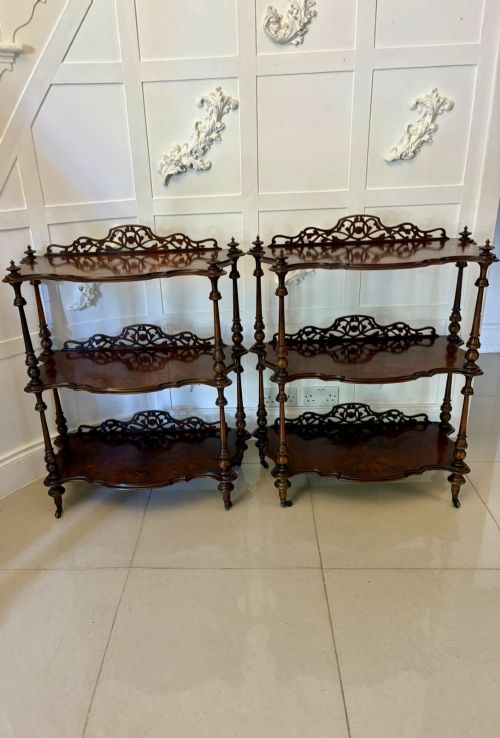
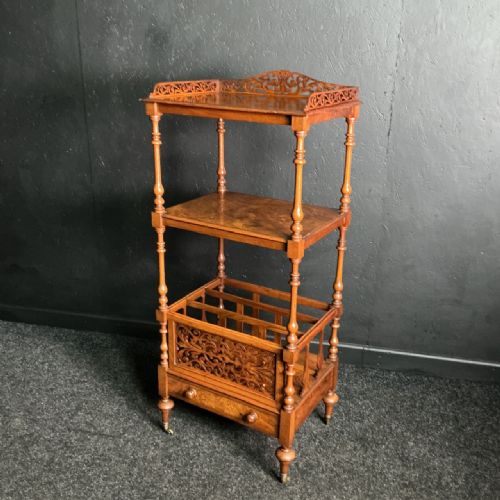


Walnut Fretwork Shelf
These walnut fretwork shelf designs deliver Victorian display practicality with rich timber character, offering structured surfaces for ornaments and collections.
Walnut Fretwork Shelf
A walnut fretwork shelf appears in forms such as corner whatnots, wall brackets, and multi-tiered display stands, spanning the Victorian period from eighteen sixty to eighteen eighty. These pieces function primarily as decorative furniture designed to hold small ornaments, books, and curiosities within nineteenth-century interiors.
The most common versions on this page are corner whatnots and display stands, utilising the corner or wall space efficiently. They emerge across Victorian, Victorian Rococo Revival, and Victorian Italianate styles, reflecting the eclectic taste of the nineteenth century.
Makers of the era constructed these shelves using walnut and burr walnut, frequently incorporating inlay, glass, and brass details. The physical forms range from three-tierhanging units to six-tier floor-standing display shelves and demi-lune console tables.
How they were made
Joiners and cabinetmakers selected walnut and burr walnut for its distinctive grain patterns, often applying paint or marquetry inlay to enhance the decorative surface. Timber preparation required careful seasoning to prevent warping in the multi-tiered structures.
Construction involved joining shaped shelves to vertical supports, which occasionally took the form of hollow barley twists or turned uprights. Brass and glass components were integrated into the design to add structural contrast and visual lightness.
Fretwork elements were hand-cut or pierced from thin wood panels, creating openwork patterns that defined the aesthetic of the display brackets and whatnot tiers.
The inventory records pieces spanning the Victorian era, including dated examples from eighteen sixty and eighteen eighty.
What varies in quality
The selection of timber grain significantly separates standard production from finer examples, particularly where burr walnut veneer displays complex figure and depth. Superior pieces exhibit precise marquetry inlay and clean, crisp fretwork rather than plain or heavily simplified cutting.
Structural complexity influences the standing of a piece within the range, distinguishing simple three-tier shelves from elaborate six-tier displays with barley twist columns or demi-lune console forms. The integration of auxiliary materials like brass fittings and glass panels indicates the original maker's ambition and investment in the commission.
The Walnut Fretwork Shelf Glossary
- Whatnot
- A piece of furniture consisting of a set of open shelves for displaying small objects. These tiered stands became popular in the nineteenth century for drawing rooms and parlours.
- Burr Walnut
- A specialised timber veneer taken from the warted growths on walnut trees. It yields swirling, highly decorative grain patterns prized by Victorian cabinetmakers.
- Demi-Lune
- A half-moon shape used for console tables and wall-mounted furniture. This profile allowed tables and shelves to sit flush against a wall while projecting into the room.
- Marquetry
- The art of applying pieces of veneer to a structure to form decorative patterns. Craftsmen utilised various woods to create pictorial or geometric designs on the surface.
- Barley Twist
- A turned column carved in a spiral shape resembling a twist of barley. This decorative woodworking technique appears frequently on Victorian upright supports.
Walnut Fretwork Shelf: Frequently Asked Questions
What rooms suit a walnut shelf?
These pieces fit naturally into living rooms, hallways, and studies where display space for small items is required. Their vertical orientation makes them particularly useful in corners or narrower circulation areas.
Selecting a wall-mounted bracket or a corner whatnot allows you to utilise unused architectural angles without crowding the floor plan.
How do I date a Victorian whatnot?
Dating relies on observing stylistic markers, timber choice, and construction methods recorded across the nineteenth-century timeline. Pieces from eighteen sixty to eighteen eighty often feature specific revival motifs and distinct veneer preparations.
Compare the turning of the uprights and the complexity of any inlay against dated examples from the same decade to narrow down the period.
Are these shelves structurally strong?
Tiered display stands and corner units were built to hold porcelain, books, and decorative objects rather than heavy loads. The integrity of each tier depends on the original joinery and the condition of the upright supports.
Placing balanced arrangements across the shelves ensures the weight distributes evenly down through the vertical framing.
How should I maintain burr walnut?
Burr walnut benefits from consistent indoor humidity levels and protection from direct sunlight to preserve the finish and prevent veneer lifting. Regular dusting with a dry, soft cloth maintains the surface sheen.
Applying specialised wax sparingly helps nourish the timber grain without building up a heavy residue over the intricate fretwork.