
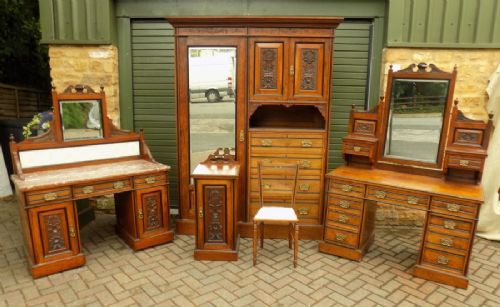


Walnut Duchess Dressing Table
A walnut duchess dressing table brings distinct Victorian character into a bedroom with its generous surface and central mirror.
Walnut Duchess Dressing Table
A walnut duchess dressing table is a substantial piece of Victorian bedroom furniture defined by its large central mirror and fitted surface. These items appear primarily from the Victorian period, spanning the nineteenth century down to eighteen ninety, and often form part of larger bedroom suites.
The form typically incorporates a low superstructure with drawers alongside a pivoting or fixed mirror plate. Alongside standard dressing tables, related variants such as toilet mirrors and pedestal dressing tables emerge within the records.
Most examples rely on rich burr walnut veneers to create striking figure on the main surfaces. Stylistic influences occasionally drift into the Aesthetic Movement, introducing ebonised details or carved elements to the traditional framework.
How they were made
Cabinet makers utilised figured burr walnut veneers laid over secondary timbers to produce rich patterns across the primary surfaces. Solid walnut provided the structural framework for pedestals, supports, and carved details.
Glass panels formed the large tilting mirrors central to the duchess form, whilst brass hardware supplied handles and swing pins. Marble inserts occasionally appeared on related bedroom pieces to provide durable display surfaces.
A few Victorian makers added secret piano-top mechanisms to hide compartments beneath the main dressing surface.
What varies in quality
The fineness of the burr walnut veneer selection dictates much of the visual appeal, with tighter and more even figuring marking superior examples. Carved ornamentation ranges from simple linear mouldings to deeply worked foliage and scrolls.
Structural proportions and the weight of the timber used in the pedestals define the overall presence of the piece. The clarity of the mirror glass and the integrity of the original brass fittings further separate standard workshop production from finer cabinet work.
The Walnut Duchess Dressing Table Glossary
- Burr walnut
- A veneer sliced from the knotty growths of walnut trees, prized for its swirling grain patterns. This material defines the primary decorative surface of almost every piece recorded.
- Duchess dressing table
- A large Victorian dressing table featuring a raised back with a central mirror and accessory drawers. It serves as the primary furniture type seen across the archive.
- Toilet mirror
- A smaller tabletop mirror resting on its own miniature set of drawers. These items share the reflective purpose and wood choice of the larger dressing tables.
- Pedestal dressing table
- A configuration where banks of drawers support the main tabletop rather than slender legs. This layout adds substantial storage beneath the surface.
- Aesthetic Movement
- A late nineteenth century design style prioritising visual beauty over traditional historical revival. Pieces influenced by this movement introduce simplified lines and contrasting dark finishes.
Walnut Duchess Dressing Table: Frequently Asked Questions
What is a duchess dressing table?
A duchess dressing table is a large nineteenth century vanity unit featuring a prominent central mirror and small trinket drawers on the superstructure.
These pieces emerged during the Victorian era and were built to anchor a bedroom suite with matching wardrobes and washstands.
How do I date a walnut dressing table?
Dating relies on observing construction methods, timber choices, and stylistic cues such as Victorian carving or Aesthetic Movement ebonisation.
Most recorded examples date from the mid to late nineteenth century, specifically between eighteen fifty and eighteen ninety.
Are these dressing tables made of solid walnut?
Cabinet makers typically applied thin veneers of figured burr walnut over solid foundational timbers to create decorative patterns.
Solid walnut was reserved for structural elements, frames, and carved mouldings where strength and shaping were required.
How do I care for burr walnut veneer?
Burr walnut requires stable room humidity and protection from direct sunlight to prevent the timber and underlying glue from drying out.
Regular dusting with a dry cloth keeps the surface clean without risking moisture damage to the antique polish.