
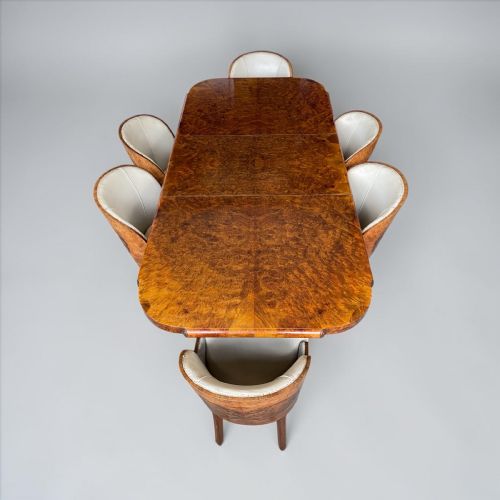
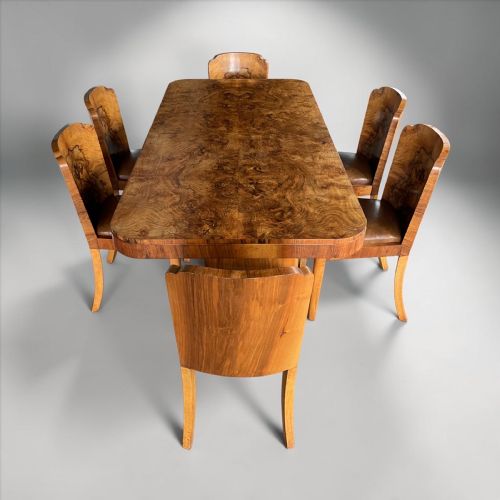
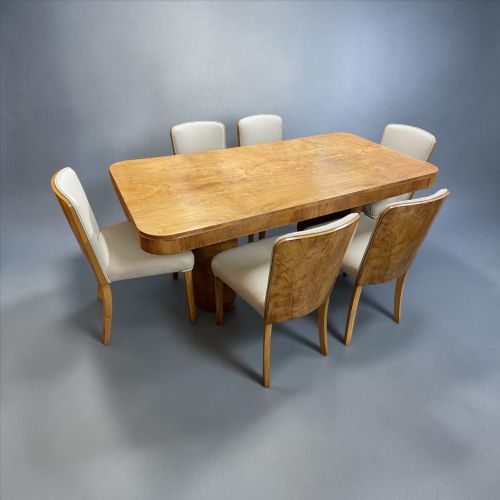


Walnut Dining Suite
A walnut dining suite brings warmth and formal symmetry to the room, uniting dining tables, chairs, and sideboards in matching timber.
Walnut Dining Suite
A walnut dining suite gathers matching tables, chairs, and sometimes sideboards or cabinets into a single coordinated ensemble for the dining room. These groupings appear across several periods, most notably in Art Deco designs from the 1930s alongside earlier Victorian and Edwardian examples.
The most common configurations on this page pair a dining table with sets of four, six, or eight chairs, occasionally accompanied by a matching buffet or server. Makers such as Maurice Adams, Harry and Lou Epstein, and Hille of London shaped many of the twentieth-century variations seen here.
Earlier nineteenth-century iterations lean toward Victorian and Queen Anne revival styles, incorporating button-back upholstery or carved details. Buyers encounter everything from compact four-chair sets to twelve-piece dining room suites complete with auxiliary cabinetry.
What separates different examples
The distinction between standard production and top-tier execution rests in the choice of timber veneer and the precision of the joinery. Suites featuring highly figured burr walnut across expansive tabletop surfaces command attention for their visual depth and balanced grain matching.
Attribution to notable workshops or makers such as Maple and Co, Shoolbred, or Gillow elevates an ensemble through documented craftsmanship and maker's stamps. The integrity of the original upholstery materials, leather seats, and carved framing also influences the standing of each suite.
Materials recorded across these suites include solid wood, timber, burr walnut, leather, fabric, and textile upholstery.
Maurice Adams·Harry and Lou Epstein·Shoolbred·Hille London·Maple and Co·Gillow
The Walnut Dining Suite Glossary
- Burr walnut
- A prized timber veneer sourced from tree growths, yielding intricate, swirling grain patterns that decorators use on prominent furniture surfaces. It appears frequently on tabletops and cabinet doors within twentieth-century suites.
- Art Deco
- A design style prominent in the 1930s characterised by sleek geometric lines, smooth surfaces, and stylised motifs. Suites from this period often pair black walnut or burr walnut with leather seating.
- Queen Anne style
- A traditional furniture aesthetic featuring cabriole legs, pad feet, and graceful curved lines. Several Edwardian and later suites adopt this revival look for chairs and dining tables.
- Empire revival
- A neoclassical style drawing on French and Roman imperial designs, known for substantial proportions and carved wooden ornamentation. Pieces from this tradition often utilise darker walnut timber.
- Button-back
- An upholstery technique where buttons are pulled deep into the padding to create a tufted diamond pattern. This method appears on Victorian chairs within the archive.
Walnut Dining Suite: Frequently Asked Questions
What pieces come in a complete walnut dining suite?
A complete dining suite typically comprises a dining table paired with a matching set of chairs, which can range from four to twelve seats. Larger ensembles often include coordinating sideboards, buffets, cabinets, or servers.
Buyers also find smaller five-piece drawing room sets and parlour suites designed for adjacent spaces.
How do I identify an Art Deco walnut dining suite?
Art Deco dining suites generally date from the 1930s and feature streamlined silhouettes, geometric shapes, and highly figured burr walnut or black walnut veneers. Makers such as Harry and Lou Epstein and Hille defined this look with clean lines and matching leather chairs.
These suites eschew heavy Victorian carving in favour of smooth, polished wood surfaces that highlight the natural grain.
What is the difference between Victorian and 1930s walnut suites?
Victorian walnut suites, often dating from the late 19th century, display traditional craftsmanship with carved details, button-back upholstery, and Queen Anne or Victorian revival forms. They tend to have darker timber finishes and heavier proportions.
By contrast, 1930s suites embrace Art Deco minimalism, focusing on burr walnut grain patterns, curved table edges, and unadorned surfaces.
How should I care for a burr walnut dining table?
Burr walnut veneer requires gentle cleaning with a soft, dry cloth to remove dust without scratching the polished surface. Avoid placing hot items or liquids directly onto the wood to protect the delicate grain.
Keeping the suite away from direct sunlight and extreme temperature fluctuations preserves the colour and prevents the timber from drying out.