
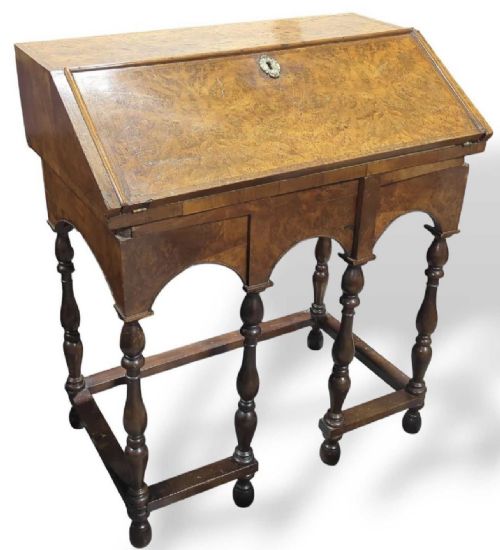

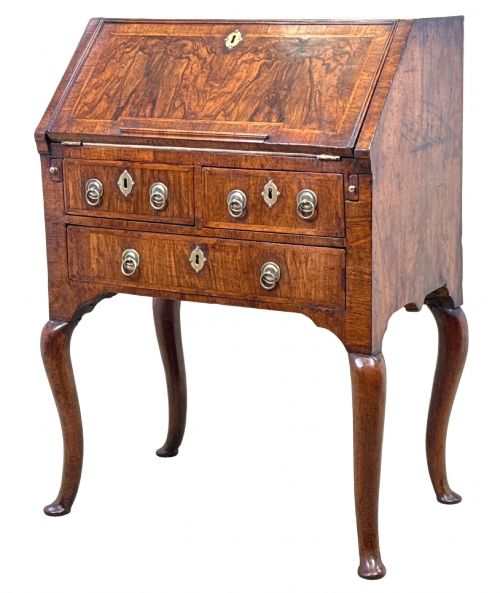


Walnut Bureau on Stand
A walnut bureau on stand combines a fall-front writing surface with a raised support, offering compact elegance and fitted interior compartments.
Walnut Bureau on Stand
When you search for a walnut bureau on stand, you encounter writing furniture elevated on legs or a base frame, originating across periods from the seventeenth century through to the twentieth century revival eras. These pieces typically feature a drop-down flap that conceals small drawers and pigeonholes, supported by various leg configurations.
The most common examples you meet on this page span the William and Mary, Queen Anne, and George I styles, alongside later nineteenth and early twentieth century interpretations. They range from compact ladies writing desks to substantial South German cabinets on stands.
Makers utilised timber grains to decorative effect, producing writing cabinets and desks that balance display and practical storage.
Materials and construction
The construction relies on walnut timber, frequently enhanced with burr walnut or oyster walnut veneer laid over secondary woods such as oak and elm. Cabinet makers cut thin concentric circles or swirling sections of timber to create patterned surfaces on the fall-fronts and drawer fronts.
Brass hardware, including escutcheons, drop handles, and hinges, secures and ornaments the structure. Marquetry inlay and carved details appear on selected examples, adding decorative contrast to the figured wood grain.
Listings include walnut, burr walnut, oyster walnut veneer, oak, elm, and brass across seventeenth-century to twentieth-century periods.
Judging quality in walnut furniture
Quality rests upon the selection and matching of the veneer, where symmetrical grain patterns across the fall-front demonstrate superior craftsmanship. The depth of colour and the preservation of the original timber surface distinguish finer examples from later alterations.
The interior fitments, including secret compartments and well-constructed small drawers, indicate the skill invested by the cabinet maker. Structural integrity in the stand and legs, especially where weight is distributed, marks the difference between standard production and exceptional work.
Adriano Brambilla
The Walnut Bureau on Stand Glossary
- Bureau on stand
- A writing desk with a fall-front flap, raised on a distinct base or frame with legs. This form elevates the writing compartment off the floor.
- Oyster walnut veneer
- Timber sliced transversely from small branches to create circular, oyster-like patterns. This technique was favored in the seventeenth century.
- Fall-front
- A hinged writing flap that drops down to reveal an interior fitted with pigeonholes and small drawers. It serves as a desktop when opened.
- Burr walnut
- Wood taken from a tree growth or burl, yielding swirling, knotty grain patterns. It provides high visual texture on cabinet fronts.
- Marquetry
- Inlaid wood pieces arranged in geometric or floral designs on a veneer background. This decorative method enhances surface detail.
Walnut Bureau on Stand: Frequently Asked Questions
What is a walnut bureau on stand?
A walnut bureau on stand is a compact writing desk featuring a fall-front flap that opens for correspondence, elevated on an open base with legs.
These pieces combine enclosed storage with a raised profile, originating in seventeenth and eighteenth-century forms and reappearing in later revival styles.
How do I identify William and Mary style?
William and Mary style pieces often exhibit oyster veneer, geometric marquetry, and distinctive tall leg stands connected by stretchers.
Proportions remain relatively upright and linear, reflecting late seventeenth-century design preferences seen in walnut writing cabinets.
Where were these desks placed?
These desks were historically positioned in private bedchambers, withdrawing rooms, or small studies for managing personal correspondence.
Their elevated stands and modest footprints allowed them to fit easily into principal rooms without dominating the floor space.