


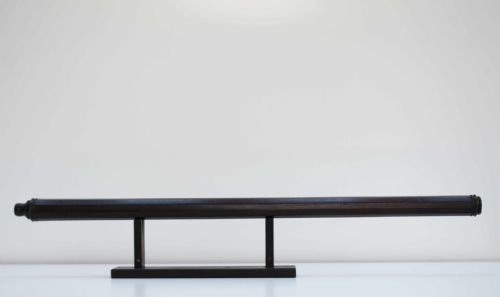
Vintage Terrestrial Telescope
These vintage terrestrial telescope examples offer a practical view of historical optics, built for land observation.
Vintage Terrestrial Telescope
When you search for a vintage terrestrial telescope, you encounter optical instruments designed primarily for viewing distant land objects rather than stars. These extendable brass tubes bring distant views into sharp focus through terrestrial lens arrangements that present images the right way up.
The pieces on this page span several centuries, running from mid eighteenth century designs through Georgian, Victorian, and Edwardian eras. You meet library models, small three-draw pocket versions, and military campaign configurations.
Makers such as Steward of London, Broadhurst Clarkson and Co, Cary London, L. Casella, and John Gilbert appear across these English scientific instruments. The form shifts from decagonal reverse taper tubes to leather-bound portable cylinders and large brass stands.
How they were made
Makers constructed these tubes predominantly from polished brass, often combining multiple draw sections to achieve variable length and focus. Metalwork was frequently paired with hand-stitched leather coverings or turned wooden bodies in mahogany and fruitwood.
Optical systems relied on glass lenses fitted within the brass draws, with early examples utilising non achromatic configurations. External metal surfaces received careful hand finishing, while inscriptions were engraved directly into the brass barrel.
What varies in quality
The refinement of the optical glass and the precision of the brass draw tubes determine the clarity and mechanical action of each instrument. Tighter tolerances in the sliding sections allow smoother extension without play between the brass cylinders.
Materials such as finely grained mahogany or stitched leather wrappings indicate the original tier of production, alongside the complexity of early non achromatic or multi-draw lens assemblies.
Steward of London·Broadhurst Clarkson and Co·Cary London·L Casella London·John Gilbert
The Vintage Terrestrial Telescope Glossary
- Terrestrial telescope
- An optical instrument designed for viewing objects on land, incorporating erecting lenses so the image appears upright. These contrast with astronomical models that typically show inverted images.
- Draw
- A sliding brass tube section that extends to focus the telescope. Multi-draw examples collapse into compact lengths for transport.
- Non achromatic
- An early lens configuration that predates the correction of chromatic aberration. It represents eighteenth century optical construction before modern glass combinations became standard.
- Library telescope
- A larger stationary instrument intended for interior use on a table or stand rather than handheld portability in the field.
Vintage Terrestrial Telescope: Frequently Asked Questions
How do I use a terrestrial telescope?
Extend the brass draw tubes fully until the internal lenses click or hold firm into alignment. Point the objective end toward your distant subject and adjust the final draw slowly until the image sharpens.
Keep the glass clean using appropriate optical cloths and store the instrument in a collapsed position to protect the interior tubes from dust and bending.
What is a military campaign telescope?
These robust instruments were built for field use by officers, featuring protective exterior materials like leather to withstand rough handling outdoors. Their multi-draw design allowed rapid deployment and compact storage in luggage.
They represent a specific utilitarian branch of optical manufacturing focused on durability during active service.
How do I date an antique telescope?
Examine the engraved maker signature on the brass barrel, as well as the address style and optical configuration. Eighteenth century examples often display simpler non achromatic lens setups and tapered decagonal shapes, while Victorian versions frequently utilise leather grips and multiple draws.
Stylistic shifts in typography on the maker inscription also provide reliable clues to the decade of manufacture.
Are these telescopes meant for daily viewing?
While these instruments remain functional optical devices, many owners treat them primarily as historical display pieces. Historic glass and brass require gentle handling to preserve their original condition.
If you choose to use them outdoors, support the extended brass barrels carefully to prevent strain on the historical joints.