
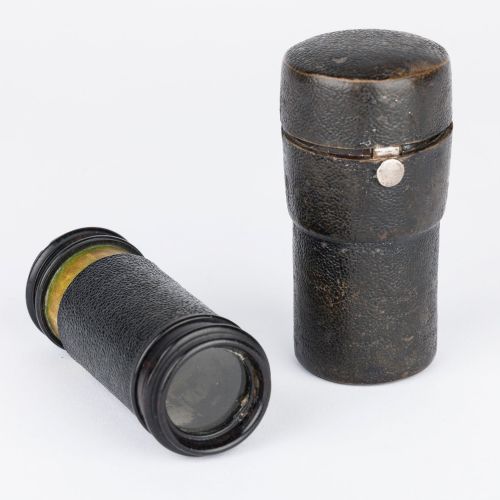


Antique Maritime Spyglass
An antique maritime spyglass is a portable optical instrument designed for navigation and reconnaissance at sea, prized for its mechanical ingenuity and tactile brass construction.
Antique Maritime Spyglass
The antique maritime spyglass category encompasses historical telescopes, monoculars, and navigational instruments spanning the eighteenth, nineteenth, and early twentieth centuries. These pieces reflect the technological progression of maritime optics from simple draw configurations to sophisticated officer of the watch and marine telescopes.
Most examples encountered on this page date from the Victorian and Edwardian periods, alongside earlier Georgian and Regency specimens. Formats range from compact pocket spyglasses to larger multi-draw instruments intended for shipboard use.
Materials and Construction
Makers constructed these instruments primarily from polished brass, often pairing the metal tubes with stitched leather, oak, mahogany, or walnut grips. Glass lenses provided the essential optical magnification, while internal cardboard or brass spacer tubes maintained alignment within the draw sections.
Assembly relied on precise lathe-turned brass barrels and draw tubes that slid smoothly into one another. Specialised makers incorporated hexagonal, decagonal, or tapered profiles to enhance grip and structural rigidity during use at sea.
Listings include instruments rendered in brass, leather, oak, walnut, mahogany, and cardboard, spanning the eighteenth century through the Edwardian era.
Factors of Quality
Quality in these instruments depends upon the precision of the draw action, the clarity and configuration of the optical glass, and the reputation of the maker. Master opticians produced lenses that delivered sharper images and maintained alignment across multiple extending draws.
The finish of the materials also distinguishes standard utility instruments from finer presentation pieces. Superior examples feature robust leather dressings, crisp maker inscriptions, and substantial gauge brass that withstands rigorous handling.
Ross of London·W and T Gilbert·Clarkson London·Richardson·Newton and Co·Broadhurst Clarkson and Co·Cary London·L Casella London·Dollond·Davis of London·John Gilbert·W Harris
The Antique Maritime Spyglass Glossary
- Spyglass
- A small, portable refracting telescope used primarily for terrestrial and maritime viewing. These instruments typically feature multiple extending draws to adjust focus.
- Draw
- An individual sliding tube section of a telescope that extends to increase the focal length. Telescopes are commonly described by the number of draws they possess, such as three-draw or four-draw.
- Achromatic
- An optical lens designed to reduce chromatic and spherical aberration, bringing light of two different wavelengths into focus in the same plane. This innovation improved clarity in nineteenth-century marine telescopes.
- Officer of the watch telescope
- A specialised marine telescope utilised by naval officers for signaling and keeping watch from the deck. These typically offered a balance of magnification and field of view suitable for day or night use.
- Non achromatic
- An earlier optical configuration lacking colour correction, commonly found on mid-eighteenth-century instruments. These specimens represent the technological baseline before achromatic doublet lenses became standard.
Antique Maritime Spyglass: Frequently Asked Questions
What is a marine telescope?
A marine telescope is an optical instrument specifically designed for use in maritime environments, featuring robust construction to resist sea air and rough handling.
These instruments assisted sailors and officers in identifying distant ships, coastlines, and navigational hazards from the rolling deck of a vessel.
How do multi-draw spyglasses work?
Multi-draw spyglasses operate on a series of nested sliding tubes that collapse into a compact cylinder for storage and extend fully to achieve the necessary focal length.
Users pull each section outward until fully extended, then adjust the final draw to bring the distant subject into sharp focus.
How can I date an antique spyglass?
Dating an antique spyglass involves examining the maker's signature, the materials used for the body and lens fittings, and the mechanical style of the draws. Stylistic shifts from eighteenth-century tapered wooden or brass barrels to standardised Victorian leather-clad brass tubes provide clear chronological markers.
Were these used at night?
Certain maritime instruments were designated as day or night spyglasses, featuring larger objective lenses designed to gather more ambient light in low-visibility conditions.
Naval officers relied on these specialised optics during dusk, dawn, or overcast weather when standard telescopes proved insufficient.