


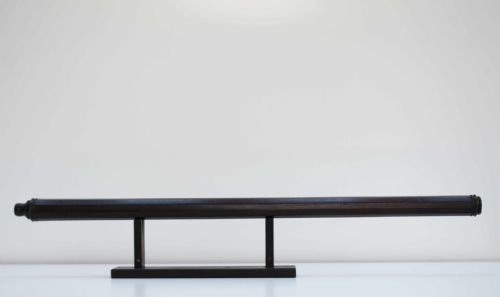
Mahogany Spyglass Instrument
A mahogany spyglass instrument brings optical precision and maritime history into your study, combining brass fittings with rich timber barrels.
Mahogany Spyglass Instrument
When you search for a mahogany spyglass instrument, you find optical tools designed for navigation, terrestrial viewing, and scientific observation. These pieces bridge the gap between practical maritime gear and precision scientific equipment.
You will most commonly encounter multi-draw telescopes housed in polished wood barrels, dating from the eighteenth century through to the Edwardian era. Many originate from London makers and retain their original brass mounts.
The selection spans small cased library instruments on stands to larger multi-draw field models used at sea or in military campaigns. Form follows function closely, with draw tubes allowing the instrument to collapse for transport.
How they were made
Maker workshops turned mahogany into protective outer barrels, sometimes wrapping sections in leather or tapering the wood into decagonal and nine-sided forms. Brass formed the sliding draw tubes, lens cells, and end caps.
Glass lenses provided the optical magnification, housed within precision-turned brass fittings that allowed smooth extension and focusing. Internal components relied on metal and wood to maintain alignment across multiple draws.
Listings span from the eighteenth century through the Edwardian period, incorporating brass, mahogany, leather, and glass across various draw configurations.
What varies in quality
Quality rests in the precision of the maker's signature and the complexity of the barrel geometry, such as multi-sided decagonal shapes rather than simple round tubes. Signed examples from prominent London makers command closer attention.
The choice of secondary materials, including fine leather coverings and substantial brass gauges, distinguishes standard utility pieces from library instruments supplied with dedicated stands.
Nairne & Blunt·W. & T. Gilbert·Clarkson London·Steward of London·Matthew Berge·G. Adams·Davis of London·John Gilbert
The Mahogany Spyglass Instrument Glossary
- Draw
- A sliding tube section that extends from the main barrel to adjust the focal length. Telescopes are commonly described by how many draws they possess.
- Achromatic
- An optical design using multiple lens elements to correct colour fringing in the field of view. Non-achromatic versions belong to earlier periods.
- Terrestrial
- An optical setup configured to present an upright image for viewing land objects rather than astronomical bodies. These instruments often include day or night settings.
- Decagonal
- Having ten sides, describing the geometric form turned into the wooden barrel of certain eighteenth-century examples. This shape prevented the instrument from rolling off flat surfaces.
Mahogany Spyglass Instrument: Frequently Asked Questions
How do I use a multi-draw spyglass?
Grip the main mahogany barrel firmly while gently pulling each brass draw section outward until fully extended. Adjust the final smaller draw nearest your eye until the distant object comes into sharp focus.
Take care to push the draws back in smoothly one by one rather than forcing them. Keep the glass lenses clean using appropriate optical cloths to maintain clarity.
What is the difference between library and campaign telescopes?
Library telescopes are typically heavier instruments mounted on dedicated wooden or brass tabletops stands for stationary indoor use. Campaign versions are built for portability, featuring rugged mahogany and leather construction designed to withstand travel.
Campaign models rely entirely on hand-held operation using sliding draws without supporting stands. Both types utilise the same fundamental optical principles but serve different environments.
How can I tell the period of a spyglass?
Examine the materials, barrel shape, and any engraved signatures left by the maker on the brass draw tube. Eighteenth-century examples often feature unusual multi-sided barrels and simpler optical configurations.
Victorian and later instruments frequently adopt standard round mahogany or leather-covered tubes with more developed draw counts. Maker names recorded on the brass help anchor the piece to a specific working decade.
Are these instruments still functional today?
Many surviving examples retain their original glass lenses and can still magnify distant terrestrial views effectively. The precision engineering of the brass draws allows them to function just as they did centuries ago.
Some pieces serve primarily as decorative objects or study display items due to age-related wear on the glass surfaces. Careful handling ensures the historical optics remain undisturbed.