


Vintage Swivel Stool
These vintage swivel stool designs unite height adjustment with practical seating, spanning music chairs, industrial workshops and refined drawing rooms.
Vintage Swivel Stool
A vintage swivel stool serves multiple functions across periods, appearing most frequently as piano stools, music chairs, and adjustable industrial workshop seating. Buyers encounter forms ranging from ornate Victorian rosewood and mahogany piano stools with revolving seats to robust cast iron and wood industrial workshop examples.
The selection encompasses diverse historical influences, including Georgian, William IV, Victorian Industrial, Art Deco, and Sheraton Revival styles. Pieces originating from the nineteenth and early twentieth centuries dominate the selection, offering both domestic elegance and utilitarian strength.
Materials and construction methods
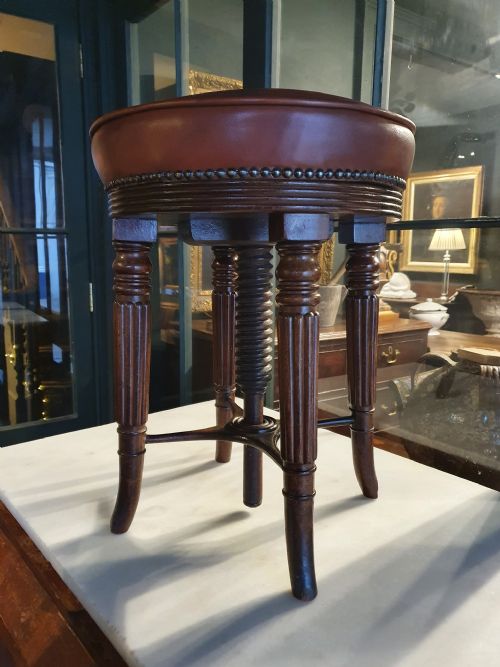
Construction relies heavily on dense hardwoods such as mahogany, walnut, rosewood, and elm, often paired with structural cast iron for industrial and workshop variants. Mechanisms incorporate brass screws and revolving spindles to permit smooth height adjustment without compromising stability.
Upholstered elements utilise leather, fabric, and fitted cushions, while frames display turned wooden legs, carved walnut details, and gilt painted finishes. Industrial pieces combine exposed metal frames with solid wooden tops to withstand daily use.
Materials recorded across the selection include mahogany, walnut, rosewood, brass, cast iron, leather, and fabric.
Distinctions in craftsmanship
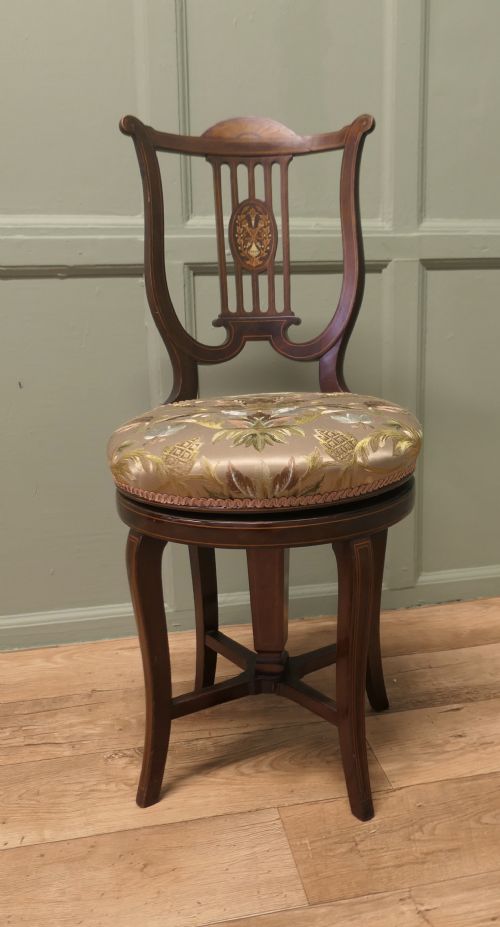
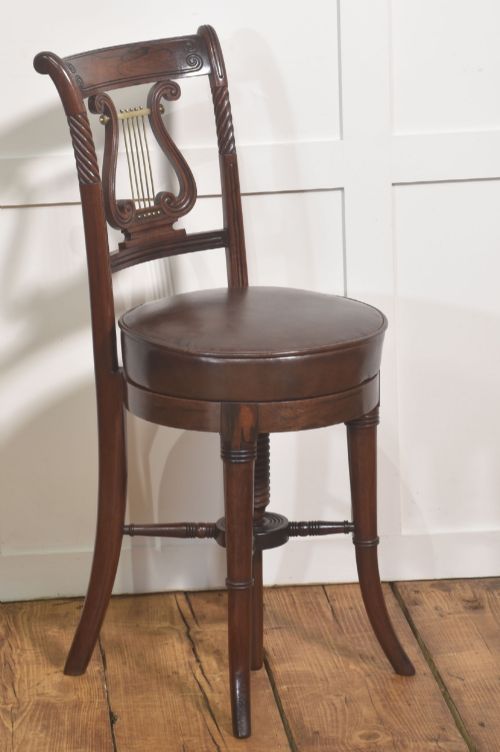
Quality reveals itself in the smoothness of the revolving mechanism and the precision of the wooden screw thread or iron spindle. Finer domestic examples display sophisticated carving, such as lyre backs or gilt painted empire ornamentation, executed in select timbers like rosewood.
Makers known for exceptional cabinet work, such as Gillows or James Shoolbred, integrate seamless revolving functions into balanced frames. Lesser examples rely on utilitarian construction where mechanical tolerances are broader and decorative flourishes minimal.
Gillows·James Shoolbred·Singer·Evertaut
The Vintage Swivel Stool Glossary
- Revolving piano stool
- A seat designed for keyboard players featuring a mechanism that turns through a full circle. This allows the musician freedom of movement while seated.
- Cast iron
- An iron-carbon alloy poured into moulds, frequently utilised for the heavy bases and frames of industrial workshop stools. It provides exceptional weight and durability.
- Adjustable screw top
- A mechanism utilising a threaded central spindle that raises or lowers the seat height when turned. This system appears commonly on nineteenth-century music chairs.
- Lyre back
- A chair back shaped in the form of a classical stringed musical instrument. This motif is frequently found on Victorian music and harpist chairs.
Vintage Swivel Stool: Frequently Asked Questions
How do I adjust the height of these stools?
Many examples utilise a central screw mechanism where turning the seat clockwise or anticlockwise raises and lowers the top.
Other models rely on metal pins or levers to secure the height at pre-set intervals, particularly on industrial workshop pieces.
Were these always used for playing the piano?
While a significant portion served musicians, many were designed as dressing table chairs, office seating, or heavy-duty workshop stools.
Industrial workshop chairs were built for factories and drafting rooms, prioritising utility over domestic display.
How do I date a revolving stool?
Dating relies on timber choices, such as rosewood and mahogany in the nineteenth century, compared to cast iron and elm in early twentieth-century industrial pieces.
Stylistic cues like Victorian carving or Art Deco geometric forms also indicate the manufacturing era.
Are industrial swivel stools sturdy enough for daily use?
Industrial examples were originally constructed for heavy workshop environments using robust cast iron and solid wood.
This robust engineering makes them exceptionally durable for modern daily seating requirements.