
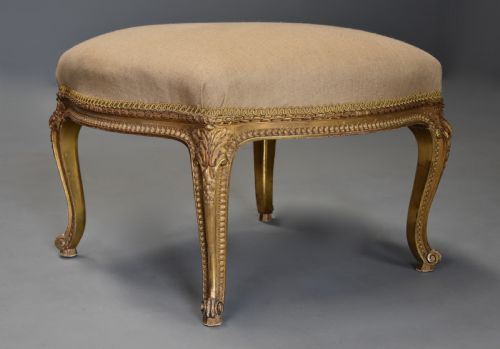


French Chateau Stool
These French chateau stools bring period seating and upholstery into a room, offering low profiles and carved frames that collectors seek.
French Chateau Stool
A french chateau stool encompasses low seating forms including window seats, footstools, piano stools, and boudoir stools originating from nineteenth-century France and Victorian Britain. These pieces often arrive in Louis XV style, Louis XVI style, French Rococo Revival, or French Regence designs.
The inventory on this page most frequently presents nineteenth-century items, alongside pieces dated specifically to 1860, 1870, 1890, and 1900. Buyers encounter long stools, circular boudoir stools, and adjustable piano stools among the listings.
Forms range from simple painted footstools to large carved giltwood pieces stamped by Parisian makers such as Loidrault Freres. Many serve dual functions as window seats or coffee and magazine tables.
How they were made
Frames rely on hardwoods such as beech and walnut, shaped through carving and joined to support upholstered tops in fabric and linen. Woodwork receives finishes of paint, giltwood, or simple gilding.
Makers integrated functional mechanics in specific forms, such as adjustable mechanisms in piano stools, alongside decorative brass elements and traditional stamping on giltwood frames.
What varies in quality
Quality rests upon the depth and crispness of the wood carving across the frame, distinguishing finely hand-carved Louis XV and XVI style curves from simpler turned or plain structures. Maker marks, such as stamps on nineteenth-century giltwood, elevate the standing of a piece.
The integrity of the original timber treatment - whether painted wood or giltwood - and the execution of the upholstery in appropriate fabric or linen dictate the visual weight and historical fidelity of the stool.
Loidrault Freres Paris
The French Chateau Stool Glossary
- Giltwood
- Wood coated with gold leaf or a gold-coloured metallic preparation. This finish appears frequently on formal nineteenth-century French seating.
- Louis XV Style
- A revival style characterised by asymmetrical curves, cabriole legs, and rococo floral carving. It dominates much of the French chateau stool inventory.
- Boudoir Stool
- A small, low seat designed for private dressing rooms or bedrooms. These are often circular and upholstered in fine fabrics.
- Adjustable Piano Stool
- A pivoting or screw-threaded seat designed for keyboard players. These pieces permit height alteration via a central wooden or metal spindle.
French Chateau Stool: Frequently Asked Questions
What rooms suit a French chateau stool?
These low seats fit easily beneath windows, at the foot of a bed, or beside low salon tables. Their compact footprints allow them to function as spare seating without crowding a floor plan.
Larger gilt pieces anchor formal drawing rooms, while painted or smaller stools sit comfortably in dressing rooms and studies.
How do I identify a Louis XV style stool?
Louis XV style pieces display characteristic cabriole legs, asymmetrical floral carvings, and flowing serpentine rails. The woodwork avoids straight lines in favour of organic, curved silhouettes.
This aesthetic developed during the eighteenth century but saw widespread revival across nineteenth-century French workshops.
Can these stools function as tables?
Certain long forms and window seats easily adapt to hold books or magazines when paired with a rigid tray. Their sturdy wood frames and flat upholstered or wooden surfaces support light display use.
Care should be taken to protect delicate fabric or antique giltwood finishes if placing objects directly onto the surface.
What is the difference between a footstool and a boudoir stool?
Footstools are typically low, rectangular or padded supports designed to elevate feet while seated in a larger chair. Boudoir stools are taller, independent seats built for personal grooming or dressing.
Circular boudoir stools often feature more elaborate painted or gilt frames and richer upholstery fabrics than utility footstools.