
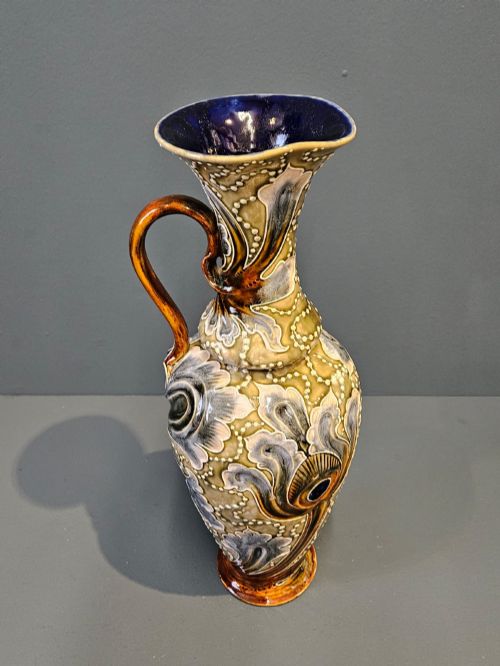


Vintage Stoneware Water Jug
These vintage stoneware water jug pieces bring robust utility and striking relief decoration to the table, offering sturdy service and enduring tactile appeal.
Vintage Stoneware Water Jug
When you search for a vintage stoneware water jug, you encounter robust vessels produced primarily during the Victorian period, alongside pieces from the 1880s, 1890s, and early twentieth century. These items span functional pitchers, ewers, and carafes, often designed with generous capacities for household service or formal table settings.
The selections on this page feature notable makers and distinct styles, ranging from Victorian Classical Revival and Gothic to Arts and Crafts and Art Nouveau. Forms include large harvest jugs, relief-moulded pitchers, and lidded salt-glazed designs suited to everyday use or display.
Materials and production methods
Potters utilised durable stoneware, earthenware, and ironstone ceramics, frequently enhancing surfaces with salt-glazes, smooth glazes, or contrasting buff-coloured bodies. These dense ceramic materials provided the impervious quality necessary for holding water.
Makers applied intricate relief moulding and applied sprigged decorations to build elaborate narrative scenes, botanical motifs, and armorial details. Certain examples incorporate fitted pewter rims to reinforce the pouring lip and handle high-use demands.
Listings feature nineteenth-century and Victorian pieces produced in stoneware, earthenware, and ironstone, utilising salt-glazed and smooth ceramic finishes.
Distinguishing finer examples
The distinction between standard utility vessels and superior pieces rests on the crispness of the relief moulding and the complexity of the decorative scheme. High-grade works exhibit sharp, deep botanical or figurative detailing without blurring across the ceramic surface.
Proportion, balance, and the application of specialised finishes such as salt-glazing or hand-applied coloured slips further elevate certain pitchers. The inclusion of hallmarked silver or pewter mounts indicates a higher grade of commissioned production.
Charles Meigh·Doulton Lambeth·Jones And Walley·Minton·Ridgway And Sons
The Vintage Stoneware Water Jug Glossary
- Stoneware
- A heavy, dense ceramic fired at high temperatures until vitrified, making it completely impermeable to liquids without requiring interior glaze.
- Salt-glaze
- A glossy, slightly textured finish achieved by throwing common salt into the kiln during high-temperature firing, creating a distinctive orange-peel texture on the ceramic surface.
- Relief-moulded
- A technique where clay is pressed into carved moulds to produce raised decorative patterns, figures, or inscriptions standing out from the body of the jug.
- Sprigged
- A method of ornamentation where separately moulded clay motifs are applied by hand onto the unfired surface of the vessel using slip as an adhesive.
- Ewer
- An ornamental water jug or pitcher featuring a wide spout and an elaborate handle, traditionally used for hand-washing at the table or as a decorative display piece.
- Hydra
- A classical vase or jug form characterised by three handles, often associated with nineteenth-century ceramic revivals of ancient Greek shapes.
Vintage Stoneware Water Jug: Frequently Asked Questions
How do I clean a vintage stoneware water jug?
Wash the interior and exterior gently using warm water and a mild detergent, avoiding harsh abrasive pads that might scratch salt-glazed or slip-decorated surfaces.
Dry the vessel thoroughly with a soft cloth, taking extra care around any applied pewter or silver rims to prevent moisture retention.
Can I use these jugs for serving water today?
Many solid stoneware and ceramic pitchers remain fully functional for serving water or other cold beverages at the dining table.
Check each piece for interior hairline cracks or historical repairs before liquid use, as certain antique examples serve better as decorative items.
What is the difference between stoneware and earthenware?
Stoneware is fired at significantly higher temperatures until the clay vitrifies and becomes non-porous, offering robust durability and resistance to moisture without glaze.
Earthenware is fired at lower temperatures, remaining slightly porous unless thoroughly coated with an impermeable surface glaze.
How can I date a nineteenth-century water jug?
Examine the base for impressed factory marks, registration diamonds, or maker stamps which often reveal the exact decade or year of manufacture.
Stylistic indicators such as Victorian Gothic revival motifs or Art Nouveau plant forms also help narrow the production period.