





Vintage Snow Scene Painting
A vintage snow scene painting brings the quiet hush of winter directly into a room, capturing frost and frozen landscapes with lasting atmosphere.
Vintage Snow Scene Painting
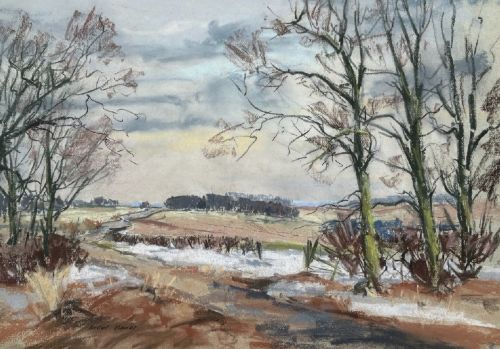
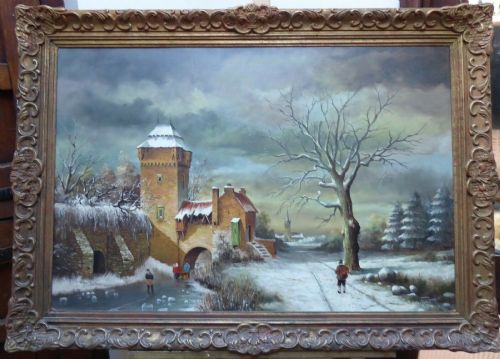
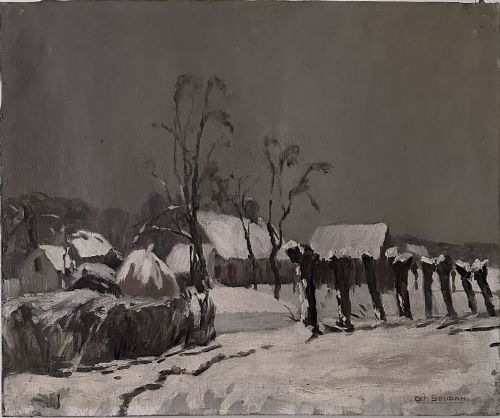
When you search for a vintage snow scene painting, you encounter works spanning from the nineteenth century through the mid-twentieth century, capturing rural villages, alpine peaks, and frosty riverbanks. The selection leans heavily toward early twentieth-century interpretations, particularly British landscapes and regional watercolours.
You meet various artistic approaches on this page, ranging from British Impressionism and Realism to Dutch Golden Age style and traditional 1930s compositions. Subjects stretch from Yorkshire dales and alpine lakes to Montmartre in winter and Canadian wilderness.
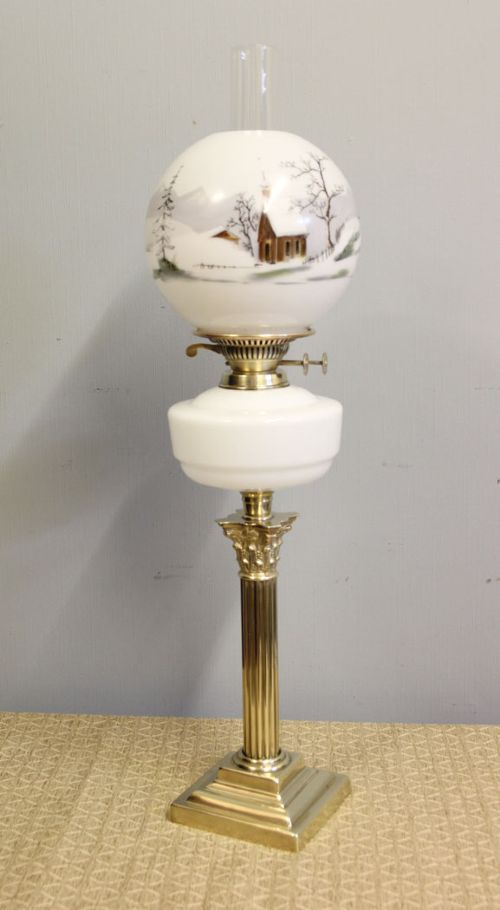
Most pieces take the form of framed oil paintings or watercolours, occasionally accompanied by unexpected decorative items such as oil lamps featuring winter scene shades. These works preserve fleeting winter light across canvas, board, and paper.
Distinctions in quality
The distinction between ordinary and exceptional works rests on the artist's handling of winter light and atmospheric perspective. Superior paintings convey the palpable chill of frost and the subtle blue and violet tones of shadows on snow rather than relying on flat white pigment.
Compositional strength and the artist's ability to render complex forms like bare branches, horses, figures, and architecture set finer pieces apart. Works bearing attribution to known painters or exhibiting distinct regional provenance carry greater artistic weight.
Vintage Snow Scene Painting Retail Price Guide 2026
Typical asking prices for vintage snow scene painting among the pieces listed under this phrase on Sellingantiques today, from the lower quarter to the upper quarter. They describe what is for sale here now, not the wider market.
Listings span from the 1860s through the 1960s, uniting Victorian romanticism with mid-century urban scenes.
A. McDonald·Ernest Uden·John Smith Atherton·Herbert Royle·George Graham·Ernest Higgins Rigg·John Richard Worsdale·Eveline Lance·Wilson·William Cave Day·Fred Lawson
The Vintage Snow Scene Painting Glossary
- Impressionism
- A nineteenth-century painting style focusing on accurate depiction of light and its changing qualities. Painters often used visible brushstrokes to capture the immediacy of a snowy landscape.
- Gesso
- A white paint mixture consisting of a binder mixed with chalk, gypsum, or pigment. It serves as a prepared surface for painting on wood panels or canvas.
- Impasto
- Paint applied thickly to a canvas, standing out from the surface. This technique allows artists to build physical texture representing drifted snow or rough bark.
- Provenance
- The chronology of the ownership, custody, or location of a historical object. A documented history confirms authenticity and links the work to its creator.
- Watercolour
- A painting method in which the paints are made of pigments suspended in a water-based solution. Artists utilise the luminosity of the underlying paper to create glowing winter scenes.
Vintage Snow Scene Painting: Frequently Asked Questions
How do I date a winter painting?
Dating relies on stylistic clues, framing methods, and signatures recorded on the work. Mid-century pieces often reflect post-war realism, while nineteenth-century works display traditional academic composition.
Examining the canvas backing, stretcher bars, and paper type provides further chronological evidence.
Where should I hang a snow scene?
These works suit spaces where subdued lighting enhances their cool atmospheric tones. Placing them away from direct sunlight protects oil pigments and delicate watercolours from fading.
Neutral walls allow the muted blues and whites of winter landscapes to stand out clearly.
Are watercolours harder to care for than oils?
Watercolours require framing under glass with acid-free mounts to protect the paper from moisture and light damage. Oil paintings on canvas or board are more robust but still benefit from stable indoor humidity.
Both mediums thrive when kept away from extreme temperature fluctuations.
What defines British Impressionism?
British Impressionism emerged as artists adopted French plein-air methods while retaining a distinctly domestic character. These painters focused on local rural scenery, overcast skies, and winter light.
Works from this movement capture fleeting weather conditions with spontaneous brushwork.