


Vintage Shoe Cleaner
These vintage shoe cleaner pieces are robust household metalwork items designed for external doorways, combining utility with period architectural presence.
Vintage Shoe Cleaner
When you search for a vintage shoe cleaner, you are looking at practical entryway furnishings designed to scrape mud and dirt from footwear before entering the house. The items appearing on this page span Georgian, Late Georgian, and Victorian periods, with specific examples referencing the Great Exhibition and Coalbrookdale.
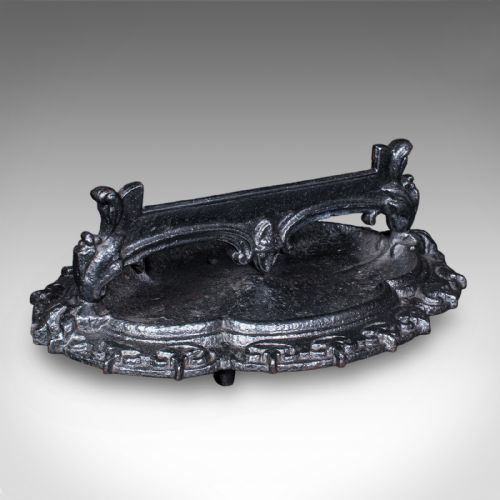
The forms on offer divide primarily into freestanding or inset architectural pieces, including country house and townhouse boot scrapers. Many feature an integrated shoe pull alongside the scraper blade to assist with footwear removal at the threshold.
How they were made
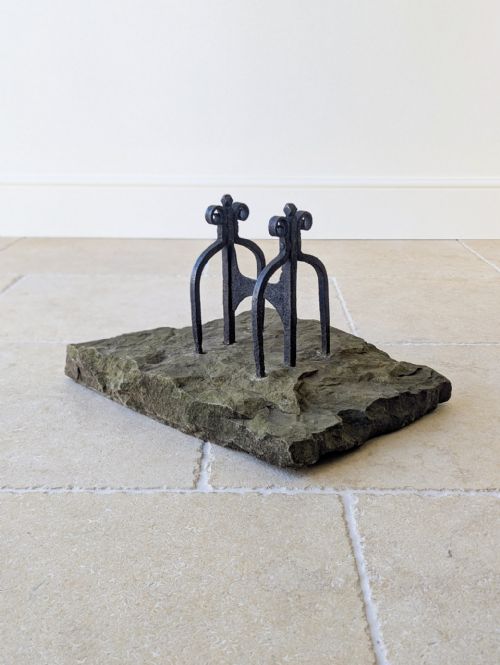
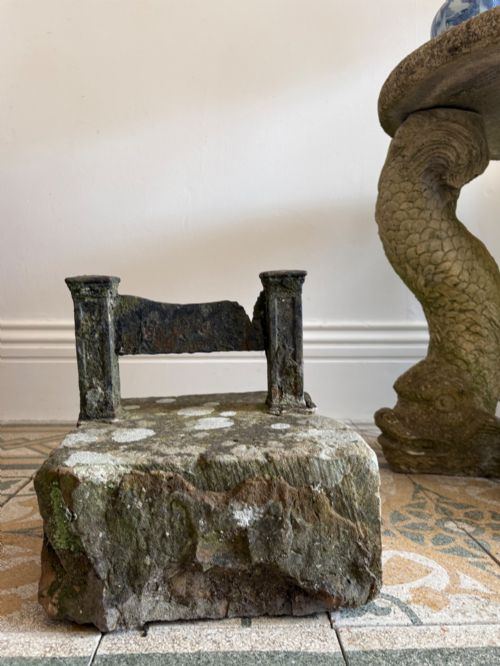
The primary metals utilised in these pieces are cast iron and wrought iron, forged or cast into rigid scraper blades and structural mounts. These iron elements are frequently paired with heavy stone bases, notably hewn stone blocks and Yorkstone, which anchor the assembly firmly beside a doorway.
Construction techniques combine foundry casting for the intricate iron frames and manual smithing for wrought iron components, all set securely into solid stone foundations to withstand heavy exterior use.
The listings span Georgian, Late Georgian, Victorian, and 1850 to 1880 periods, constructed from cast iron, wrought iron, stone, and Yorkstone.
What varies in quality
Quality across these items rests in the substance of the materials and the refinement of the ironwork. Heavy, solid cast iron combined with substantial Yorkstone or hewn stone blocks represents the higher tier of production.
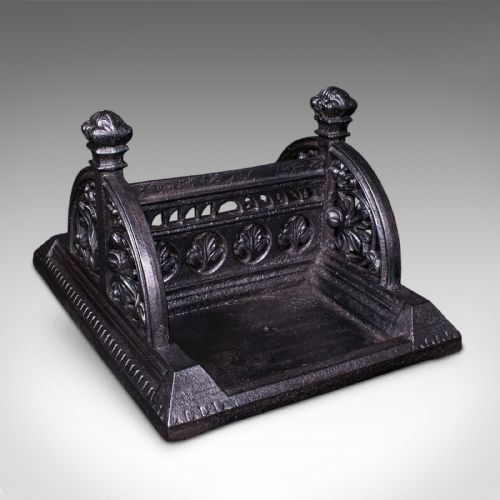
The presence of auxiliary elements, such as an integrated shoe pull or decorative Victorian Gothic Revival styling, elevates the design complexity beyond simple utilitarian scrapers.
Coalbrookdale
The Vintage Shoe Cleaner Glossary
- Boot scraper
- A metal blade or plate fixed near an entrance to remove mud from boots and shoes. These devices were essential fixtures outside domestic doorways before modern paved pathways.
- Shoe pull
- A handle or hook incorporated into a boot scraper to help leverage footwear off the foot. This feature is commonly found on townhouse and country house examples.
- Yorkstone
- A tough, tight-grained sandstone quarried in Yorkshire, frequently used as the heavy mounting block for iron scrapers. It provides a durable, weather-resistant foundation.
- Coalbrookdale
- A Shropshire foundry renowned for producing high-quality decorative and architectural ironwork during the nineteenth century. Pieces from this source reflect advanced industrial casting standards.
Vintage Shoe Cleaner: Frequently Asked Questions
Where were these shoe cleaners placed?
These items were positioned immediately outside exterior doorways, often embedded directly into stone steps or flanking the threshold of townhouses and country houses.
Their location ensured that mud and dirt were scraped away before visitors or residents stepped inside the hallway.
What is a shoe pull?
A shoe pull is an integrated metal loop or handle designed to assist in gripping the heel or sole of a boot.
This allowed individuals to steady themselves and pull tight footwear off their feet without bending down into the dirt.
How do I identify a Victorian piece?
Victorian examples often display heavier cast iron forms and may incorporate decorative elements associated with the Victorian Gothic Revival style.
Reference to exhibitions or specific nineteenth-century manufacturing hallmarks further helps date these items accurately.
Why are they mounted in stone?
The heavy stone bases, such as Yorkstone or hewn stone blocks, provided the necessary weight to keep the scraper stationary during use.
Without a solid stone anchor, the force exerted by scraping heavy boots would dislodge the metal blade from the ground.