


Vintage Porcelain Saucers
Vintage porcelain saucers bring tactile history to the table, offering delicate craftsmanship from Georgian tea sets to Art Deco coffee services.
Vintage Porcelain Saucers
Vintage porcelain saucers encompass individual shallow dishes alongside matching cups, trios, and larger afternoon tea services. Buyers seeking vintage porcelain saucers frequently encounter pieces from the Victorian, Edwardian, and Art Deco periods, spanning British, continental European, and Asian origins.
The selection ranges from single cabinet display dishes to complete multi-person coffee and tea services. Many items form part of larger sets including teacups, coffee cans, and decorative bowls.
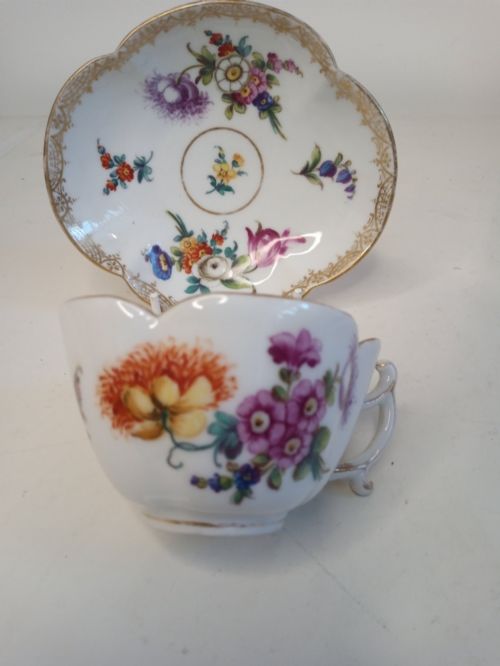
Origins represented in the collection stretch from English factories like Royal Worcester and Coalport to French Vieux Paris workshops, German manufactories such as Meissen and KPM, and Japanese Satsuma and Hirado kilns.
How they were made
Manufacture relies upon hard-paste and soft-paste porcelain bodies, bone china, and ironstone, shaped manually or moulded before firing. Artisans applied hand-painted enamels, transfer printing, and polychrome glazes across the surfaces.
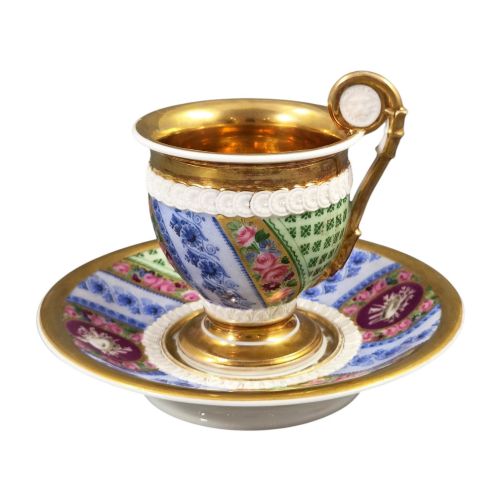
Finishing touches frequently involved applied gold leaf, gilt highlights, and intricate gilding around the rims and cavetto. Specialised techniques such as the transfer-printed bat-wing pattern or Kakiemon enamel palettes required multiple kiln firings to achieve their final depth.
Listings feature porcelain forms spanning the 18th, 19th, and 20th centuries, incorporating materials from soft-paste porcelain to ironstone and gold leaf.
What varies in quality
Quality separates through the precision of the hand-painting, the crispness of moulded details like lion mask handles, and the purity of the porcelain body. Superior pieces display delicate translucency, register careful alignment in transfer patterns, and exhibit finely burnished gold leaf.
Maker attribution and period integrity heavily influence standing, with recognised factories such as Royal Worcester, Meissen, and Spode demonstrating superior paste formulation and artistic execution. The complexity of hand-painted motifs, such as detailed fancy birds or botanical studies, distinguishes standard productionware from high-end cabinet pieces.
Royal Crown Derby·New Hall·Coalport·Royal Worcester·Elkington·Royal Albert·Doric China·Gardner Moscow Factory·Taniguchi·Meissen·KPM Berlin·Spode·Wileman Foley Shelley·Hutschenreuther
The Vintage Porcelain Saucers Glossary
- Soft-Paste Porcelain
- An artificial porcelain composition fired at lower temperatures than hard-paste, common in 18th-century English wares. It typically exhibits a warmer, slightly creamy body and absorbs glaze differently.
- Imari
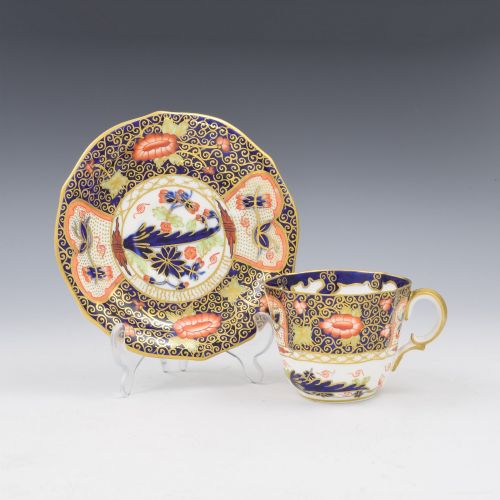
- A decorative style originating in Japan featuring rich blue and rust-red ironstone palettes highlighted with gold. British and European factories extensively copied these striking motifs during the 19th century.
- Cavetto
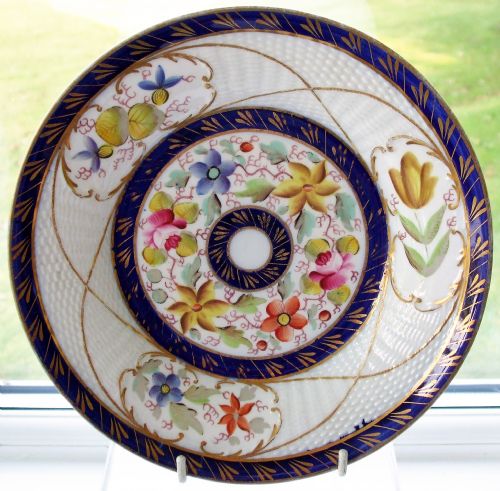
- The central recessed circular area of a saucer where the teacup rests. This zone often contains distinct painted roundels or geometric borders.
- Demitasse
- A small cup designed for serving strong black coffee or espresso, almost invariably paired with a matching saucer. These miniature vessels frequently showcase dense gilding and fine hand-painted landscapes.
- Bone China
- A type of porcelain incorporating bone ash into the paste, developed in England to increase strength and whiteness. It allows for thinner vessel walls while retaining durability.
Vintage Porcelain Saucers: Frequently Asked Questions
Can I use vintage saucers for daily dining?
While durable, antique and vintage porcelain saucers often feature delicate overglaze enamels and gold leaf that degrade under modern dishwasher heat and detergents. Hand washing preserves the integrity of hand-painted surfaces and avoids micro-abrasions on soft-paste bodies.
For everyday use, selecting 20th-century bone china items from robust production periods offers greater resilience than delicate 18th-century soft-paste porcelain designed purely for display.
How do I identify the period of a saucer?
Dating relies on maker marks stamped, painted, or impressed into the porcelain base, combined with stylistic cues such as Victorian floral transfers or Art Deco geometric framing. Examining the translucency of the paste and the application method of the gilding further clarifies the era of manufacture.
Unmarked pieces require stylistic comparison of the baseline clay body, glaze pooling, and painting style against authenticated examples from known factories like Worcester or Meissen.
What is the difference between a tea saucer and a coffee saucer?
Coffee saucers generally feature a deeper or narrower central well, known as the cavetto, designed to snugly hold a steep-sided coffee can or demitasse. Tea saucers are typically shallower with a wider flat base to accommodate the wider bowl of a traditional teacup.
Matching cups to saucers requires noting the exact diameter of the foot ring to ensure the vessel sits securely without rocking in the well.
How should I display mixed vintage saucers together?
Grouping saucers by a shared element, such as a consistent Imari palette, a uniform gilding style, or matching floral motifs, creates a cohesive decorative wall or cabinet display. Mixing periods from Georgian to Edwardian adds visual texture when tonal colours link the diverse patterns.
Wall mounting requires specialised plate hangers with rubber-coated grips to protect the delicate porcelain edges from chipping while securing the pieces safely.